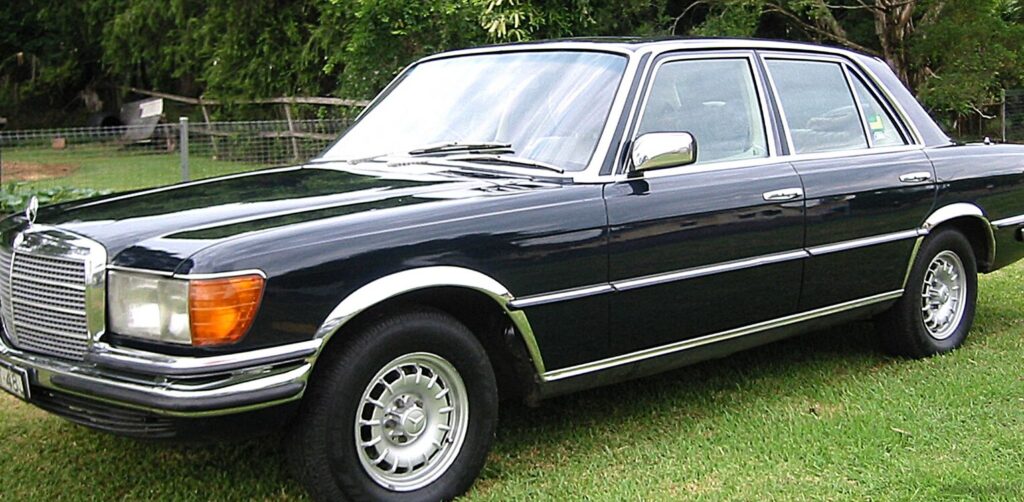
The Mercedes-Benz W116 series, produced from 1972 to 1979, represented a significant leap forward in luxury and safety for the German automaker. The 350 SE, introduced in March 1972 and continuing through January 1976, was a cornerstone of the initial W116 lineup. Positioned as a mid-range offering, it bridged the gap between the entry-level 280 SE and the flagship 450 SE, offering a compelling blend of performance, comfort, and prestige. The “SE” designation stood for “Sonderklasse-Einspritzung” (Special Class – Fuel Injection), highlighting a key technological feature of the model. This variant was primarily aimed at the North American and European markets, where buyers sought a sophisticated and powerful luxury sedan.
Technical Specifications
| Brand | Mercedes-Benz |
| Model | S-class |
| Generation | S-class SE (W116) |
| Type (Engine) | 350 SE V8 (200 Hp) Automatic |
| Start of production | March, 1972 |
| End of production | January, 1976 |
| Powertrain Architecture | Internal Combustion engine |
| Body type | Sedan |
| Seats | 5 |
| Doors | 4 |
| Fuel consumption (combined) | 13 l/100 km (18.1 US mpg, 21.7 UK mpg, 7.7 km/l) |
| Fuel Type | Petrol (Gasoline) |
| Acceleration 0 – 100 km/h | 10.3 sec |
| Acceleration 0 – 62 mph | 10.3 sec |
| Acceleration 0 – 60 mph | 9.8 sec |
| Maximum speed | 200 km/h (124.27 mph) |
| Weight-to-power ratio | 8.4 kg/Hp, 119.4 Hp/tonne |
| Weight-to-torque ratio | 5.9 kg/Nm, 170.7 Nm/tonne |
| Power | 200 Hp @ 5800 rpm |
| Power per litre | 57.2 Hp/l |
| Torque | 286 Nm @ 4000 rpm (210.94 lb.-ft. @ 4000 rpm) |
| Engine layout | Front, Longitudinal |
| Engine Model/Code | M 116 E 35 / 116.983 |
| Engine displacement | 3499 cm3 (213.52 cu. in.) |
| Number of cylinders | 8 |
| Engine configuration | V-engine |
| Cylinder Bore | 92 mm (3.62 in.) |
| Piston Stroke | 65.8 mm (2.59 in.) |
| Compression ratio | 9.5:1 |
| Number of valves per cylinder | 2 |
| Fuel injection system | Multi-port manifold injection |
| Engine aspiration | Naturally aspirated engine |
| Valvetrain | SOHC |
| Engine oil capacity | 8 l (8.45 US qt | 7.04 UK qt) |
| Coolant capacity | 8 l (8.45 US qt | 7.04 UK qt) |
| Kerb Weight | 1675 kg (3692.74 lbs.) |
| Max. weight | 2195 kg (4839.15 lbs.) |
| Max load | 520 kg (1146.4 lbs.) |
| Trunk (boot) space – minimum | 530 l (18.72 cu. ft.) |
| Fuel tank capacity | 96 l (25.36 US gal | 21.12 UK gal) |
| Length | 4960 mm (195.28 in.) |
| Width | 1870 mm (73.62 in.) |
| Height | 1425 mm (56.1 in.) |
| Wheelbase | 2860 mm (112.6 in.) |
| Front track | 1521 mm (59.88 in.) |
| Rear (Back) track | 1505 mm (59.25 in.) |
| Drivetrain Architecture | The Internal combustion engine (ICE) drives the rear wheels of the vehicle. |
| Drive wheel | Rear wheel drive |
| Number of gears and type of gearbox | 3 gears, automatic transmission |
| Front suspension | Double wishbone |
| Rear suspension | Leaf spring |
| Front brakes | Ventilated discs |
| Rear brakes | Disc |
| Steering type | Cone worm with recirculation balls |
| Power steering | Hydraulic Steering |
| Tires size | Front wheel tires: 205/70 R14 Rear wheel tires: 205/70 R14 |
| Wheel rims size | Front wheel rims: 6.5J x 14 Rear wheel rims: 6.5J x 14 |
Powertrain & Engine Architecture
The heart of the 350 SE was the M116 E 35 engine, a 3.5-liter naturally aspirated V8. This engine featured a single overhead camshaft (SOHC) design and utilized Bosch K-Jetronic multi-port fuel injection, a sophisticated system for its time that contributed to smooth power delivery and relatively good fuel efficiency. The engine produced 200 horsepower at 5800 rpm and 286 Nm (210.94 lb-ft) of torque at 4000 rpm. The engine block was cast iron, while the cylinder heads were aluminum alloy. The 350 SE was exclusively paired with a three-speed automatic transmission, designed to provide effortless cruising and a comfortable driving experience. This transmission was known for its durability, but its limited number of gears meant it wasn’t as efficient as later automatic transmissions.
Driving Characteristics
The 350 SE Automatic offered a refined and comfortable driving experience. While not overtly sporty, the V8 engine provided ample power for effortless highway cruising and confident acceleration. The three-speed automatic transmission, while smooth, did result in slightly slower acceleration times compared to the manual transmission equipped models. The gear ratios were optimized for relaxed cruising rather than outright performance. The car felt substantial and planted on the road, thanks to its relatively heavy weight and well-tuned suspension. Compared to the 280 SE, the 350 SE offered a noticeable performance advantage, while the 450 SE provided even more power but at a higher price point.
Equipment & Trim Levels
The 350 SE came standard with a high level of equipment, befitting its luxury status. This included power steering, power brakes, automatic climate control, leather upholstery, and wood trim. Optional extras included a sunroof, air conditioning (often considered essential, especially in warmer climates), and a premium sound system. Interior upholstery was typically high-quality leather in a variety of colors. The dashboard layout was classic Mercedes-Benz, with a focus on functionality and understated elegance. The 350 SE was generally positioned as a well-equipped, comfortable cruiser, with options available to further enhance the luxury experience.
Chassis & Braking
The W116 chassis featured independent suspension at the front, utilizing double wishbones, and a leaf spring suspension at the rear. This setup provided a good balance of ride comfort and handling. The 350 SE was equipped with ventilated disc brakes at the front and solid disc brakes at the rear, providing adequate stopping power for the vehicle’s weight and performance. Hydraulic power steering was standard, making the car easy to maneuver at low speeds. Stabilizer bars were fitted to both the front and rear axles to reduce body roll during cornering.
Market Reception & Comparison
The 350 SE was well-received by critics and buyers alike. It was praised for its comfortable ride, refined interior, and powerful engine. Compared to the 280 SE, the 350 SE offered a significant performance upgrade, while remaining more affordable than the 450 SE. Fuel economy, while not a primary concern for buyers in this segment, was reasonable for a V8 engine of that era. Reliability was generally good, although maintenance costs could be high due to the complexity of the fuel injection system and the overall sophistication of the vehicle. The 350 SE was seen as a strong competitor to other luxury sedans from brands like BMW and Jaguar.
Legacy
The Mercedes-Benz W116 350 SE remains a desirable classic car today. The M116 engine is known for its durability and relatively straightforward maintenance, although parts availability can be a challenge. Well-maintained examples command a premium in the used car market. The W116 series as a whole is credited with establishing Mercedes-Benz as a leader in automotive safety and luxury, and the 350 SE represents a sweet spot in the lineup, offering a compelling combination of performance, comfort, and classic styling. Its robust construction and relatively simple (compared to later Mercedes models) mechanicals make it a rewarding car for enthusiasts to own and maintain.