
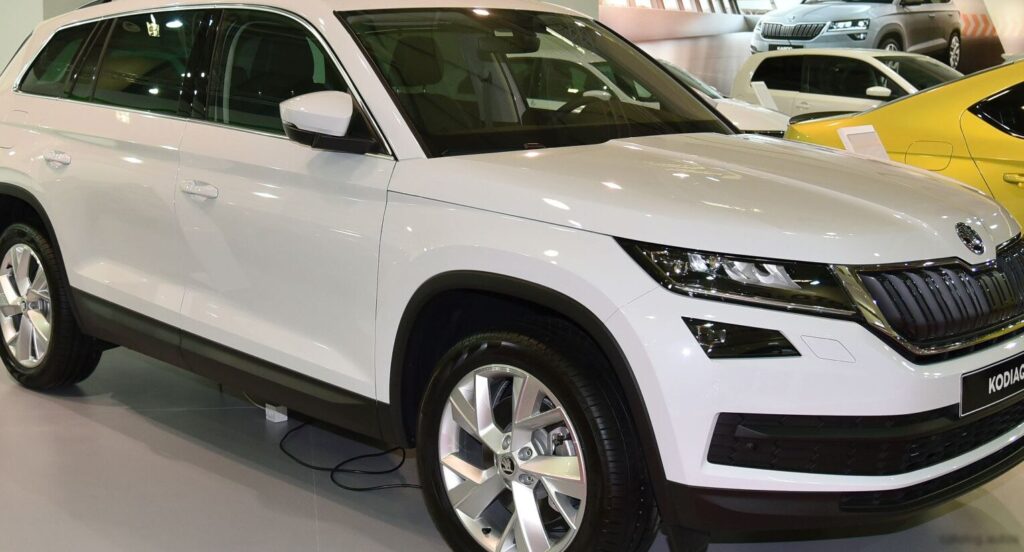
The Skoda Kodiaq 1.4 TSI (150 hp) ACT 4×4 marked Skoda’s initial entry into the competitive mid-size SUV segment when it was introduced in 2016. Manufactured through 2018, this variant held a crucial position within the first generation Kodiaq (based on the Volkswagen Group’s MQB platform – 1HX0/A3) as a compelling blend of affordability, fuel efficiency, and all-weather capability. It was designed to appeal to families and drivers desiring a practical, roomy vehicle with the added security of all-wheel drive. Named after the Alaskan Kodiak bear, the Kodiaq was primarily sold in Europe, offering a strong alternative to established rivals such as the Nissan X-Trail and Hyundai Santa Fe.
Technical Specifications
| Brand | Skoda |
| Model | Kodiaq |
| Generation | Kodiaq I |
| Type (Engine) | 1.4 TSI (150 Hp) ACT 4×4 |
| Start of production | 2016 |
| End of production | 2018 |
| Powertrain Architecture | Internal Combustion engine |
| Body type | SUV |
| Seats | 5 |
| Doors | 5 |
| Fuel consumption (urban) | 8.2 l/100 km (28.7 US mpg, 34.4 UK mpg, 12.2 km/l) |
| Fuel consumption (extra urban) | 5.9 l/100 km (39.9 US mpg, 47.9 UK mpg, 16.9 km/l) |
| Fuel consumption (combined) | 6.8 l/100 km (34.6 US mpg, 41.5 UK mpg, 14.7 km/l) |
| CO2 emissions | 153 g/km |
| Fuel Type | Petrol (Gasoline) |
| Acceleration 0 – 100 km/h | 9.8 sec |
| Acceleration 0 – 62 mph | 9.8 sec |
| Acceleration 0 – 60 mph | 9.3 sec |
| Maximum speed | 197 km/h (122.41 mph) |
| Emission standard | Euro 6 |
| Weight-to-power ratio | 10.3 kg/Hp, 97.4 Hp/tonne |
| Weight-to-torque ratio | 6.2 kg/Nm, 162.3 Nm/tonne |
| Power | 150 Hp @ 5000-6000 rpm |
| Power per litre | 107.5 Hp/l |
| Torque | 250 Nm @ 1500-3500 rpm (184.39 lb.-ft. @ 1500-3500 rpm) |
| Engine layout | Front, Transverse |
| Engine Model/Code | EA211 / CZEA |
| Engine displacement | 1395 cm3 (85.13 cu. in.) |
| Number of cylinders | 4 |
| Engine configuration | Inline |
| Cylinder Bore | 74.5 mm (2.93 in.) |
| Piston Stroke | 80 mm (3.15 in.) |
| Compression ratio | 10:1 |
| Number of valves per cylinder | 4 |
| Fuel injection system | Direct injection |
| Engine aspiration | Turbocharger, Intercooler |
| Valvetrain | DOHC |
| Engine oil capacity | 4 l (4.23 US qt | 3.52 UK qt) |
| Kerb Weight | 1540 kg (3395.12 lbs.) |
| Max. weight | 2215 kg (4883.24 lbs.) |
| Max load | 675 kg (1488.12 lbs.) |
| Trunk (boot) space – minimum | 650-835 l (22.95 – 29.49 cu. ft.) |
| Trunk (boot) space – maximum | 2065 l (72.92 cu. ft.) |
| Fuel tank capacity | 60 l (15.85 US gal | 13.2 UK gal) |
| Max. roof load | 75 kg (165.35 lbs.) |
| Permitted trailer load with brakes (8%) | 2000 kg (4409.25 lbs.) |
| Permitted trailer load with brakes (12%) | 2000 kg (4409.25 lbs.) |
| Permitted trailer load without brakes | 750 kg (1653.47 lbs.) |
| Permitted towbar download | 100 kg (220.46 lbs.) |
| Length | 4697 mm (184.92 in.) |
| Width | 1882 mm (74.09 in.) |
| Height | 1655 mm (65.16 in.) |
| Wheelbase | 2791 mm (109.88 in.) |
| Front track | 1586 mm (62.44 in.) |
| Rear (Back) track | 1576 mm (62.05 in.) |
| Ride height (ground clearance) | 187 mm (7.36 in.) |
| Drag coefficient (Cd) | 0.33 |
| Minimum turning circle (turning diameter) | 11.6 m (38.06 ft.) |
| Drive wheel | All wheel drive (4×4) |
| Number of gears and type of gearbox | 6 gears, manual transmission |
| Front suspension | Independent, type McPherson with coil spring and anti-roll bar |
| Rear suspension | Independent multi-link suspension |
| Front brakes | Ventilated discs |
| Rear brakes | Disc |
| Assisting systems | ABS (Anti-lock braking system) |
| Steering type | Steering rack and pinion |
| Power steering | Electric Steering |
| Tires size | 215/65 R17 |
| Wheel rims size | 7J x 17 |
Powertrain & Engine Architecture
The Kodiaq 1.4 TSI 4×4 was powered by the EA211 engine family, specifically the CZEA engine code. This 1.4-liter, turbocharged, direct-injection inline-four engine was a common component within the Volkswagen Group’s engine range. A defining characteristic was Active Cylinder Technology (ACT), which could deactivate two cylinders during light load conditions to enhance fuel economy. The engine utilized a single turbocharger with an intercooler to boost power and torque output. Direct fuel injection optimized combustion efficiency. The valvetrain featured a dual overhead camshaft (DOHC) design with four valves per cylinder. The engine was mounted transversely in the front of the vehicle. A 6-speed manual transmission was standard, offering a balance between fuel efficiency and driver control.
Driving Characteristics
The 150 hp output, combined with the 6-speed manual transmission, delivered adequate performance for typical driving scenarios. Acceleration from 0-60 mph took approximately 9.3 seconds, and the top speed reached 122.41 mph. While not designed for sporty performance, the Kodiaq 1.4 TSI provided sufficient power for highway driving and overtaking maneuvers. The manual transmission allowed for precise control, but the gear ratios were optimized for fuel economy rather than rapid acceleration. Compared to the more powerful 2.0 TSI versions, the 1.4 TSI felt less responsive, especially when carrying a full load. However, the all-wheel-drive system provided improved traction and stability in challenging weather conditions, making it a more confident option than front-wheel-drive Kodiaq models.
Equipment & Trim Levels
The 1.4 TSI 4×4 typically included a reasonable level of standard equipment. This generally encompassed air conditioning, alloy wheels, a touchscreen infotainment system with Bluetooth connectivity, and a comprehensive suite of safety features such as ABS, ESC, and multiple airbags. Higher trim levels, like SE L and Elegance, added features like automatic climate control, parking sensors, a rearview camera, and upgraded interior upholstery. Optional extras included a panoramic sunroof, adaptive cruise control, and a premium sound system. Interior upholstery was typically cloth in the base trims, with leather options available on higher-specification models. The dashboard layout was functional and well-designed, prioritizing ergonomics.
Chassis & Braking
The Kodiaq’s chassis featured independent suspension on all four wheels – McPherson struts at the front and a multi-link setup at the rear – contributing to a comfortable ride quality. The suspension was tuned to prioritize comfort over sporty handling characteristics. The 1.4 TSI models generally used ventilated front discs and solid rear discs for braking. ABS (Anti-lock Braking System) was standard, enhancing braking performance and stability. Stabilizer bars were fitted to both the front and rear axles to minimize body roll during cornering. The all-wheel-drive system utilized a Haldex clutch, automatically distributing torque between the front and rear axles as needed.
Market Reception & Comparison
The Skoda Kodiaq 1.4 TSI 4×4 received generally positive reviews from automotive critics. It was praised for its spacious interior, comfortable ride, and good value for money. Fuel economy was considered respectable, especially given the vehicle’s size and all-wheel-drive capability. However, some reviewers noted that the 1.4 TSI engine could feel underpowered when the vehicle was fully loaded or driving uphill. Compared to the 2.0 TSI variants, the 1.4 TSI offered a more affordable entry point into the Kodiaq range, but at the cost of performance. The 1.4 TSI was also frequently compared to diesel-powered Kodiaqs (such as the 2.0 TDI), with the petrol engine offering a quieter and smoother driving experience, while the diesel provided superior fuel economy and torque.
Legacy
The EA211 1.4 TSI engine, while generally reliable, has been known to develop carbon buildup on the intake valves over time, particularly in vehicles that primarily undertake short journeys. Regular servicing and the use of high-quality fuel can help mitigate this issue. The Haldex all-wheel-drive system is also relatively durable, but requires periodic maintenance to ensure optimal performance. Today, used Kodiaq 1.4 TSI 4×4 models represent a good value proposition for buyers seeking a spacious, practical, and capable SUV. Their relatively affordable price point and decent fuel economy make them an attractive option in the used car market, although potential buyers should be aware of the potential for carbon buildup and ensure the vehicle has been properly maintained.
