
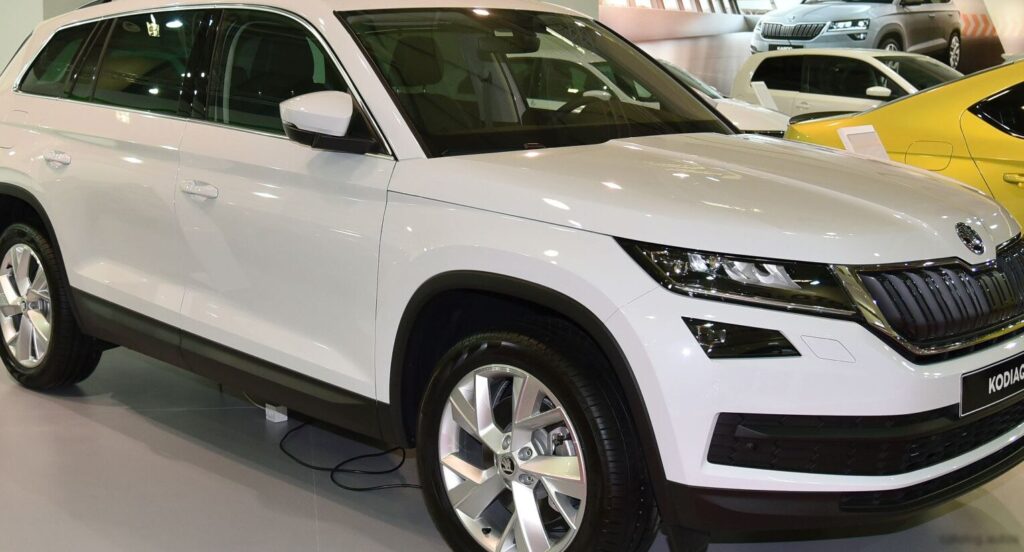
The Skoda Kodiaq 1.4 TSI (150 hp) ACT 4×4 7-Seat, produced from 2016 to 2018, represents a significant entry point into Skoda’s first-ever seven-seater SUV. Positioned within the Kodiaq I generation (based on the Volkswagen Group’s MQB platform – 1HX0/A3), this variant aimed to offer a balance of practicality, fuel efficiency, and all-weather capability for families. It served as a mid-range offering, slotting below the more powerful 2.0 TSI engines and above the lower-spec 1.4 TSI variants without all-wheel drive. The Kodiaq was Skoda’s response to the growing demand for family SUVs in Europe, offering a compelling alternative to established competitors with a focus on value and space.
Technical Specifications
| Brand | Skoda |
| Model | Kodiaq |
| Generation | Kodiaq I |
| Type (Engine) | 1.4 TSI (150 Hp) ACT 4×4 7 Seat |
| Start of production | 2016 |
| End of production | 2018 |
| Powertrain Architecture | Internal Combustion engine |
| Body type | SUV |
| Seats | 7 |
| Doors | 5 |
| Fuel consumption (urban) | 8.2 l/100 km (28.7 US mpg, 34.4 UK mpg, 12.2 km/l) |
| Fuel consumption (extra urban) | 5.9 l/100 km (39.9 US mpg, 47.9 UK mpg, 16.9 km/l) |
| Fuel consumption (combined) | 6.8 l/100 km (34.6 US mpg, 41.5 UK mpg, 14.7 km/l) |
| CO2 emissions | 154 g/km |
| Fuel Type | Petrol (Gasoline) |
| Acceleration 0 – 100 km/h | 9.9 sec |
| Acceleration 0 – 62 mph | 9.9 sec |
| Acceleration 0 – 60 mph | 9.4 sec |
| Maximum speed | 196 km/h (121.79 mph) |
| Emission standard | Euro 6 |
| Weight-to-power ratio | 10.5 kg/Hp, 95.1 Hp/tonne |
| Weight-to-torque ratio | 6.3 kg/Nm, 158.4 Nm/tonne |
| Power | 150 Hp @ 5000-6000 rpm |
| Power per litre | 107.5 Hp/l |
| Torque | 250 Nm @ 1500-3500 rpm (184.39 lb.-ft. @ 1500-3500 rpm) |
| Engine layout | Front, Transverse |
| Engine Model/Code | EA211 / CZEA |
| Engine displacement | 1395 cm3 (85.13 cu. in.) |
| Number of cylinders | 4 |
| Engine configuration | Inline |
| Cylinder Bore | 74.5 mm (2.93 in.) |
| Piston Stroke | 80 mm (3.15 in.) |
| Compression ratio | 10:1 |
| Number of valves per cylinder | 4 |
| Fuel injection system | Direct injection |
| Engine aspiration | Turbocharger, Intercooler |
| Valvetrain | DOHC |
| Engine oil capacity | 4 l (4.23 US qt | 3.52 UK qt) |
| Kerb Weight | 1578 kg (3478.89 lbs.) |
| Max. weight | 2292 kg (5053 lbs.) |
| Max load | 714 kg (1574.1 lbs.) |
| Trunk (boot) space – minimum | 560-765 l (19.78 – 27.02 cu. ft.) |
| Trunk (boot) space – maximum | 2005 l (70.81 cu. ft.) |
| Fuel tank capacity | 60 l (15.85 US gal | 13.2 UK gal) |
| Max. roof load | 75 kg (165.35 lbs.) |
| Permitted trailer load with brakes (8%) | 2000 kg (4409.25 lbs.) |
| Permitted trailer load with brakes (12%) | 2000 kg (4409.25 lbs.) |
| Permitted trailer load without brakes | 750 kg (1653.47 lbs.) |
| Permitted towbar download | 88 kg (194.01 lbs.) |
| Length | 4697 mm (184.92 in.) |
| Width | 1882 mm (74.09 in.) |
| Height | 1655 mm (65.16 in.) |
| Wheelbase | 2791 mm (109.88 in.) |
| Front track | 1586 mm (62.44 in.) |
| Rear (Back) track | 1576 mm (62.05 in.) |
| Ride height (ground clearance) | 188 mm (7.4 in.) |
| Drag coefficient (Cd) | 0.34 |
| Minimum turning circle (turning diameter) | 11.6 m (38.06 ft.) |
| Drive wheel | All wheel drive (4×4) |
| Number of gears and type of gearbox | 6 gears, manual transmission |
| Front suspension | Independent, type McPherson with coil spring and anti-roll bar |
| Rear suspension | Independent multi-link suspension |
| Front brakes | Ventilated discs |
| Rear brakes | Disc |
| Assisting systems | ABS (Anti-lock braking system) |
| Steering type | Steering rack and pinion |
| Power steering | Electric Steering |
| Tires size | 215/65 R17 |
| Wheel rims size | 7J x 17 |
Powertrain & Engine Architecture
The Kodiaq 1.4 TSI 4×4 utilizes the EA211 engine family, specifically the CZEA code. This 1.4-liter, turbocharged, direct-injection engine is a four-cylinder inline configuration. A key feature is its Active Cylinder Technology (ACT), which allows the engine to deactivate two cylinders under light load conditions to improve fuel economy. The engine employs a sophisticated direct injection system, delivering fuel directly into the combustion chamber for precise control and increased efficiency. The valvetrain is a dual overhead camshaft (DOHC) design with four valves per cylinder, optimizing airflow for enhanced performance. The turbocharger, coupled with an intercooler, provides a boost in power and torque. This engine was paired with a six-speed manual transmission, delivering power to all four wheels via Skoda’s all-wheel-drive system. The all-wheel drive system uses a multi-plate clutch to distribute torque between the front and rear axles as needed, providing enhanced traction in various conditions.
Driving Characteristics
The 150 hp output, combined with the six-speed manual transmission, provides adequate performance for everyday driving. Acceleration from 0-60 mph takes approximately 9.4 seconds, and the top speed is around 122 mph. While not a particularly sporty setup, the engine delivers a usable amount of torque (250 Nm or 184 lb-ft) from 1500-3500 rpm, making it reasonably responsive in most situations. Compared to the more powerful 2.0 TSI variants, the 1.4 TSI feels less eager to accelerate, particularly when fully loaded with passengers and luggage. The manual transmission offers precise shifts, but the gear ratios are tuned for fuel efficiency rather than outright performance. The all-wheel-drive system provides confident handling and stability, especially on slippery surfaces. The ACT cylinder deactivation is generally seamless, but can sometimes be noticeable as a slight vibration when the engine switches between four and two cylinders.
Equipment & Trim Levels
The 1.4 TSI 4×4 7-Seat Kodiaq typically came equipped with a respectable level of standard features. These included air conditioning, a touchscreen infotainment system with Bluetooth connectivity, alloy wheels, and a suite of safety features such as ABS, ESC (Electronic Stability Control), and multiple airbags. Higher trim levels offered upgrades such as leather upholstery, a panoramic sunroof, adaptive cruise control, and a more advanced infotainment system with navigation. Optional extras included parking sensors, a rear-view camera, and a premium sound system. Interior upholstery was typically cloth on the base models, with leather options available on higher trims. The dashboard layout was functional and well-designed, with a focus on ergonomics and ease of use.
Chassis & Braking
The Kodiaq’s chassis features independent suspension all around – McPherson struts at the front and a multi-link setup at the rear. This configuration provides a comfortable ride quality and good handling characteristics. The suspension is tuned to prioritize comfort over sporty handling, but it still offers a reasonable level of control in corners. Braking duties are handled by ventilated discs at the front and solid discs at the rear. ABS (Anti-lock Braking System) is standard, providing enhanced stopping power and stability. Stabilizer bars are fitted to both the front and rear axles to reduce body roll during cornering.
Market Reception & Comparison
The Skoda Kodiaq 1.4 TSI 4×4 7-Seat was generally well-received by automotive critics. It was praised for its spacious interior, comfortable ride, and good value for money. However, some reviewers noted that the 1.4 TSI engine could feel underpowered when the vehicle was fully loaded. Compared to the 2.0 TSI variants, the 1.4 TSI offered better fuel economy but less performance. The 1.4 TSI also offered a more affordable entry point into the Kodiaq range. Reliability reports suggest that the EA211 engine is generally reliable, but regular maintenance is essential to prevent issues such as carbon buildup and turbocharger problems.
Legacy
The Skoda Kodiaq 1.4 TSI 4×4 7-Seat remains a popular choice in the used car market. Its combination of practicality, space, and affordability makes it an attractive option for families. The EA211 engine, while not known for its blistering performance, has proven to be reasonably durable with proper maintenance. Common issues to look for when purchasing a used Kodiaq 1.4 TSI include potential carbon buildup in the intake manifold and wear and tear on the turbocharger. Overall, the Kodiaq 1.4 TSI 4×4 7-Seat represents a solid and well-rounded SUV that continues to offer good value for money.
