
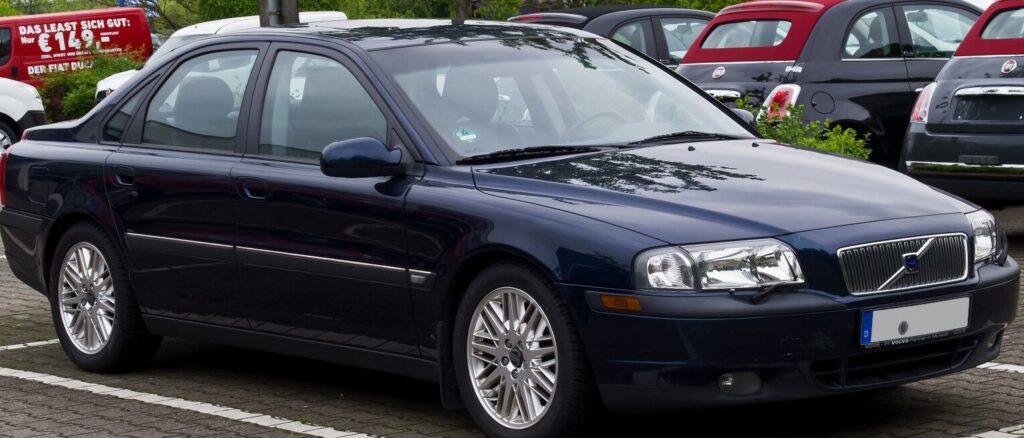
The Volvo S80 2.0T, produced between 2000 and 2003, represented an entry point into Volvo’s flagship sedan range during the first generation (1998-2006) of the S80. Positioned below the more powerful 2.9 and 3.0-liter six-cylinder models, the 2.0T offered a blend of Scandinavian practicality, safety, and a more accessible price point. This variant was primarily aimed at buyers seeking a comfortable and refined sedan with reasonable performance and fuel economy. It served as a key model in establishing the S80’s presence in the mid-size luxury segment, particularly in European and North American markets.
Technical Specifications
| Brand | Volvo |
| Model | S80 |
| Generation | S80 |
| Type (Engine) | 2.0T (180 Hp) |
| Start of production | 2000 year |
| End of production | 2003 year |
| Powertrain Architecture | Internal Combustion engine |
| Body type | Sedan |
| Seats | 5 |
| Doors | 4 |
| Fuel consumption (economy) – urban | 13.1 l/100 km (18 US mpg, 21.6 UK mpg, 7.6 km/l) |
| Fuel consumption (economy) – extra urban | 7.2 l/100 km (32.7 US mpg, 39.2 UK mpg, 13.9 km/l) |
| Fuel Type | Petrol (Gasoline) |
| Acceleration 0 – 100 km/h | 9.1 sec |
| Acceleration 0 – 62 mph | 9.1 sec |
| Acceleration 0 – 60 mph | 8.6 sec |
| Maximum speed | 225 km/h (139.81 mph) |
| Weight-to-power ratio | 8.3 kg/Hp, 120.8 Hp/tonne |
| Weight-to-torque ratio | 6.2 kg/Nm, 161.1 Nm/tonne |
| Power | 180 Hp @ 5300 rpm |
| Power per litre | 90.7 Hp/l |
| Torque | 240 Nm @ 2200 rpm (177.01 lb.-ft. @ 2200 rpm) |
| Engine layout | Front, Transverse |
| Engine Model/Code | B5204T5 |
| Engine displacement | 1984 cm3 (121.07 cu. in.) |
| Number of cylinders | 5 |
| Engine configuration | Inline |
| Cylinder Bore | 81 mm (3.19 in.) |
| Piston Stroke | 77 mm (3.03 in.) |
| Compression ratio | 9.5:1 |
| Number of valves per cylinder | 4 |
| Fuel injection system | Multi-port manifold injection |
| Engine aspiration | Turbocharger |
| Valvetrain | DOHC |
| Engine oil capacity | 5.5 l (5.81 US qt, 4.84 UK qt) |
| Coolant | 8.8 l (9.3 US qt, 7.74 UK qt) |
| Kerb Weight | 1490 kg (3284.89 lbs.) |
| Max. weight | 2050 kg (4519.48 lbs.) |
| Max load | 560 kg (1234.59 lbs.) |
| Trunk (boot) space – minimum | 460 l (16.24 cu. ft.) |
| Trunk (boot) space – maximum | 1126 l (39.76 cu. ft.) |
| Fuel tank capacity | 80 l (21.13 US gal, 17.6 UK gal) |
| Length | 4822 mm (189.84 in.) |
| Width | 1832 mm (72.13 in.) |
| Height | 1434 mm (56.46 in.) |
| Wheelbase | 2791 mm (109.88 in.) |
| Front track | 1562 mm (61.5 in.) |
| Rear (Back) track | 1560 mm (61.42 in.) |
| Drivetrain Architecture | The Internal combustion engine (ICE) drives the front wheels of the vehicle. |
| Drive wheel | Front wheel drive |
| Number of gears and type of gearbox | 5 gears, manual transmission |
| Front suspension | Wishbone |
| Rear suspension | Coil spring |
| Front brakes | Ventilated discs |
| Rear brakes | Disc |
| Assisting systems | ABS (Anti-lock braking system) |
| Steering type | Steering rack and pinion |
| Power steering | Hydraulic Steering |
| Tires size | 215/55 R16 |
| Wheel rims size | 16 |
Powertrain & Engine Architecture
The heart of the S80 2.0T is the Volvo B5204T5 engine, a 1.984-liter (121.07 cubic inches) inline-five cylinder gasoline engine. This engine was a significant departure for Volvo, which had traditionally favored six-cylinder engines. The five-cylinder configuration offered a good balance between smoothness, power, and packaging. The B5204T5 utilizes a light-pressure turbocharger, providing a boost in power without significantly compromising fuel efficiency. Fuel delivery is managed by a multi-port fuel injection system, ensuring precise fuel metering for optimal combustion. The engine features a double overhead camshaft (DOHC) valvetrain with four valves per cylinder, enhancing volumetric efficiency and contributing to its respectable power output. The 2.0T was exclusively offered with a 5-speed manual transmission, providing drivers with direct control over the engine’s power delivery.
Driving Characteristics
The S80 2.0T offered a comfortable and composed driving experience. While not overtly sporty, the 180 horsepower and 240 Nm (177 lb-ft) of torque provided adequate performance for everyday driving and highway cruising. Acceleration from 0 to 60 mph took approximately 8.6 seconds, and the car could reach a top speed of 225 km/h (139.81 mph). The turbocharger provided a noticeable boost in power during acceleration, but the power delivery was relatively linear. Compared to the higher-output six-cylinder models, the 2.0T felt less urgent, but it offered better fuel economy and a lighter front-end feel. The 5-speed manual transmission allowed for precise gear selection, enhancing driver engagement. The gear ratios were well-matched to the engine’s torque curve, providing good acceleration in most driving situations.
Equipment & Trim Levels
The S80 2.0T typically came equipped with a respectable level of standard features, reflecting Volvo’s commitment to safety and comfort. Standard equipment included power windows, power locks, air conditioning, and an AM/FM stereo system. Safety features were a hallmark of Volvo, and the S80 2.0T included standard ABS brakes, front airbags, and side-impact protection. Optional extras included leather upholstery, a sunroof, premium audio systems, and automatic climate control. The interior design was typically Scandinavian, characterized by clean lines, comfortable seats, and a focus on functionality. The dashboard layout was straightforward and easy to use.
Chassis & Braking
The S80 2.0T featured a robust chassis designed for comfort and stability. The front suspension utilized a wishbone configuration, while the rear suspension employed coil springs. This setup provided a comfortable ride quality, absorbing bumps and imperfections in the road surface effectively. The braking system consisted of ventilated discs at the front and solid discs at the rear, providing adequate stopping power. The ABS (Anti-lock Braking System) helped to maintain control during emergency braking situations. The steering system was a rack and pinion type with hydraulic power assistance, offering precise steering feel and ease of maneuverability.
Market Reception & Comparison
The Volvo S80 2.0T was generally well-received by automotive critics. It was praised for its comfortable ride, spacious interior, and strong safety features. However, some critics noted that the 2.0T engine lacked the refinement and power of the six-cylinder models. Compared to its competitors, such as the BMW 5 Series and Mercedes-Benz E-Class, the S80 2.0T offered a more affordable entry point into the luxury sedan segment. Fuel economy was a strong point for the 2.0T, offering better mileage than the larger-engined variants. Reliability was generally good, although some owners reported minor issues with the turbocharger and fuel injection system.
Legacy
The Volvo S80 2.0T remains a relatively common sight on used car markets today. The B5204T5 engine is known for its durability and relatively straightforward maintenance. While not as sought-after as the higher-performance six-cylinder models, the 2.0T offers a good value proposition for buyers seeking a comfortable, safe, and reliable sedan. Parts availability is generally good, and the car’s simple mechanical design makes it relatively easy to repair. The S80 2.0T represents a significant chapter in Volvo’s history, demonstrating the brand’s ability to offer a compelling blend of Scandinavian design, safety, and practicality.
