
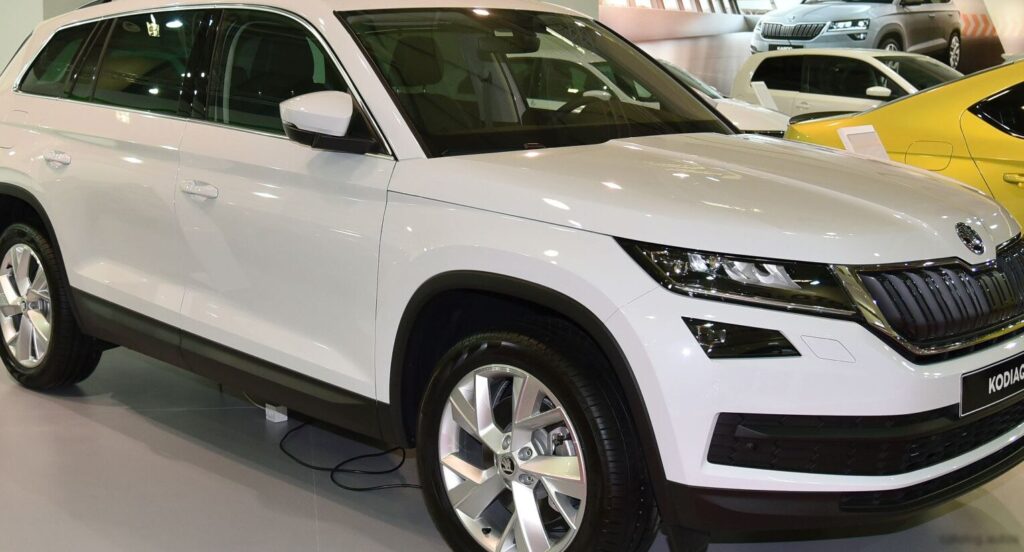
The Skoda Kodiaq 1.4 TSI (150 hp) ACT 4×4 DSG was a mid-range variant of Skoda’s first foray into the seven-seat SUV segment. Introduced in 2016 and remaining in production through 2018, this model played a significant role in establishing the Kodiaq as a popular family vehicle, particularly in the European market. Positioned within the broader Kodiaq I generation (based on the Volkswagen Group’s MQB platform), the 1.4 TSI offered a balance between fuel efficiency, performance, and all-weather capability thanks to its all-wheel-drive system and dual-clutch transmission. It aimed to appeal to buyers seeking a practical and versatile SUV without the higher price tag of the more powerful engine options.
Technical Specifications
| Brand | Skoda |
| Model | Kodiaq |
| Generation | Kodiaq I |
| Type (Engine) | 1.4 TSI (150 Hp) ACT 4×4 DSG |
| Start of production | 2016 |
| End of production | 2018 |
| Powertrain Architecture | Internal Combustion engine |
| Body type | SUV |
| Seats | 5 |
| Doors | 5 |
| Fuel consumption (combined) | 7.1 l/100 km (33.1 US mpg, 39.8 UK mpg, 14.1 km/l) |
| CO2 emissions | 164 g/km |
| Fuel Type | Petrol (Gasoline) |
| Acceleration 0 – 100 km/h | 9.7 sec |
| Acceleration 0 – 62 mph | 9.7 sec |
| Acceleration 0 – 60 mph | 9.2 sec |
| Maximum speed | 194 km/h (120.55 mph) |
| Emission standard | Euro 6 |
| Weight-to-power ratio | 10.3 kg/Hp, 96.8 Hp/tonne |
| Weight-to-torque ratio | 6.2 kg/Nm, 161.3 Nm/tonne |
| Power | 150 Hp @ 5000-6000 rpm |
| Power per litre | 107.5 Hp/l |
| Torque | 250 Nm @ 1500-3500 rpm (184.39 lb.-ft. @ 1500-3500 rpm) |
| Engine layout | Front, Transverse |
| Engine Model/Code | EA211 / CZEA |
| Engine displacement | 1395 cm3 (85.13 cu. in.) |
| Number of cylinders | 4 |
| Engine configuration | Inline |
| Cylinder Bore | 74.5 mm (2.93 in.) |
| Piston Stroke | 80 mm (3.15 in.) |
| Compression ratio | 10:1 |
| Number of valves per cylinder | 4 |
| Fuel injection system | Direct injection |
| Engine aspiration | Turbocharger, Intercooler |
| Valvetrain | DOHC |
| Engine oil capacity | 4 l (4.23 US qt | 3.52 UK qt) |
| Kerb Weight | 1550 kg (3417.17 lbs.) |
| Max. weight | 2225 kg (4905.29 lbs.) |
| Max load | 675 kg (1488.12 lbs.) |
| Trunk (boot) space – minimum | 650-835 l (22.95 – 29.49 cu. ft.) |
| Trunk (boot) space – maximum | 2065 l (72.92 cu. ft.) |
| Fuel tank capacity | 60 l (15.85 US gal | 13.2 UK gal) |
| Max. roof load | 75 kg (165.35 lbs.) |
| Permitted trailer load with brakes (8%) | 2000 kg (4409.25 lbs.) |
| Permitted trailer load with brakes (12%) | 2000 kg (4409.25 lbs.) |
| Permitted trailer load without brakes | 750 kg (1653.47 lbs.) |
| Permitted towbar download | 100 kg (220.46 lbs.) |
| Length | 4697 mm (184.92 in.) |
| Width | 1882 mm (74.09 in.) |
| Height | 1655 mm (65.16 in.) |
| Wheelbase | 2791 mm (109.88 in.) |
| Front track | 1586 mm (62.44 in.) |
| Rear (Back) track | 1576 mm (62.05 in.) |
| Ride height (ground clearance) | 187 mm (7.36 in.) |
| Drag coefficient (Cd) | 0.33 |
| Minimum turning circle (turning diameter) | 11.6 m (38.06 ft.) |
| Drive wheel | All wheel drive (4×4) |
| Number of gears and type of gearbox | 6 gears, automatic transmission DSG |
| Front suspension | Independent, type McPherson with coil spring and anti-roll bar |
| Rear suspension | Independent multi-link suspension |
| Front brakes | Ventilated discs |
| Rear brakes | Disc |
| Assisting systems | ABS (Anti-lock braking system) |
| Steering type | Steering rack and pinion |
| Power steering | Electric Steering |
| Tires size | 215/65 R17 |
| Wheel rims size | 7J x 17 |
INTRODUCTION
The Skoda Kodiaq, launched in 2016, represented Skoda’s first venture into the mid-size SUV market. The 1.4 TSI 150 hp variant, equipped with a seven-speed DSG dual-clutch transmission and all-wheel drive (4×4), was a key component of the initial Kodiaq lineup. This model aimed to provide a compelling alternative to traditional estate cars and smaller SUVs, offering increased space, practicality, and a more commanding driving position. The ‘ACT’ designation signifies Active Cylinder Technology, a fuel-saving feature that could deactivate two cylinders under light load conditions. This variant was primarily sold in Europe, where demand for efficient and versatile family vehicles is high.
Powertrain & Engine Architecture
At the heart of the Kodiaq 1.4 TSI 4×4 lies the EA211 engine family, specifically the CZEA engine code. This 1.4-liter, turbocharged, direct-injection petrol engine is a four-cylinder inline unit. It utilizes a turbocharger with an intercooler to boost power and torque. The direct injection system delivers fuel directly into the combustion chamber, improving efficiency and responsiveness. The engine also features Active Cylinder Technology (ACT), which shuts down cylinders two and three during low-load cruising to reduce fuel consumption. The valvetrain is a dual overhead camshaft (DOHC) design with four valves per cylinder. The seven-speed DSG (Direct-Shift Gearbox) is a dual-clutch transmission known for its quick and smooth gear changes. It offers both automatic and manual shifting modes. The DSG transmission is integral to the vehicle’s performance and efficiency, providing seamless power delivery.
Driving Characteristics
The 150 hp 1.4 TSI engine, paired with the DSG transmission and all-wheel-drive system, delivered a respectable, though not particularly sporty, driving experience. Acceleration from 0-62 mph (0-100 km/h) took around 9.7 seconds. The DSG transmission provided quick shifts, but the engine could feel somewhat strained when accelerating hard, especially when fully loaded. The all-wheel-drive system offered enhanced traction and stability, particularly in adverse weather conditions. Compared to the more powerful 2.0 TSI variants, the 1.4 TSI felt less eager to accelerate, but it offered better fuel economy. The gear ratios in the DSG were tuned for a balance between performance and efficiency, with taller gearing for highway cruising and shorter gearing for quicker acceleration in lower gears. The ACT system was generally unobtrusive, contributing to fuel savings without noticeable performance loss during normal driving.
Equipment & Trim Levels
The Kodiaq 1.4 TSI 4×4 typically came with a good level of standard equipment. This included air conditioning, a touchscreen infotainment system with Bluetooth connectivity, alloy wheels, and a suite of safety features such as ABS, ESC (Electronic Stability Control), and multiple airbags. Higher trim levels offered additional features like leather upholstery, heated seats, a panoramic sunroof, and advanced driver-assistance systems such as adaptive cruise control and lane assist. Interior upholstery was typically cloth on the base models, with leather options available on higher trims. Dashboard configuration was generally straightforward and functional, with a focus on usability. Optional extras included a navigation system, parking sensors, and a premium sound system.
Chassis & Braking
The Kodiaq’s chassis featured independent suspension all around, with a McPherson strut setup at the front and a multi-link suspension at the rear. This provided a comfortable ride quality, absorbing bumps and imperfections in the road effectively. Stabilizer bars were fitted to both axles to reduce body roll during cornering. The braking system consisted of ventilated discs at the front and solid discs at the rear. ABS (Anti-lock Braking System) was standard, providing enhanced braking performance and stability. The suspension was tuned to prioritize comfort and ride quality, rather than outright handling prowess. The all-wheel-drive system distributed power between the front and rear axles as needed, optimizing traction and stability.
Market Reception & Comparison
The Skoda Kodiaq 1.4 TSI 4×4 was generally well-received by automotive critics. It was praised for its spacious interior, practicality, and comfortable ride. However, some reviewers noted that the 1.4 TSI engine could feel underpowered, especially when the vehicle was fully loaded. Fuel economy was considered good for a vehicle of its size and class. Compared to the 2.0 TSI variants, the 1.4 TSI offered a more affordable entry point into the Kodiaq range, but at the expense of performance. The 1.4 TSI was also often compared to other mid-size SUVs such as the Nissan X-Trail and Hyundai Santa Fe, offering a compelling combination of value, space, and features.
Legacy
The Skoda Kodiaq 1.4 TSI 4×4 has proven to be a relatively reliable vehicle in the used car market. The EA211 engine is generally considered durable, although regular maintenance is essential. The DSG transmission requires periodic servicing, including fluid changes, to ensure optimal performance and longevity. Common issues reported by owners include occasional problems with the infotainment system and minor electrical glitches. Overall, the Kodiaq 1.4 TSI 4×4 remains a popular choice for families seeking a practical, spacious, and reliable SUV. Its blend of fuel efficiency, all-wheel-drive capability, and comfortable ride continues to appeal to buyers in the used car market today.
