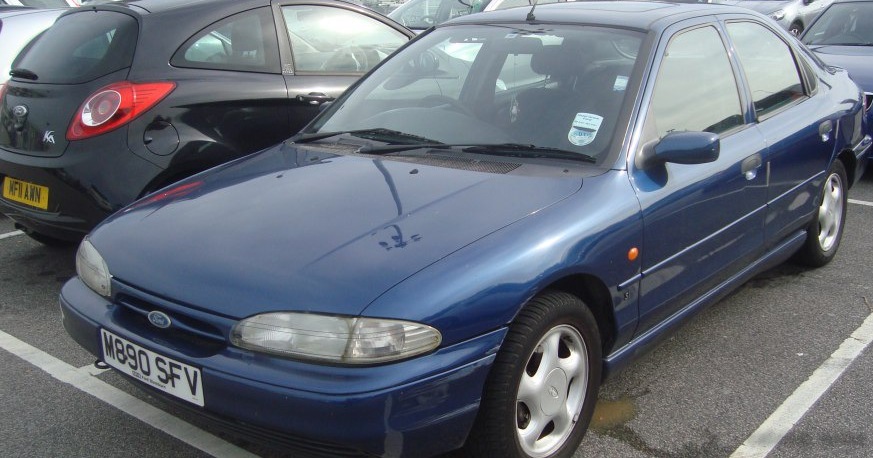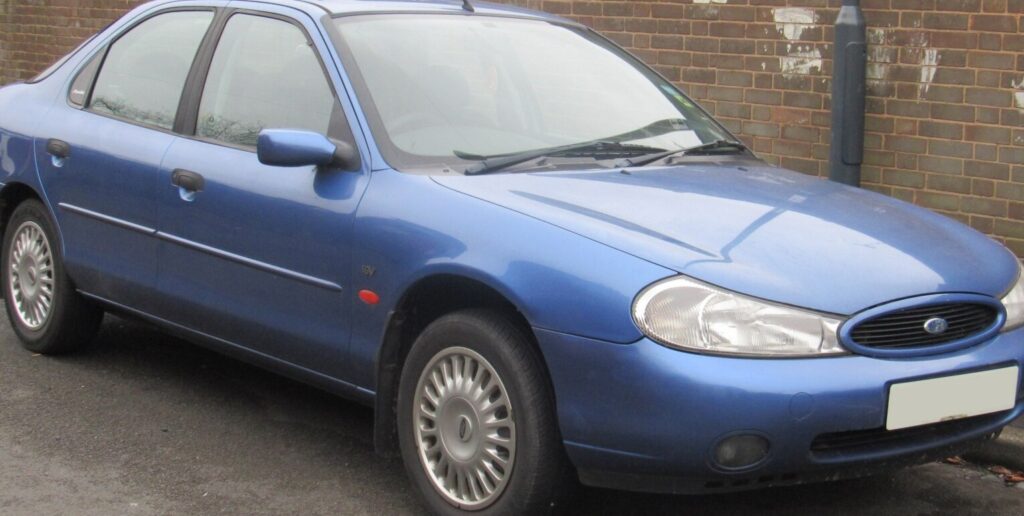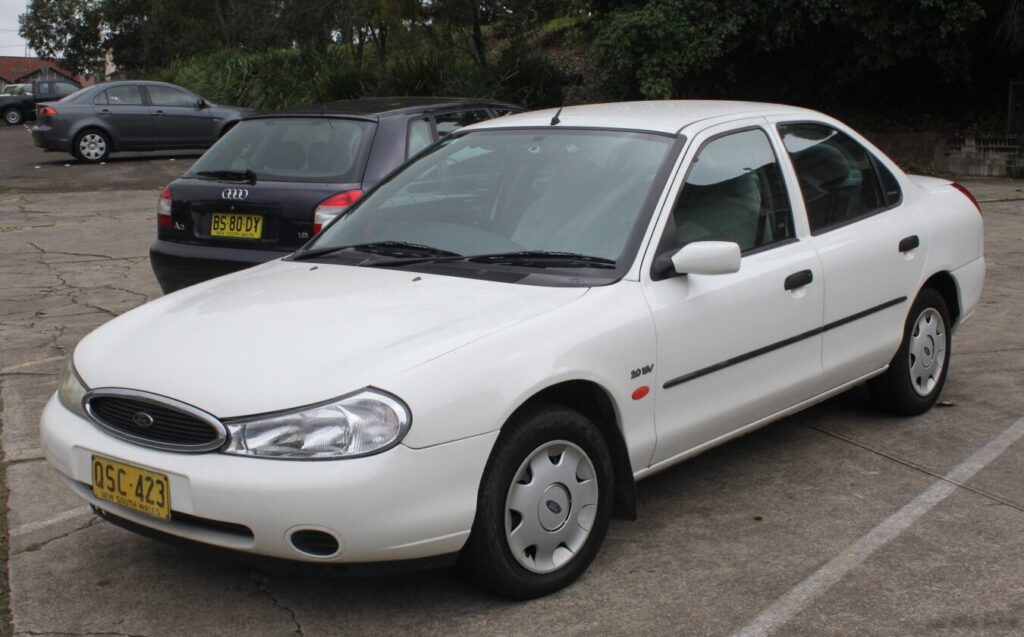
The Ford Mondeo I Sedan, particularly the facelifted version introduced in 1996, represented a significant step forward for Ford’s mid-size offerings in Europe. Positioned as a direct competitor to vehicles like the Volkswagen Passat and Opel Vectra, the Mondeo aimed to deliver a more modern and sophisticated driving experience. Production of this generation spanned from 1993 to 2000, with the 1996 facelift bringing revised styling and, crucially, the introduction of the 2.5i V6 engine option. This variant, producing 170 horsepower, occupied the premium end of the Mondeo I Sedan lineup, offering a blend of performance and comfort not found in the lower-displacement models. It was a key model in establishing the Mondeo’s reputation for being a well-rounded and capable family car.
Technical Specifications
| Brand | Ford |
| Model | Mondeo |
| Generation | Mondeo I Sedan (facelift 1996) |
| Type (Engine) | 2.5i V6 (170 Hp) |
| Start of production | 1996 |
| End of production | 2000 |
| Powertrain Architecture | Internal Combustion engine |
| Body type | Sedan |
| Seats | 5 |
| Doors | 4 |
| Fuel Type | Petrol (Gasoline) |
| Weight-to-power ratio | 7.9 kg/Hp, 126.4 Hp/tonne |
| Weight-to-torque ratio | 6.1 kg/Nm, 163.6 Nm/tonne |
| Power | 170 Hp @ 6250 rpm |
| Power per litre | 66.8 Hp/l |
| Torque | 220 Nm @ 4250 rpm (162.26 lb.-ft. @ 4250 rpm) |
| Engine layout | Front, Transverse |
| Engine Model/Code | Duratec / SEB, SEC |
| Engine displacement | 2544 cm3 (155.24 cu. in.) |
| Number of cylinders | 6 |
| Engine configuration | V-engine |
| Cylinder Bore | 82.4 mm (3.24 in.) |
| Piston Stroke | 79.5 mm (3.13 in.) |
| Compression ratio | 9.7:1 |
| Number of valves per cylinder | 4 |
| Fuel injection system | Multi-port manifold injection |
| Engine aspiration | Naturally aspirated engine |
| Valvetrain | DOHC |
| Engine oil capacity | 5.5 l (5.81 US qt | 4.84 UK qt) |
| Coolant | 9.5 l (10.04 US qt | 8.36 UK qt) |
| Kerb Weight | 1345 kg (2965.22 lbs.) |
| Max. weight | 1870 kg (4122.64 lbs.) |
| Max load | 525 kg (1157.43 lbs.) |
| Trunk (boot) space – minimum | 450 l (15.89 cu. ft.) |
| Trunk (boot) space – maximum | 1290 l (45.56 cu. ft.) |
| Fuel tank capacity | 61 l (16.11 US gal | 13.42 UK gal) |
| Length | 4556 mm (179.37 in.) |
| Width | 1751 mm (68.94 in.) |
| Height | 1424 mm (56.06 in.) |
| Wheelbase | 2704 mm (106.46 in.) |
| Front track | 1503 mm (59.17 in.) |
| Rear (Back) track | 1487 mm (58.54 in.) |
| Drivetrain Architecture | The Internal combustion engine (ICE) drives the front wheels of the vehicle. |
| Drive wheel | Front wheel drive |
| Number of gears and type of gearbox | 5 gears, manual transmission |
| Front suspension | Wishbone |
| Rear suspension | Coil spring |
| Front brakes | Ventilated discs |
| Rear brakes | Disc |
| Assisting systems | ABS (Anti-lock braking system) |
| Steering type | Steering rack and pinion |
| Power steering | Hydraulic Steering |
| Tires size | 215/45 R17 |
Powertrain & Engine Architecture
The heart of the Mondeo I Sedan 2.5i V6 is the Duratec engine, specifically the SEB or SEC variant. This 2.5-liter, 60-degree V6 engine was a significant departure from the four-cylinder engines offered in lower trims. It featured a dual overhead camshaft (DOHC) valvetrain with four valves per cylinder, contributing to its relatively high power output. The engine utilized multi-port fuel injection, delivering fuel directly into the intake ports for improved combustion efficiency. The 5-speed manual transmission was the standard pairing, offering precise gear changes and allowing drivers to fully exploit the engine’s power. The engine’s design prioritized smoothness and refinement, characteristics that set it apart from competitors offering more raw, but less polished, performance.
Driving Characteristics
The 2.5i V6 Mondeo offered a noticeably different driving experience compared to the 1.8L or 2.0L models. The V6 provided a broader torque curve, resulting in strong acceleration across the rev range. While not a sports car, the 170 horsepower allowed for confident overtaking and effortless cruising. The five-speed manual transmission was well-matched to the engine, providing a good balance between performance and fuel economy. Compared to the automatic transmissions available on other Mondeo trims, the manual offered a more engaging and responsive driving experience. The weight distribution, while front-heavy, was well-managed by the chassis, resulting in predictable handling.
Equipment & Trim Levels
The 2.5i V6 Mondeo typically came equipped with a higher level of standard features than the base models. This included power windows, power steering, central locking, and an upgraded audio system. Interior upholstery was generally cloth, but leather options were available. Air conditioning was a common feature, and higher-spec models could be equipped with features like a sunroof, alloy wheels, and upgraded trim pieces. The dashboard layout was functional and well-designed, prioritizing ergonomics and ease of use. The overall interior ambiance was one of understated quality, reflecting the Mondeo’s positioning as a comfortable and refined family car.
Chassis & Braking
The Mondeo I Sedan utilized an independent front suspension with wishbones and a coil spring rear suspension. This setup provided a comfortable ride while maintaining good handling characteristics. The front brakes were ventilated discs, offering excellent stopping power, while the rear brakes were solid discs. Anti-lock Braking System (ABS) was standard, enhancing safety and control during emergency braking situations. The steering was a rack and pinion system with hydraulic power assistance, providing precise and responsive steering feel. The suspension was tuned to balance comfort and handling, making it suitable for both everyday driving and longer journeys.
Market Reception & Comparison
The 2.5i V6 Mondeo was generally well-received by automotive critics. It was praised for its smooth and powerful engine, comfortable ride, and spacious interior. However, some critics noted that the fuel economy was not as competitive as some of its rivals. Compared to the 1.8L and 2.0L models, the V6 offered significantly more performance but came at a higher price point. The V6 was also more expensive to maintain due to the increased complexity of the engine. Against competitors like the Volkswagen Passat and Opel Vectra, the Mondeo V6 offered a compelling combination of performance, comfort, and value.
Legacy
The Duratec V6 engine proved to be a relatively reliable powertrain, although regular maintenance is crucial. Common issues include oil leaks and occasional sensor failures. Today, the Mondeo I Sedan 2.5i V6 is a sought-after classic among enthusiasts who appreciate its smooth power delivery and refined driving experience. Well-maintained examples are becoming increasingly rare, and values are steadily rising. The Mondeo I Sedan, and particularly the V6 variant, played a significant role in establishing Ford’s reputation for building capable and well-rounded family cars, paving the way for the success of subsequent Mondeo generations.