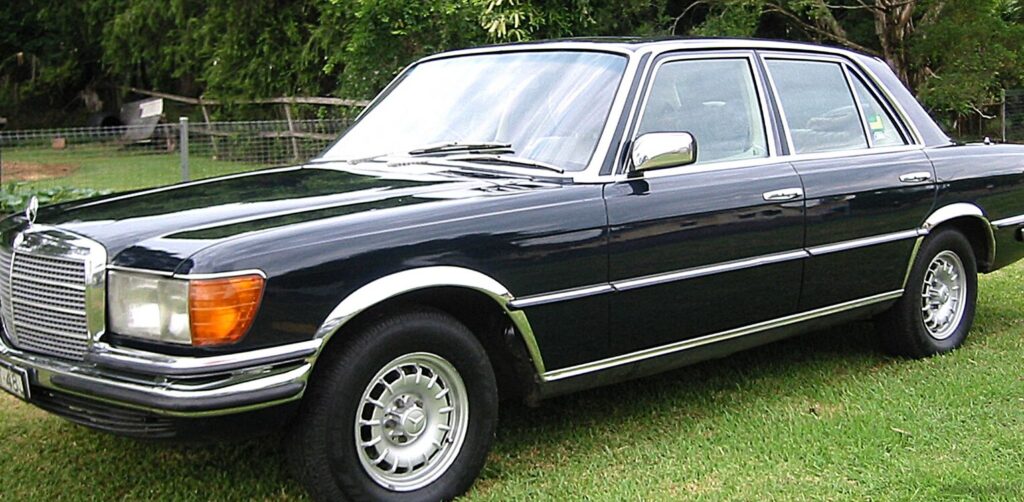
The Mercedes-Benz W116 series, produced from 1972 to 1979, represented a significant leap forward in luxury and safety for the German automaker. The 450 SE, introduced in August 1972 and continuing through November 1975, was a cornerstone of the initial W116 lineup. Positioned as a mid-range offering, it bridged the gap between the entry-level 280 SE and the flagship 450 SEL (long wheelbase). This variant, powered by the 4.5-liter V8 engine paired with a three-speed automatic transmission, aimed to deliver a refined and powerful driving experience, cementing Mercedes-Benz’s reputation for engineering excellence. The W116 was the first Mercedes-Benz to feature crumple zones, and other safety innovations, setting a new standard for passenger protection.
Technical Specifications
| Brand | Mercedes-Benz |
| Model | S-class |
| Generation | S-class SE (W116) |
| Type (Engine) | 450 SE V8 (225 Hp) Automatic |
| Start of production | August, 1972 |
| End of production | November, 1975 |
| Powertrain Architecture | Internal Combustion engine |
| Body type | Sedan |
| Seats | 5 |
| Doors | 4 |
| Fuel consumption (combined) | 14.5 l/100 km |
| Fuel consumption (US mpg) | 16.2 |
| Fuel consumption (UK mpg) | 19.5 |
| Fuel consumption (km/l) | 6.9 |
| Fuel Type | Petrol (Gasoline) |
| Acceleration 0 – 100 km/h | 9.3 sec |
| Acceleration 0 – 62 mph | 9.3 sec |
| Acceleration 0 – 60 mph | 8.8 sec |
| Maximum speed | 210 km/h (130.49 mph) |
| Weight-to-power ratio | 7.7 kg/Hp |
| Weight-to-torque ratio | 4.6 kg/Nm |
| Power | 225 Hp @ 5000 rpm |
| Power per litre | 49.8 Hp/l |
| Torque | 378 Nm @ 3000 rpm (278.8 lb.-ft. @ 3000 rpm) |
| Engine Model/Code | M 117 E 45 / 117.983 |
| Engine displacement | 4520 cm3 (275.83 cu. in.) |
| Number of cylinders | 8 |
| Engine configuration | V-engine |
| Cylinder Bore | 92 mm (3.62 in.) |
| Piston Stroke | 85 mm (3.35 in.) |
| Compression ratio | 8.8:1 |
| Number of valves per cylinder | 2 |
| Fuel injection system | Multi-port manifold injection |
| Engine aspiration | Naturally aspirated engine |
| Valvetrain | SOHC |
| Engine oil capacity | 9 l (9.51 US qt | 7.92 UK qt) |
| Coolant capacity | 14 l (14.79 US qt | 12.32 UK qt) |
| Kerb Weight | 1730 kg (3814 lbs.) |
| Max. weight | 2250 kg (4960.4 lbs.) |
| Max load | 520 kg (1146.4 lbs.) |
| Trunk (boot) space – minimum | 530 l (18.72 cu. ft.) |
| Fuel tank capacity | 96 l (25.36 US gal | 21.12 UK gal) |
| Length | 4960 mm (195.28 in.) |
| Width | 1870 mm (73.62 in.) |
| Height | 1425 mm (56.1 in.) |
| Wheelbase | 2860 mm (112.6 in.) |
| Front track | 1521 mm (59.88 in.) |
| Rear (Back) track | 1505 mm (59.25 in.) |
| Drivetrain Architecture | The Internal combustion engine (ICE) drives the rear wheels of the vehicle. |
| Drive wheel | Rear wheel drive |
| Number of gears and type of gearbox | 3 gears, automatic transmission |
| Front suspension | Double wishbone |
| Rear suspension | Threaded twist beam |
| Front brakes | Ventilated discs |
| Rear brakes | Disc |
| Steering type | Cone worm with recirculation balls |
| Power steering | Hydraulic Steering |
| Tires size | Front wheel tires: 205/70 R14Rear wheel tires: 205/70 R14 |
| Wheel rims size | Front wheel rims: 6.5J x 14Rear wheel rims: 6.5J x 14 |
Powertrain & Engine Architecture
The heart of the 450 SE was the M117 E 45 engine, a 4.5-liter (4520 cc) naturally aspirated V8. This engine featured a single overhead camshaft (SOHC) design with two valves per cylinder. Crucially, it employed Bosch K-Jetronic multi-port fuel injection, a sophisticated system for its time that improved fuel efficiency and reduced emissions compared to carbureted engines. The engine produced 225 horsepower at 5000 rpm and 278.8 lb-ft of torque at 3000 rpm. The automatic transmission was a three-speed unit, designed for smooth and comfortable shifts. While not particularly advanced by modern standards, it was a reliable and well-matched partner for the V8 engine, prioritizing luxury over outright performance.
Driving Characteristics
The 450 SE with the automatic transmission offered a distinctly different driving experience compared to the manual transmission versions or the higher-output 450 SEL 6.9. Acceleration from 0 to 60 mph took approximately 8.8 seconds, respectable for the era but noticeably slower than the manual variants. The automatic transmission’s gear ratios were geared towards relaxed cruising and effortless highway driving. While it lacked the responsiveness of a manual gearbox, the automatic provided a seamless and comfortable ride, perfectly suited to the car’s luxury positioning. The emphasis was on smooth power delivery and quiet operation, rather than sporty handling.
Equipment & Trim Levels
The 450 SE came standard with a high level of equipment, reflecting its status as a luxury vehicle. Interior features included plush velour upholstery, wood trim on the dashboard and door panels, and power windows. Air conditioning was standard, as was a high-quality radio. Optional extras included leather upholstery, a sunroof, and upgraded sound systems. The dashboard layout was classic Mercedes-Benz, with clearly marked gauges and a focus on functionality. The 450 SE aimed for understated elegance, avoiding excessive ornamentation.
Chassis & Braking
The W116 chassis featured independent suspension all around, with double wishbones at the front and a threaded twist beam rear axle. This setup provided a comfortable ride and good handling characteristics. Brakes were ventilated discs at the front and solid discs at the rear, providing adequate stopping power for the car’s weight. Power-assisted steering was standard, making maneuvering the large sedan relatively easy. The suspension was tuned for comfort, prioritizing a smooth ride over sharp handling.
Market Reception & Comparison
The 450 SE was generally well-received by automotive critics. It was praised for its luxurious interior, smooth ride, and powerful engine. However, some critics noted that the automatic transmission dulled the driving experience compared to the manual versions. Fuel economy, at 16.2 US mpg, was considered relatively poor even for the early 1970s. Compared to the 280 SE, the 450 SE offered significantly more power and a more refined driving experience, but at a higher price. The 450 SEL 6.9, with its larger engine and more advanced features, represented a further step up in luxury and performance, but also carried a substantially higher price tag.
Legacy
The Mercedes-Benz W116 450 SE remains a sought-after classic car today. The M117 V8 engine is known for its durability and relatively straightforward maintenance, although parts availability can be a challenge. Well-maintained examples command high prices in the collector car market. The W116 series is remembered as a pivotal model for Mercedes-Benz, establishing the brand’s reputation for luxury, safety, and engineering excellence. The 450 SE, in particular, represents a sweet spot in the lineup, offering a blend of power, comfort, and classic Mercedes-Benz styling.