
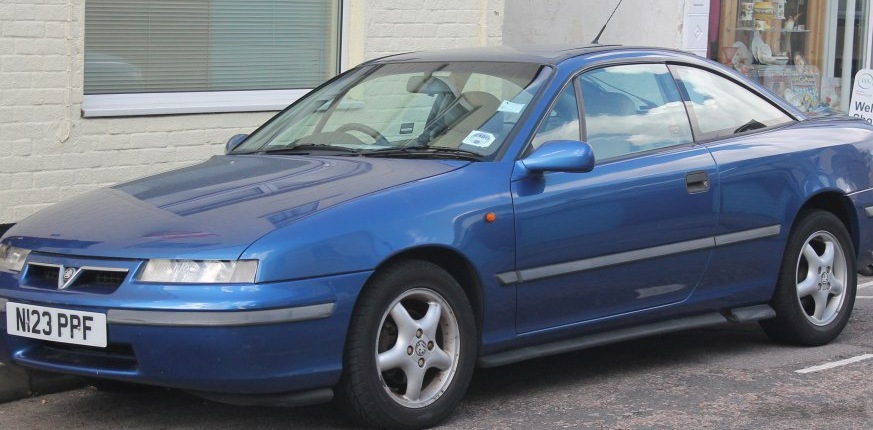
The Vauxhall Calibra 2.0 16V Automatic, produced between 1994 and 1997, represented a compelling blend of sporty styling and accessible performance within the Calibra range. Positioned as a mid-range offering, it catered to buyers seeking a more refined driving experience than the base models, without the higher price tag and performance focus of the flagship versions. The Calibra itself, launched in 1989, was a distinctive coupe designed to appeal to a younger demographic, and quickly gained popularity for its aerodynamic shape and relatively affordable price point. This variant, utilizing the X20XEV engine paired with a four-speed automatic transmission, aimed to broaden the Calibra’s appeal by offering convenience and ease of driving.
Technical Specifications
| Brand | Vauxhall |
| Model | Calibra |
| Generation | Calibra |
| Type (Engine) | 2.0 16V (136 Hp) Automatic |
| Start of production | 1994 |
| End of production | 1997 |
| Powertrain Architecture | Internal Combustion engine |
| Body type | Coupe |
| Seats | 4 |
| Doors | 2 |
| Fuel consumption (economy) – urban (NEDC) | 14.5 l/100 km (16.2 US mpg, 19.5 UK mpg, 6.9 km/l) |
| Fuel consumption (economy) – extra urban (NEDC) | 7 l/100 km (33.6 US mpg, 40.4 UK mpg, 14.3 km/l) |
| Fuel consumption (economy) – combined (NEDC) | 9.8 l/100 km (24 US mpg, 28.8 UK mpg, 10.2 km/l) |
| CO2 emissions (NEDC) | 231 g/km |
| Fuel Type | Petrol (Gasoline) |
| Acceleration 0 – 60 mph | 10 sec |
| Maximum speed | 214 km/h (132.97 mph) |
| Weight-to-power ratio | 9.5 kg/Hp, 105 Hp/tonne |
| Weight-to-torque ratio | 6.9 kg/Nm, 145.2 Nm/tonne |
| Power | 136 Hp @ 5600 rpm |
| Power per litre | 68.1 Hp/l |
| Torque | 188 Nm @ 3200 rpm (138.66 lb.-ft. @ 3200 rpm) |
| Engine layout | Front, Transverse |
| Engine Model/Code | X20XEV |
| Engine displacement | 1998 cm3 (121.93 cu. in.) |
| Number of cylinders | 4 |
| Engine configuration | Inline |
| Cylinder Bore | 86 mm (3.39 in.) |
| Piston Stroke | 86 mm (3.39 in.) |
| Compression ratio | 10.8:1 |
| Number of valves per cylinder | 4 |
| Fuel injection system | Multi-port manifold injection |
| Engine aspiration | Naturally aspirated engine |
| Valvetrain | DOHC |
| Engine oil capacity | 4.5 l (4.76 US qt | 3.96 UK qt) |
| Coolant | 6.9 l (7.29 US qt | 6.07 UK qt) |
| Kerb Weight | 1295 kg (2854.99 lbs.) |
| Max. weight | 1700 kg (3747.86 lbs.) |
| Max load | 405 kg (892.87 lbs.) |
| Trunk (boot) space – minimum | 300 l (10.59 cu. ft.) |
| Trunk (boot) space – maximum | 980 l (34.61 cu. ft.) |
| Max. roof load | 100 kg (220.46 lbs.) |
| Permitted trailer load with brakes (12%) | 1350 kg (2976.24 lbs.) |
| Permitted trailer load without brakes | 650 kg (1433 lbs.) |
| Length | 4492 mm (176.85 in.) |
| Width | 1688 mm (66.46 in.) |
| Width including mirrors | 1906 mm (75.04 in.) |
| Height | 1320 mm (51.97 in.) |
| Wheelbase | 2600 mm (102.36 in.) |
| Front overhang | 938 mm (36.93 in.) |
| Rear overhang | 954 mm (37.56 in.) |
| Drag coefficient (Cd) | 0.29 |
| Minimum turning circle (turning diameter) | 10.6 m (34.78 ft.) |
| Drivetrain Architecture | The Internal combustion engine (ICE) drives the front wheels of the vehicle. |
| Drive wheel | Front wheel drive |
| Number of gears and type of gearbox | 4 gears, automatic transmission |
| Front suspension | Independent, type McPherson with coil spring and anti-roll bar |
| Rear suspension | Transverse stabilizer, Trailing arm |
| Front brakes | Ventilated discs |
| Rear brakes | Disc |
| Assisting systems | ABS (Anti-lock braking system) |
| Steering type | Steering rack and pinion |
| Power steering | Hydraulic Steering |
| Tires size | 205/55 R15 |
| Wheel rims size | 6J x 15 |
Powertrain & Engine Architecture
At the heart of the Calibra 2.0 16V Automatic lies the X20XEV engine, a 1998cc inline-four cylinder unit. This engine was a mainstay in various Vauxhall/Opel models of the era, known for its robust construction and relatively straightforward maintenance. The ‘16V’ designation refers to the four valves per cylinder, contributing to improved breathing and power output. Fuel delivery is managed by a multi-port fuel injection system, providing precise fuel metering for optimal combustion. The engine utilizes a double overhead camshaft (DOHC) valvetrain, further enhancing its volumetric efficiency. The four-speed automatic transmission, while not known for its sportiness, offered smooth shifts and convenience, making it a popular choice for drivers prioritizing comfort. This transmission was designed to handle the engine’s 188 Nm (138.66 lb.-ft.) of torque, delivered at 3200 rpm.
Driving Characteristics
The 136 horsepower output and automatic transmission configuration resulted in a driving experience geared towards comfortable cruising rather than outright performance. Acceleration from 0 to 60 mph took around 10 seconds, and the top speed was approximately 133 mph. Compared to the manual transmission versions of the 2.0 16V, the automatic suffered a slight performance penalty due to the inherent losses within the torque converter. However, the automatic provided a more relaxed driving experience, particularly in urban traffic. The gear ratios were tuned for fuel efficiency and smooth transitions, rather than aggressive acceleration. While not as engaging as the manual, the automatic Calibra offered a refined and accessible driving experience for a wider range of drivers.
Equipment & Trim Levels
The Calibra 2.0 16V Automatic typically came equipped with features such as central locking, electric windows, and power steering as standard. Interior upholstery was generally cloth, although leather options were available as upgrades. The dashboard layout was functional and driver-focused, with clear instrumentation. Optional extras included an upgraded sound system, sunroof, and alloy wheels. The trim level often dictated the availability of these extras, with higher-spec models offering a more luxurious and well-equipped interior.
Chassis & Braking
The Calibra’s chassis featured independent suspension at the front, utilizing McPherson struts with coil springs and an anti-roll bar. The rear suspension employed a trailing arm setup with a transverse stabilizer. This configuration provided a reasonable balance between ride comfort and handling. Braking duties were handled by ventilated discs at the front and solid discs at the rear, supplemented by an Anti-lock Braking System (ABS) for enhanced safety. The suspension setup was tuned to provide a comfortable ride, but it wasn’t particularly sporty, reflecting the car’s overall focus on accessibility and refinement.
Market Reception & Comparison
The Calibra 2.0 16V Automatic received mixed reviews. Critics praised its stylish design and comfortable ride, but some found the automatic transmission to be somewhat sluggish compared to the manual. Fuel economy was also a point of concern, with the combined cycle consumption rated at around 24 US mpg. Compared to the more powerful Calibra 2.8 V6, the 2.0 16V Automatic offered a more affordable and fuel-efficient alternative, albeit with significantly less performance. Against the diesel-powered Calibras, it provided a smoother and quieter driving experience, but at the cost of fuel economy.
Legacy
The Vauxhall Calibra 2.0 16V Automatic, while not the most sought-after variant, remains a popular choice among classic car enthusiasts. The X20XEV engine is known for its reliability, provided it is properly maintained. However, like many cars of its age, it is susceptible to corrosion and age-related issues. The automatic transmission, while generally durable, can require attention over time. Today, well-maintained examples command a reasonable price in the used car market, appealing to those seeking a stylish and affordable coupe with a touch of 1990s nostalgia.
