
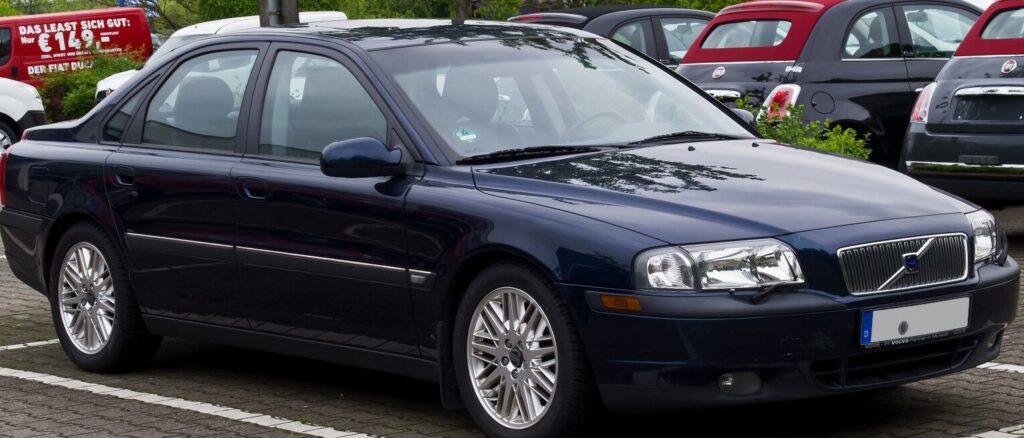
Technical Specifications
| Brand | Volvo |
| Model | S80 |
| Generation | S80 |
| Type (Engine) | 2.4 20V (170 Hp) |
| Start of production | 1999 |
| End of production | 2003 |
| Powertrain Architecture | Internal Combustion engine |
| Body type | Sedan |
| Seats | 5 |
| Doors | 4 |
| Fuel consumption (urban) | 11 l/100 km (21.4 US mpg) |
| Fuel consumption (extra urban) | 7.4 l/100 km (31.8 US mpg) |
| Fuel consumption (combined) | 9.2 l/100 km (25.6 US mpg) |
| Fuel Type | Petrol (Gasoline) |
| Acceleration 0 – 100 km/h | 9.9 sec |
| Acceleration 0 – 62 mph | 9.9 sec |
| Acceleration 0 – 60 mph | 9.4 sec |
| Maximum speed | 215 km/h (133.59 mph) |
| Weight-to-power ratio | 8.6 kg/Hp |
| Weight-to-torque ratio | 6.4 kg/Nm |
| Power | 170 Hp @ 5900 rpm |
| Torque | 230 Nm @ 4500 rpm (169.64 lb.-ft. @ 4500 rpm) |
| Engine layout | Front, Transverse |
| Engine Model/Code | B5244S |
| Engine displacement | 2435 cm3 (148.59 cu. in.) |
| Number of cylinders | 5 |
| Engine configuration | Inline |
| Cylinder Bore | 83 mm (3.27 in.) |
| Piston Stroke | 90 mm (3.54 in.) |
| Compression ratio | 10.3:1 |
| Number of valves per cylinder | 4 |
| Fuel injection system | Multi-port manifold injection |
| Engine aspiration | Naturally aspirated |
| Valvetrain | DOHC |
| Engine oil capacity | 5.5 l (5.81 US qt | 4.84 UK qt) |
| Coolant capacity | 8 l (8.45 US qt | 7.04 UK qt) |
| Kerb Weight | 1470 kg (3240.8 lbs.) |
| Max. weight | 2140 kg (4717.89 lbs.) |
| Max load | 670 kg (1477.1 lbs.) |
| Trunk (boot) space – minimum | 440 l (15.54 cu. ft.) |
| Trunk (boot) space – maximum | 1106 l (39.06 cu. ft.) |
| Fuel tank capacity | 80 l (21.13 US gal | 17.6 UK gal) |
| Length | 4822 mm (189.84 in.) |
| Width | 1832 mm (72.13 in.) |
| Height | 1434 mm (56.46 in.) |
| Wheelbase | 2791 mm (109.88 in.) |
| Front track | 1562 mm (61.5 in.) |
| Rear track | 1560 mm (61.42 in.) |
| Drivetrain Architecture | Front wheel drive |
| Drive wheel | Front wheel drive |
| Number of gears | 5 gears, manual transmission |
| Front suspension | Coil spring |
| Rear suspension | Coil spring |
| Front brakes | Ventilated discs |
| Rear brakes | Disc |
| Assisting systems | ABS (Anti-lock braking system) |
| Steering type | Steering rack and pinion |
| Power steering | Hydraulic Steering |
| Tires size | 205/65 R15 |
| Wheel rims size | 15 |
The Volvo S80 2.4 20V, launched in 1999, was a pivotal model for the Swedish automaker. It represented a departure from the boxy designs of previous Volvos, embracing a more contemporary and aerodynamic aesthetic. Built on Volvo’s P2 platform, the S80 aimed to provide a luxurious and safe driving experience. The 2.4-liter engine variant was positioned as the entry-level offering, providing a balance of affordability and performance. It was a popular choice for buyers who prioritized comfort and safety over outright speed.
Powertrain & Engine Architecture
At the heart of the S80 2.4 20V lies the B5244S engine, a 2.4-liter inline-five cylinder powerplant. This engine, a hallmark of Volvo’s engineering, featured a cast iron block and an aluminum cylinder head. The “20V” designation indicates the engine’s five valves per cylinder (four intake, one exhaust) configuration, contributing to improved breathing and power delivery. Fuel delivery was managed by a multi-port fuel injection system, ensuring precise fuel metering. The engine’s DOHC (Double Overhead Camshaft) valvetrain further optimized airflow. The 2.4L engine was known for its durability and relatively simple maintenance requirements. The standard transmission for this model was a 5-speed manual, though a 4-speed automatic transmission was also available, impacting acceleration and fuel economy.
Driving Characteristics
The S80 2.4 20V with the manual transmission offered a reasonably engaging driving experience. While not a sports sedan, the 170 horsepower and 230 Nm (169.64 lb-ft) of torque provided adequate power for everyday driving and highway cruising. Acceleration from 0-60 mph took around 9.4 seconds. The automatic transmission, while offering convenience, noticeably dulled performance, extending the 0-60 mph time to around 10.5 seconds. The gear ratios were tuned for comfort and fuel efficiency rather than outright acceleration. The S80’s suspension prioritized ride comfort, resulting in a smooth and composed ride, even on uneven surfaces. Steering was light and precise, making the car easy to maneuver.
Equipment & Trim Levels
The S80 2.4 20V typically came standard with a respectable array of features, including power windows, power locks, air conditioning, and a basic audio system. Higher trim levels offered upgrades such as leather upholstery, a sunroof, heated front seats, and a more sophisticated audio system. Safety features were a Volvo hallmark, and the S80 2.4 20V included standard ABS brakes, side airbags, and a robust safety cage. Optional extras included automatic climate control, a navigation system, and premium wheel designs.
Chassis & Braking
The S80 2.4 20V utilized a MacPherson strut front suspension and a multi-link rear suspension, providing a comfortable and controlled ride. The chassis was designed for stability and handling, though it wasn’t particularly sporty. Braking duties were handled by ventilated discs at the front and solid discs at the rear. ABS (Anti-lock Braking System) was standard, enhancing braking performance and safety. The steering system employed a hydraulic power steering rack and pinion, offering a balance of assistance and feel.
Market Reception & Comparison
The Volvo S80 2.4 20V was generally well-received by automotive critics. It was praised for its comfortable ride, spacious interior, and strong safety credentials. However, some critics noted that the 2.4-liter engine could feel underpowered, especially when paired with the automatic transmission. Compared to the higher-output S80 T6 (with its turbocharged engine), the 2.4 20V offered significantly less performance. However, it was more fuel-efficient and less expensive to maintain. The 2.4L model also offered a more affordable entry point into the S80 range, appealing to a wider audience. Fuel economy figures averaged around 25.6 US mpg combined.
Legacy
The Volvo S80 2.4 20V has proven to be a reliable and durable vehicle. The B5244S engine is known for its longevity, and with proper maintenance, can easily exceed 200,000 miles. Today, the S80 2.4 20V remains a relatively affordable option in the used car market. While it may not offer the latest technology or the highest performance, it provides a comfortable, safe, and reliable driving experience, making it a popular choice for budget-conscious buyers seeking a classic Volvo sedan. Parts availability is generally good, and the car’s relatively simple mechanical design makes it accessible for DIY repairs.
