
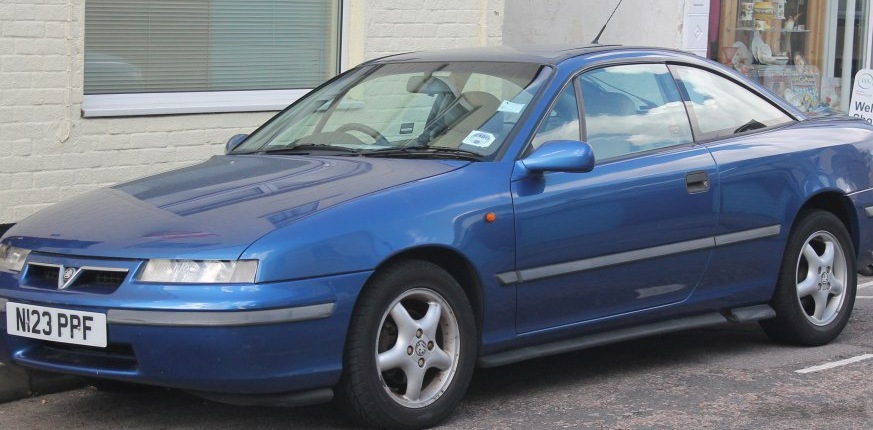
The Vauxhall Calibra 2.0 16V, produced between 1989 and 1994, represented a significant offering in the coupe market, particularly in Europe. Positioned as a stylish and sporty alternative to more conventional saloons and hatchbacks, the Calibra was based on the GM AE platform, shared with the Opel Vectra and Cavalier. The 2.0 16V variant, boasting 150 horsepower, occupied a middle ground in the Calibra lineup, offering a balance between performance and affordability. It aimed to attract buyers seeking a more engaging driving experience than the base models, without the higher price tag of the more potent, and often turbocharged, options.
Technical Specifications
| Brand | Vauxhall |
| Model | Calibra |
| Generation | Calibra |
| Type (Engine) | 2.0 16V (150 Hp) |
| Start of production | 1989 |
| End of production | 1994 |
| Powertrain Architecture | Internal Combustion engine |
| Body type | Coupe |
| Seats | 4 |
| Doors | 2 |
| Fuel consumption (urban) | 11.2 l/100 km (21 US mpg, 25.2 UK mpg, 8.9 km/l) |
| Fuel consumption (extra urban) | 6.1 l/100 km (38.6 US mpg, 46.3 UK mpg, 16.4 km/l) |
| Fuel Type | Petrol (Gasoline) |
| Acceleration 0 – 100 km/h | 7.5 sec |
| Acceleration 0 – 62 mph | 7.5 sec |
| Acceleration 0 – 60 mph | 7.1 sec |
| Maximum speed | 214 km/h (132.97 mph) |
| Weight-to-power ratio | 8.2 kg/Hp, 122 Hp/tonne |
| Weight-to-torque ratio | 6.3 kg/Nm, 159.3 Nm/tonne |
| Power | 150 Hp @ 6000 rpm |
| Power per litre | 75.1 Hp/l |
| Torque | 196 Nm @ 4600 rpm (144.56 lb.-ft. @ 4600 rpm) |
| Engine layout | Front, Transverse |
| Engine Model/Code | C20XE |
| Engine displacement | 1998 cm3 (121.93 cu. in.) |
| Number of cylinders | 4 |
| Engine configuration | Inline |
| Cylinder Bore | 86 mm (3.39 in.) |
| Piston Stroke | 86 mm (3.39 in.) |
| Compression ratio | 10.5:1 |
| Number of valves per cylinder | 4 |
| Fuel injection system | Multi-port manifold injection |
| Engine aspiration | Naturally aspirated engine |
| Valvetrain | DOHC |
| Engine oil capacity | 4.5 l (4.76 US qt | 3.96 UK qt) |
| Coolant | 6.9 l (7.29 US qt | 6.07 UK qt) |
| Kerb Weight | 1230 kg (2711.69 lbs.) |
| Max. weight | 1635 kg (3604.56 lbs.) |
| Max load | 405 kg (892.87 lbs.) |
| Trunk (boot) space – minimum | 300 l (10.59 cu. ft.) |
| Trunk (boot) space – maximum | 980 l (34.61 cu. ft.) |
| Fuel tank capacity | 63 l (16.64 US gal | 13.86 UK gal) |
| Max. roof load | 100 kg (220.46 lbs.) |
| Permitted trailer load with brakes (12%) | 1200 kg (2645.55 lbs.) |
| Permitted trailer load without brakes | 580 kg (1278.68 lbs.) |
| Permitted towbar download | 75 kg (165.35 lbs.) |
| Length | 4492 mm (176.85 in.) |
| Width | 1688 mm (66.46 in.) |
| Height | 1320 mm (51.97 in.) |
| Wheelbase | 2600 mm (102.36 in.) |
| Drivetrain Architecture | The Internal combustion engine (ICE) drives the front wheels of the vehicle. |
| Drive wheel | Front wheel drive |
| Number of gears and type of gearbox | 5 gears, manual transmission |
| Front suspension | Independent, type McPherson with coil spring and anti-roll bar |
| Rear suspension | Independent coil spring, Transverse stabilizer |
| Front brakes | Ventilated discs, 256.54 mm |
| Rear brakes | Disc, 269.24 mm |
| Assisting systems | ABS (Anti-lock braking system) |
| Steering type | Steering rack and pinion |
| Power steering | Hydraulic Steering |
Powertrain & Engine Architecture
The heart of the Calibra 2.0 16V is the C20XE engine, a 1998cc inline-four cylinder unit. This engine is a member of the Opel/Vauxhall “Family II” series, known for its robust construction and tuning potential. The ‘XE’ designation signifies a dual overhead camshaft (DOHC) configuration with four valves per cylinder, contributing to its relatively high specific output. Fuel delivery is managed by a Bosch Motronic multi-port fuel injection system, optimizing air-fuel mixture for improved efficiency and performance. The engine’s 10.5:1 compression ratio further enhances its power output. The Calibra 2.0 16V exclusively came with a five-speed manual transmission, providing drivers with direct control over the engine’s power. This transmission was chosen to complement the engine’s sporty character and deliver a more engaging driving experience.
Driving Characteristics
The Calibra 2.0 16V offered a noticeably more spirited driving experience compared to the lower-spec models. The 150 horsepower engine provided brisk acceleration, achieving 0-60 mph in approximately 7.1 seconds. While not a sports car in the purest sense, the Calibra’s well-tuned suspension and relatively low weight (around 2700 lbs) allowed for confident handling and cornering. The five-speed manual transmission allowed drivers to keep the engine in its optimal power band, maximizing performance. Compared to the later turbocharged Calibra models, the 2.0 16V offered a more linear power delivery, making it more predictable and easier to control, especially for less experienced drivers. However, it lacked the outright punch and acceleration of its turbocharged siblings.
Equipment & Trim Levels
The Calibra 2.0 16V typically came equipped with a reasonable level of standard features for its time. These included central locking, electric windows, and a basic stereo system. Interior upholstery was generally cloth, although leather options were available as upgrades. The dashboard layout was functional and driver-focused, with clear instrumentation. Optional extras included alloy wheels, a sunroof, and upgraded audio systems. The trim level was generally positioned as a mid-range offering, bridging the gap between the more basic Calibras and the higher-performance, often more luxuriously equipped, turbocharged versions.
Chassis & Braking
The Calibra’s chassis featured independent suspension all around, with McPherson struts at the front and a multi-link setup at the rear. This configuration provided a good balance between ride comfort and handling precision. The 2.0 16V model was equipped with ventilated disc brakes at the front and solid discs at the rear, providing adequate stopping power for its performance level. Anti-lock braking system (ABS) was standard, enhancing safety and control during emergency braking situations. A stabilizer bar was fitted to both the front and rear axles, further reducing body roll during cornering.
Market Reception & Comparison
The Calibra 2.0 16V was generally well-received by automotive critics. It was praised for its stylish design, engaging driving dynamics, and relatively affordable price. Compared to other coupes in its class, such as the Ford Escort Cosworth and the Toyota Celica, the Calibra offered a compelling combination of performance, practicality, and value. Fuel economy was reasonable for a performance coupe of the era, averaging around 25 mpg in mixed driving. Reliability was generally good, although the C20XE engine could be susceptible to oil leaks if not properly maintained. The 2.0 16V offered a more economical and less demanding ownership experience compared to the more powerful, turbocharged Calibra models.
Legacy
The Vauxhall Calibra 2.0 16V has developed a loyal following among enthusiasts. The C20XE engine is known for its durability and tunability, making it a popular choice for engine swaps and modifications. Today, well-maintained examples of the Calibra 2.0 16V are becoming increasingly collectible. While not as sought-after as the turbocharged versions, the 2.0 16V offers a more accessible entry point into Calibra ownership, providing a classic 1990s coupe experience with a good balance of performance, reliability, and affordability. Its enduring appeal lies in its distinctive styling, engaging driving dynamics, and the robust engineering of the C20XE engine.
