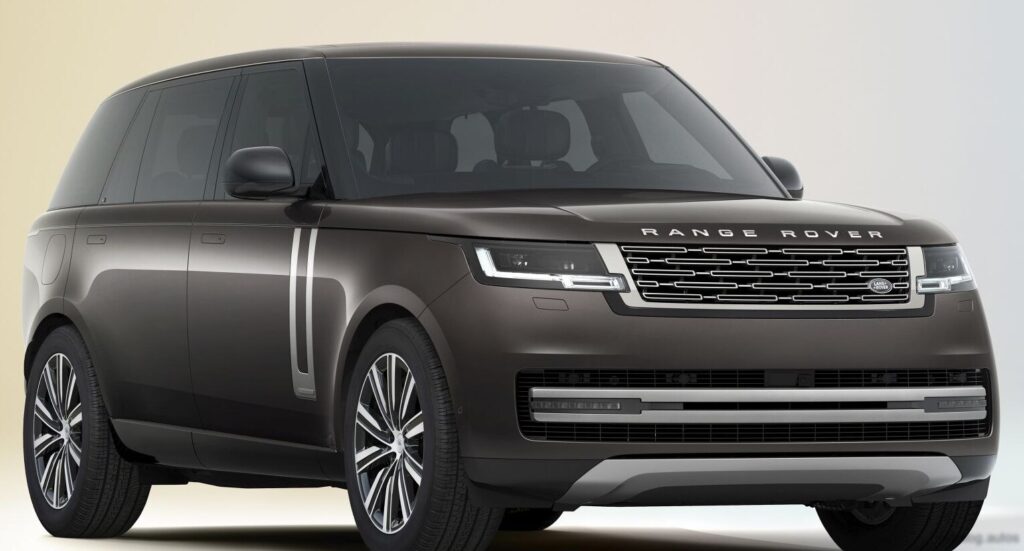
The Land Rover Range Rover V LWB 4.4 V8 P530, introduced in October 2021, represents the pinnacle of luxury and performance within the fifth-generation Range Rover (L460) family. The “LWB” designation signifies a long wheelbase variant, prioritizing rear passenger space and comfort. This particular model, powered by a 4.4-liter twin-turbocharged V8 engine producing 530 horsepower, occupies the top echelon of the Range Rover lineup, offering a blend of opulent features, robust off-road capability, and impressive on-road performance. It’s positioned as the flagship powertrain option, catering to buyers seeking the ultimate Range Rover experience. The vehicle is built on the MLA3 platform, a new all-aluminum architecture designed for both internal combustion and electric powertrains.
Technical Specifications
| Brand | Land Rover |
| Model | Range Rover |
| Generation | Range Rover V LWB |
| Type | 4.4 V8 P530 (530 Hp) AWD Automatic 7 Seat |
| Start of production | October, 2021 |
| Powertrain Architecture | Internal Combustion engine |
| Body type | SUV |
| Seats | 7 |
| Doors | 5 |
| Combined fuel consumption (WLTP) | 11.6-12 l/100 km (20.3 – 19.6 US mpg, 24.4 – 23.5 UK mpg, 8.6 – 8.3 km/l) |
| CO2 emissions (WLTP) | 264-272 g/km |
| CO2 emissions (NEDC, WLTP equivalent) | 275 g/km |
| Fuel Type | Petrol (Gasoline) |
| Acceleration 0 – 100 km/h | 4.8 sec |
| Acceleration 0 – 62 mph | 4.8 sec |
| Acceleration 0 – 60 mph | 4.6 sec |
| Maximum speed | 250 km/h (155.34 mph) |
| Emission standard | Euro 6d Final |
| Weight-to-power ratio | 5 kg/Hp, 200 Hp/tonne |
| Weight-to-torque ratio | 3.5 kg/Nm, 283 Nm/tonne |
| Power | 530 Hp |
| Power per litre | 120.6 Hp/l |
| Torque | 750 Nm (553.17 lb.-ft.) |
| Engine layout | Front, Longitudinal |
| Engine displacement | 4395 cm3 (268.2 cu. in.) |
| Number of cylinders | 8 |
| Engine configuration | V-engine |
| Cylinder Bore | 89 mm (3.5 in.) |
| Piston Stroke | 88.29 mm (3.48 in.) |
| Compression ratio | 10.5:1 |
| Number of valves per cylinder | 4 |
| Fuel injection system | Direct injection |
| Engine aspiration | Supercharger, Intercooler |
| Engine oil capacity | 11 l (11.62 US qt | 9.68 UK qt) |
| Kerb Weight | 2650 kg (5842.25 lbs.) |
| Trunk (boot) space – minimum | 229 l (8.09 cu. ft.) |
| Trunk (boot) space – maximum | 2601 l (91.85 cu. ft.) |
| Fuel tank capacity | 90 l (23.78 US gal | 19.8 UK gal) |
| Permitted trailer load with brakes (12%) | 3500 kg (7716.18 lbs.) |
| Permitted trailer load without brakes | 750 kg (1653.47 lbs.) |
| Length | 5252 mm (206.77 in.) |
| Width with mirrors folded | 2047 mm (80.59 in.) |
| Width including mirrors | 2209 mm (86.97 in.) |
| Height | 1870 mm (73.62 in.) |
| Wheelbase | 3197 mm (125.87 in.) |
| Front track | 1702 mm (67.01 in.) |
| Rear (Back) track | 1704 mm (67.09 in.) |
| Front overhang | 860 mm (33.86 in.) |
| Rear overhang | 1195 mm (47.05 in.) |
| Ride height (ground clearance) | 294-295 mm (11.57 – 11.61 in.) |
| Drag coefficient (Cd) | 0.33 |
| Minimum turning circle (turning diameter) | 11.96 m (39.24 ft.) |
| Approach angle | 34.7° |
| Departure angle | 29° |
| Ramp-over (brakeover) angle | 25.2° |
| Wading depth | 900 mm (35.43 in.) |
| Drivetrain Architecture | All wheel drive (4×4). ICE drives all four wheels permanently. |
| Number of gears and type of gearbox | 8 gears, automatic transmission |
| Front suspension | Double wishbone |
| Rear suspension | Independent multi-link suspension |
| Front brakes | Ventilated discs, 400 mm |
| Rear brakes | Ventilated discs, 370 mm |
| Steering type | Steering rack and pinion |
| Power steering | Electric Steering |
Powertrain & Engine Architecture
At the heart of the Range Rover V LWB P530 lies the BMW S68 4.4-liter twin-turbocharged V8 engine. This engine, a significant departure from Land Rover’s traditional in-house designs, delivers substantial power and torque. The engine utilizes a hot-wire mass airflow sensor system and direct fuel injection, operating at a compression ratio of 10.5:1. The twin-scroll turbochargers, positioned within the V of the engine, minimize turbo lag and provide a broad torque curve. The engine is paired with an eight-speed ZF automatic transmission, known for its smooth shifts and efficiency. This transmission is electronically controlled and features a wide gear ratio spread, optimizing both acceleration and fuel economy. The drivetrain is a full-time all-wheel-drive system, utilizing a sophisticated torque-vectoring system to enhance handling and stability.
Driving Characteristics
The 530 horsepower and 553 lb-ft of torque translate into exhilarating performance. Acceleration from 0 to 60 mph takes just 4.6 seconds, making it one of the quickest full-size luxury SUVs available. The eight-speed automatic transmission provides seamless gear changes, and the torque converter is tuned for both responsiveness and comfort. Compared to lower-powered Range Rover variants, such as the P400 (3.0L inline-six), the P530 offers significantly more effortless acceleration and passing power. While the P400 provides adequate performance for most drivers, the P530 caters to those who prioritize outright speed and responsiveness. The long wheelbase contributes to a more stable and comfortable ride, particularly at highway speeds.
Equipment & Trim Levels
The Range Rover V LWB P530 comes standard with a comprehensive suite of luxury features, including premium leather upholstery, heated and ventilated front and rear seats, a panoramic sunroof, and a Meridian Signature sound system. The long wheelbase configuration provides ample legroom for rear passengers, and available executive rear seating packages add features such as individual rear seats with massage function and a rear entertainment system. Optional extras include a variety of interior trim materials, exterior styling enhancements, and advanced driver-assistance systems. The Autobiography trim level, often selected with the P530 engine, adds even more luxurious appointments and exclusive features.
Chassis & Braking
The Range Rover V LWB P530 features a sophisticated chassis designed to deliver both on-road comfort and off-road capability. The suspension system utilizes double wishbones at the front and an independent multi-link setup at the rear, with air suspension and adaptive dampers as standard equipment. This allows the vehicle to adjust its ride height and damping characteristics based on road conditions and driving mode. Braking duties are handled by ventilated discs at all four corners, with the front discs measuring 400mm and the rear discs measuring 370mm. The braking system is augmented by ABS, electronic brake-force distribution, and brake assist.
Market Reception & Comparison
The Range Rover V LWB P530 has been well-received by automotive critics, who praise its luxurious interior, powerful engine, and refined driving experience. However, its high price tag and relatively low fuel economy (11.6-12 l/100 km) are often cited as drawbacks. Compared to competitors such as the Bentley Bentayga and the Rolls-Royce Cullinan, the Range Rover offers a compelling combination of luxury, performance, and off-road capability at a slightly lower price point. The P530 variant, while more expensive than lower-powered Range Rover models, provides a significant performance upgrade that justifies the cost for many buyers.
Legacy
The BMW-sourced V8 engine in the Range Rover V LWB P530 is expected to be a reliable and durable powertrain, benefiting from BMW’s extensive experience in V8 engine development. However, long-term reliability data is still emerging. The MLA3 platform, with its aluminum construction, is designed to be lightweight and rigid, contributing to improved handling and fuel efficiency. As a flagship model, the Range Rover V LWB P530 is likely to hold its value well in the used car market, appealing to buyers seeking a luxurious and capable SUV with a prestigious brand name.