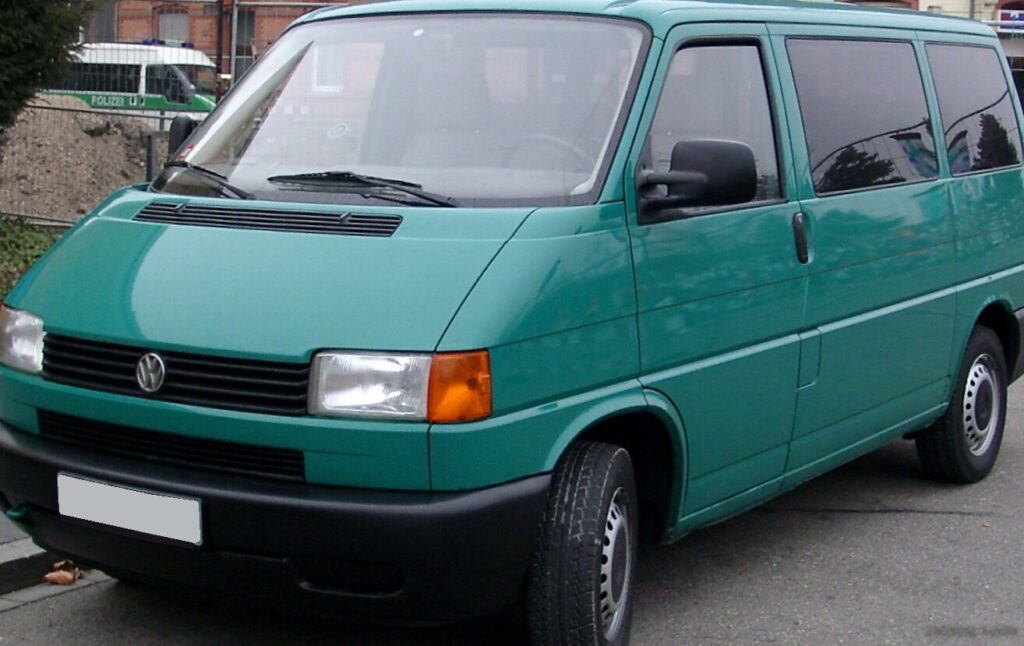
The Volkswagen Transporter (T4), particularly the Kombi variant with the 1.9 TD (68 hp) engine introduced during the 1996 facelift, represented a significant evolution in the popular van lineage. Produced from 1996 through 2003, this configuration occupied a crucial position in the European market as an affordable and practical commercial and passenger vehicle. The T4, internally designated as the 7D series, aimed to modernize the Transporter while retaining its core functionality and reputation for durability. The L1H1 designation indicates a short wheelbase and a standard roof height, making it a versatile option for a wide range of applications. This specific engine and transmission combination was aimed at buyers prioritizing fuel efficiency and lower running costs over outright performance.
Technical Specifications
| Brand | Volkswagen |
| Model | Transporter |
| Generation | Transporter (T4, facelift 1996) Kombi |
| Type (Engine) | 1.9 TD (68 Hp) L1H1 |
| Start of production | 1996 |
| End of production | 2003 |
| Powertrain Architecture | Internal Combustion engine |
| Body type | Van |
| Seats | 2-9 |
| Doors | 4-5 |
| Fuel consumption (urban) | 9 l/100 km (26.1 US mpg, 31.4 UK mpg, 11.1 km/l) |
| Fuel consumption (extra urban) | 6.9 l/100 km (34.1 US mpg, 40.9 UK mpg, 14.5 km/l) |
| Fuel Type | Diesel |
| Maximum speed | 132 km/h (82.02 mph) |
| Weight-to-power ratio | 23.2 kg/Hp, 43 Hp/tonne |
| Weight-to-torque ratio | 11.3 kg/Nm, 88.6 Nm/tonne |
| Power | 68 Hp @ 3700 rpm |
| Power per litre | 35.9 Hp/l |
| Torque | 140 Nm @ 2000-3000 rpm (103.26 lb.-ft. @ 2000-3000 rpm) |
| Engine layout | Front, Transverse |
| Engine Model/Code | ABL |
| Engine displacement | 1896 cm3 (115.7 cu. in.) |
| Number of cylinders | 4 |
| Engine configuration | Inline |
| Cylinder Bore | 79.5 mm (3.13 in.) |
| Piston Stroke | 95.5 mm (3.76 in.) |
| Compression ratio | 22.5:1 |
| Number of valves per cylinder | 2 |
| Fuel injection system | Precombustion chamber injection |
| Engine aspiration | Turbocharger |
| Valvetrain | SOHC |
| Engine oil capacity | 5 l (5.28 US qt | 4.4 UK qt) |
| Coolant | 9 l (9.51 US qt | 7.92 UK qt) |
| Kerb Weight | 1580 kg (3483.3 lbs.) |
| Max. weight | 2380-2785 kg (5247 – 6139.87 lbs.) |
| Max load | 800-1205 kg (1763.7 – 2656.57 lbs.) |
| Trunk (boot) space – maximum | 5400 l (190.7 cu. ft.) |
| Fuel tank capacity | 80 l (21.13 US gal | 17.6 UK gal) |
| Max. roof load | 100 kg (220.46 lbs.) |
| Permitted trailer load with brakes (12%) | 2000 kg (4409.25 lbs.) |
| Permitted trailer load without brakes | 700 kg (1543.24 lbs.) |
| Permitted towbar download | 100 kg (220.46 lbs.) |
| Length | 4707 mm (185.31 in.) |
| Width | 1840 mm (72.44 in.) |
| Width including mirrors | 2175 mm (85.63 in.) |
| Height | 1940 mm (76.38 in.) |
| Wheelbase | 2920 mm (114.96 in.) |
| Front track | 1589 mm (62.56 in.) |
| Rear (Back) track | 1554 mm (61.18 in.) |
| Front overhang | 886 mm (34.88 in.) |
| Rear overhang | 901 mm (35.47 in.) |
| Ride height (ground clearance) | 180 mm (7.09 in.) |
| Minimum turning circle (turning diameter) | 11.7 m (38.39 ft.) |
| Wading depth | 350 mm (13.78 in.) |
| Drivetrain Architecture | The Internal combustion engine (ICE) drives the front wheels of the vehicle. |
| Drive wheel | Front wheel drive |
| Number of gears and type of gearbox | 5 gears, manual transmission |
| Front suspension | Independent torsion bar, double wishbone, Transverse stabilizer |
| Rear suspension | Independent coil spring, Trailing arm |
| Front brakes | Disc |
| Rear brakes | Disc |
| Assisting systems | ABS (Anti-lock braking system) |
| Steering type | Steering rack and pinion |
| Power steering | Hydraulic Steering |
| Tires size | 195/70 R15; 205/65 R15 |
| Wheel rims size | 6J x 15 |
Powertrain & Engine Architecture
The heart of this Transporter variant is the 1.9-liter, inline four-cylinder diesel engine, specifically the ABL engine code. This engine utilizes a precombustion chamber injection system, a common design for Volkswagen diesels of the era. This system involves injecting fuel into a precombustion chamber connected to the main cylinder, promoting more complete combustion and reducing noise. The engine is turbocharged, providing a modest boost in power and torque. The single overhead camshaft (SOHC) valvetrain operates two valves per cylinder. The 5-speed manual transmission was the standard offering, chosen for its simplicity and cost-effectiveness. The gearbox was designed to maximize fuel efficiency rather than provide sporty acceleration.
Driving Characteristics
The 1.9 TD with 68 horsepower in the T4 offered a utilitarian driving experience. Acceleration was modest, and overtaking required careful planning. The engine’s torque peak, arriving at 2000-3000 rpm, provided adequate pulling power for everyday driving and moderate loads. The gear ratios in the 5-speed manual transmission were spaced to prioritize fuel economy, meaning the engine often needed to be revved to maintain speed on inclines. Compared to the more powerful 2.5 TDI variants, this engine felt significantly less responsive. However, it offered a smoother and more refined driving experience than the naturally aspirated diesel options.
Equipment & Trim Levels
The Kombi trim level, even in its base form, offered a reasonable level of equipment. Standard features typically included power steering, central locking, and a basic audio system. Interior upholstery was typically cloth, with durable plastics used throughout the cabin. Optional extras included air conditioning, electric windows, and upgraded audio systems. The Kombi configuration allowed for flexible seating arrangements, with options for multiple rows of seats or a more open cargo area. The dashboard layout was functional and straightforward, prioritizing practicality over aesthetics.
Chassis & Braking
The T4 Transporter utilized an independent suspension setup on both the front and rear axles. The front suspension employed torsion bars and double wishbones, while the rear featured coil springs and trailing arms. This setup provided a comfortable ride, even when the vehicle was loaded. Disc brakes were fitted on all four wheels, providing adequate stopping power. An Anti-lock Braking System (ABS) was standard, enhancing safety. The steering was rack and pinion, offering precise control. Stabilizer bars were included on both axles to reduce body roll during cornering.
Market Reception & Comparison
The 1.9 TD Kombi was well-received in the European market as a practical and economical workhorse. Critics praised its fuel efficiency and reliability, but noted its lack of outright performance. Compared to the more powerful TDI variants, the 1.9 TD offered a lower purchase price and reduced running costs. However, it was less suitable for demanding applications or long-distance highway driving. The 1.9 TD was often favored by businesses and individuals who prioritized affordability and practicality over performance.
Legacy
The ABL 1.9 TD engine, while not known for its high performance, proved to be remarkably durable and reliable. Many examples of this engine are still in service today, testament to its robust construction. The T4 Transporter, in general, has gained a reputation as a dependable and versatile vehicle. In the used car market, the 1.9 TD Kombi remains a popular choice for those seeking an affordable and practical van. However, potential buyers should be aware of the age-related issues common to older vehicles, such as rust and wear and tear on suspension components. Regular maintenance and careful inspection are essential to ensure the continued reliability of this classic van.