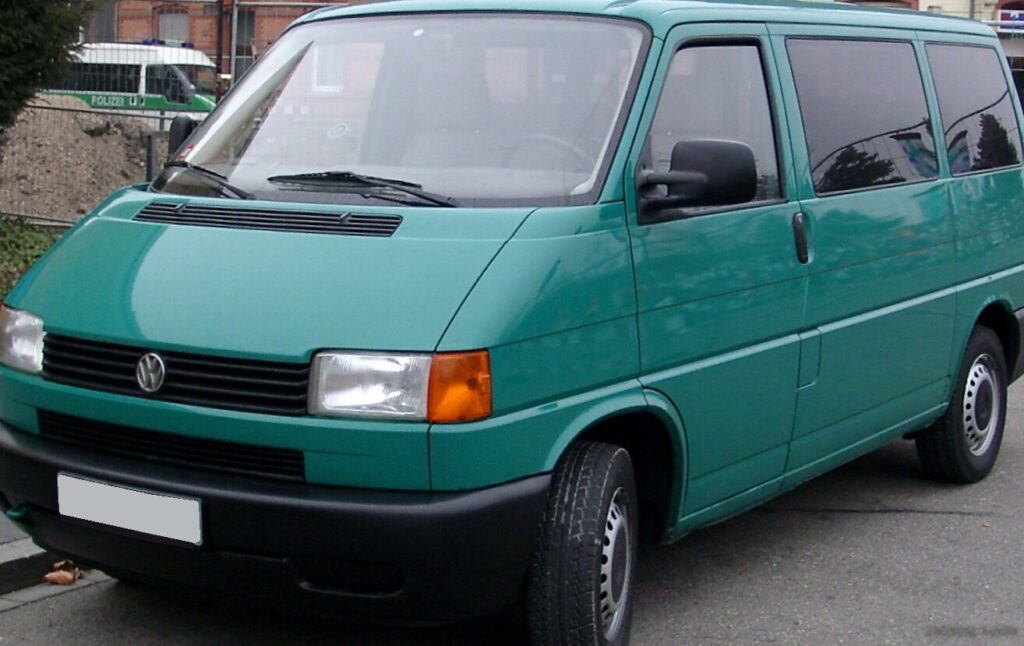
The Volkswagen Transporter (T4), particularly the Kombi variant with the 1.9 TD (68 hp) engine and L2H2 body configuration, represents a significant iteration in Volkswagen’s long-running commercial vehicle lineage. Produced from 1996 to 2003, this version of the T4 – a facelift of the original fourth-generation introduced in 1990 – served as a workhorse for businesses and families across Europe and other markets. The “Kombi” designation signified a versatile passenger/cargo configuration, while the L2H2 indicated a long wheelbase and high roof, maximizing interior space. This specific engine and transmission combination occupied a position as an economical and practical option within the T4 range, appealing to buyers prioritizing fuel efficiency and reliability over outright performance.
Technical Specifications
| Brand | Volkswagen |
| Model | Transporter |
| Generation | Transporter (T4, facelift 1996) Kombi |
| Type (Engine) | 1.9 TD (68 Hp) L2H2 |
| Start of production | 1996 |
| End of production | 2003 |
| Powertrain Architecture | Internal Combustion engine |
| Body type | Van |
| Seats | 2-9 |
| Doors | 4-5 |
| Fuel consumption (urban) | 9.2 l/100 km (25.6 US mpg) |
| Fuel consumption (extra urban) | 7.5 l/100 km (31.4 US mpg) |
| Fuel Type | Diesel |
| Maximum speed | 126 km/h (78.29 mph) |
| Weight-to-power ratio | 24.7 kg/Hp |
| Weight-to-torque ratio | 12 kg/Nm |
| Power | 68 Hp @ 3700 rpm |
| Power per litre | 35.9 Hp/l |
| Torque | 140 Nm @ 2000-3000 rpm (103.26 lb.-ft.) |
| Engine layout | Front, Transverse |
| Engine Model/Code | ABL |
| Engine displacement | 1896 cm3 (115.7 cu. in.) |
| Number of cylinders | 4 |
| Engine configuration | Inline |
| Cylinder Bore | 79.5 mm (3.13 in.) |
| Piston Stroke | 95.5 mm (3.76 in.) |
| Compression ratio | 22.5:1 |
| Number of valves per cylinder | 2 |
| Fuel injection system | Precombustion chamber injection |
| Engine aspiration | Turbocharger |
| Valvetrain | SOHC |
| Engine oil capacity | 5 l (5.28 US qt | 4.4 UK qt) |
| Coolant | 9 l (9.51 US qt | 7.92 UK qt) |
| Kerb Weight | 1680 kg (3703.77 lbs.) |
| Max. weight | 2625-2800 kg (5787.13 – 6172.94 lbs.) |
| Max load | 945-1120 kg (2083.37 – 2469.18 lbs.) |
| Trunk (boot) space – maximum | 7800 l (275.45 cu. ft.) |
| Fuel tank capacity | 80 l (21.13 US gal | 17.6 UK gal) |
| Max. roof load | 100 kg (220.46 lbs.) |
| Permitted trailer load with brakes (12%) | 2000 kg (4409.25 lbs.) |
| Permitted trailer load without brakes | 700 kg (1543.24 lbs.) |
| Permitted towbar download | 100 kg (220.46 lbs.) |
| Length | 5107 mm (201.06 in.) |
| Width | 1840 mm (72.44 in.) |
| Width including mirrors | 2175 mm (85.63 in.) |
| Height | 2430 mm (95.67 in.) |
| Wheelbase | 3320 mm (130.71 in.) |
| Front track | 1589 mm (62.56 in.) |
| Rear (Back) track | 1554 mm (61.18 in.) |
| Front overhang | 886 mm (34.88 in.) |
| Rear overhang | 901 mm (35.47 in.) |
| Ride height (ground clearance) | 180 mm (7.09 in.) |
| Minimum turning circle (turning diameter) | 12.9 m (42.32 ft.) |
| Wading depth | 350 mm (13.78 in.) |
| Drivetrain Architecture | Front wheel drive |
| Drive wheel | Front wheel drive |
| Number of gears and type of gearbox | 5 gears, manual transmission |
| Front suspension | Independent torsion bar, double wishbone, Transverse stabilizer |
| Rear suspension | Independent coil spring, Trailing arm |
| Front brakes | Disc |
| Rear brakes | Disc |
| Assisting systems | ABS (Anti-lock braking system) |
| Steering type | Steering rack and pinion |
| Power steering | Hydraulic Steering |
| Tires size | 195/70 R15; 205/65 R15 |
| Wheel rims size | 6J x 15 |
INTRODUCTION
The 1996-2003 Volkswagen Transporter T4 Kombi 1.9 TD, powered by the ABL engine, was a common sight on European roads. This variant was positioned as an entry-level to mid-range option within the T4 lineup, offering a balance between affordability, practicality, and fuel economy. The facelifted T4, introduced in 1996, featured revised styling, improved safety features, and updated engine options compared to the original 1990 model. The L2H2 configuration – a long wheelbase and high roof – made it particularly suitable for businesses requiring substantial cargo space or families needing a versatile people carrier. It was a direct competitor to vans like the Mercedes-Benz Vito, Ford Transit, and Renault Trafic.
Powertrain & Engine Architecture
The heart of this Transporter is the 1.9-liter, inline-four cylinder diesel engine, designated ABL. This engine utilizes a precombustion chamber injection system, a common technology for diesel engines of that era. This system involves injecting fuel into a small precombustion chamber within the cylinder head, where it partially ignites before being fully combusted in the main cylinder. This design aids in smoother combustion and reduced engine noise. The engine features a single overhead camshaft (SOHC) valvetrain operating two valves per cylinder. A turbocharger, a crucial component, forces more air into the engine, boosting power output to 68 horsepower at 3700 rpm and 140 Nm (103.26 lb.-ft.) of torque between 2000 and 3000 rpm. The engine is transversely mounted at the front of the vehicle. The transmission is a 5-speed manual gearbox, chosen for its simplicity and efficiency. While an automatic transmission was available on some T4 models, it wasn’t commonly paired with the 1.9 TD engine due to concerns about performance and reliability.
Driving Characteristics
The 1.9 TD with 68 hp and a manual transmission in the T4 Kombi L2H2 wasn’t designed for speed. Acceleration was modest, and overtaking required careful planning. However, the engine’s torque delivery was relatively strong at lower revs, making it suitable for hauling loads and navigating urban environments. The gear ratios were optimized for fuel efficiency rather than outright performance. Compared to the more powerful 2.5 TDI or VR6 variants, the 1.9 TD felt significantly slower. The manual transmission allowed for greater control and driver engagement, but also demanded more effort in stop-and-go traffic. The long wheelbase and high roof contributed to a noticeable amount of body roll in corners, but the suspension provided a reasonably comfortable ride, even when fully loaded.
Equipment & Trim Levels
The T4 Kombi 1.9 TD L2H2 typically came with a fairly basic level of equipment. Standard features included power steering, central locking, and a driver’s airbag. The interior was functional and durable, with hard-wearing plastic trim and cloth upholstery. The Kombi configuration allowed for flexible seating arrangements, with options for multiple rear seats that could be folded or removed to maximize cargo space. Optional extras included air conditioning, electric windows, and upgraded audio systems. Higher trim levels offered features like alloy wheels, upgraded interior trim, and additional safety equipment.
Chassis & Braking
The T4 utilized an independent suspension setup on both the front and rear axles. The front suspension featured a torsion bar and double wishbone configuration, while the rear employed a trailing arm setup with coil springs. A transverse stabilizer bar was fitted to both axles to reduce body roll. The braking system consisted of disc brakes on all four wheels, providing adequate stopping power for the vehicle’s weight. An Anti-lock Braking System (ABS) was standard, enhancing safety by preventing wheel lockup during hard braking. The steering was a rack and pinion system with hydraulic power assistance, offering precise and responsive handling.
Market Reception & Comparison
The T4 1.9 TD Kombi L2H2 was generally well-received as a practical and economical workhorse. Critics praised its fuel efficiency, reliability, and spacious interior. However, the engine’s lack of power was a common criticism, particularly when the vehicle was fully loaded. Compared to the more expensive 2.5 TDI models, the 1.9 TD offered a significant cost saving, making it an attractive option for budget-conscious buyers. The 1.9 TDI, while offering more power, was often considered less reliable than the simpler 1.9 TD. Fuel economy was a strong point, consistently achieving around 30-35 mpg in real-world driving conditions.
Legacy
The Volkswagen Transporter T4 1.9 TD, particularly the ABL-engined version, has proven to be a remarkably durable vehicle. Many examples are still on the road today, testament to their robust construction and relatively simple mechanical design. While age and mileage inevitably take their toll, the ABL engine is generally considered reliable, provided it has been properly maintained. Parts availability remains good, and the T4 enjoys a strong following among van enthusiasts and classic vehicle collectors. In the used car market, these vans are often sought after for their affordability, practicality, and potential for conversion into campervans or mobile workshops. However, potential buyers should be aware of common issues such as rust, particularly in areas prone to corrosion, and potential wear and tear on suspension components.