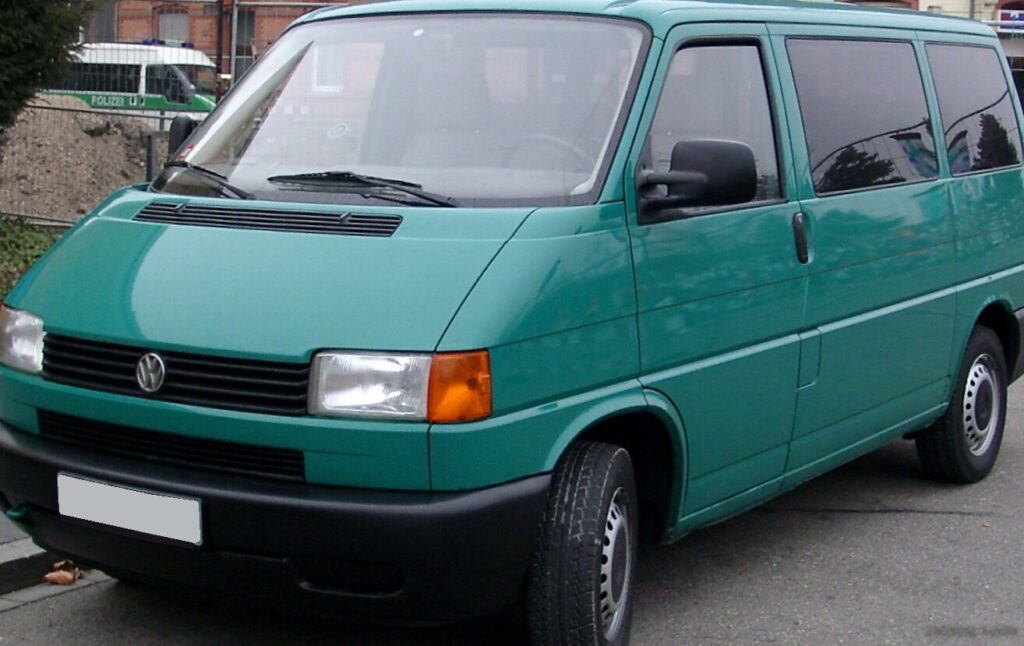
Technical Specifications
| Brand | Volkswagen |
| Model | Transporter |
| Generation | Transporter (T4, facelift 1996) Kombi |
| Type (Engine) | 2.0 (84 Hp) L2H2 |
| Start of production | 1996 |
| End of production | 2003 |
| Powertrain Architecture | Internal Combustion engine |
| Body type | Van |
| Seats | 2-9 |
| Doors | 4-5 |
| Fuel consumption (urban) | 13.6 l/100 km (17.3 US mpg, 20.8 UK mpg) |
| Fuel consumption (extra urban) | 9.4 l/100 km (25 US mpg, 30.1 UK mpg) |
| Fuel Type | Petrol (Gasoline) |
| Maximum speed | 137 km/h (85.13 mph) |
| Weight-to-power ratio | 20 kg/Hp, 50 Hp/tonne |
| Weight-to-torque ratio | 10.6 kg/Nm, 94.6 Nm/tonne |
| Power | 84 Hp @ 4300 rpm |
| Power per litre | 42.7 Hp/l |
| Torque | 159 Nm @ 2200 rpm (117.27 lb.-ft. @ 2200 rpm) |
| Engine layout | Front, Transverse |
| Engine Model/Code | AAC |
| Engine displacement | 1968 cm3 (120.09 cu. in.) |
| Number of cylinders | 4 |
| Engine configuration | Inline |
| Cylinder Bore | 81 mm (3.19 in.) |
| Piston Stroke | 95.5 mm (3.76 in.) |
| Compression ratio | 8.5:1 |
| Number of valves per cylinder | 2 |
| Fuel injection system | Multi-port manifold injection |
| Engine aspiration | Naturally aspirated engine |
| Valvetrain | SOHC |
| Engine oil capacity | 5 l (5.28 US qt | 4.4 UK qt) |
| Coolant | 9 l (9.51 US qt | 7.92 UK qt) |
| Kerb Weight | 1680 kg (3703.77 lbs.) |
| Max. weight | 2625-2800 kg (5787.13 – 6172.94 lbs.) |
| Max load | 945-1120 kg (2083.37 – 2469.18 lbs.) |
| Trunk (boot) space – maximum | 7800 l (275.45 cu. ft.) |
| Fuel tank capacity | 80 l (21.13 US gal | 17.6 UK gal) |
| Max. roof load | 100 kg (220.46 lbs.) |
| Permitted trailer load with brakes (12%) | 2000 kg (4409.25 lbs.) |
| Permitted trailer load without brakes | 700 kg (1543.24 lbs.) |
| Permitted towbar download | 100 kg (220.46 lbs.) |
| Length | 5107 mm (201.06 in.) |
| Width | 1840 mm (72.44 in.) |
| Width including mirrors | 2175 mm (85.63 in.) |
| Height | 2430 mm (95.67 in.) |
| Wheelbase | 3320 mm (130.71 in.) |
| Front track | 1589 mm (62.56 in.) |
| Rear (Back) track | 1554 mm (61.18 in.) |
| Front overhang | 886 mm (34.88 in.) |
| Rear overhang | 901 mm (35.47 in.) |
| Ride height (ground clearance) | 180 mm (7.09 in.) |
| Minimum turning circle (turning diameter) | 12.9 m (42.32 ft.) |
| Wading depth | 350 mm (13.78 in.) |
| Drivetrain Architecture | The Internal combustion engine (ICE) drives the front wheels of the vehicle. |
| Drive wheel | Front wheel drive |
| Number of gears and type of gearbox | 5 gears, manual transmission |
| Front suspension | Independent torsion bar, double wishbone, Transverse stabilizer |
| Rear suspension | Independent coil spring, Trailing arm |
| Front brakes | Disc |
| Rear brakes | Disc |
| Assisting systems | ABS (Anti-lock braking system) |
| Steering type | Steering rack and pinion |
| Power steering | Hydraulic Steering |
| Tires size | 195/70 R15; 205/65 R15 |
| Wheel rims size | 6J x 15 |
The Volkswagen Transporter T4, particularly the facelifted models produced from 1996 to 2003, represented a significant refinement of Volkswagen’s popular van. The “Kombi” designation, widely used in Europe and other markets outside of North America, denoted a passenger-oriented configuration. Within the T4 range, the 2.0-liter (1968 cc) 84 horsepower variant, frequently paired with a four-speed automatic transmission, occupied a middle ground, balancing affordability, usability, and acceptable performance. This configuration, often found in the L2H2 body style (long wheelbase, high roof), was a common sight as a versatile workhorse and family vehicle.
Powertrain & Engine Architecture
The 2.0-liter Transporter variant was powered by the Volkswagen AAC engine, an inline four-cylinder gasoline engine displacing 1968 cubic centimeters. This engine was a member of the EA827 series, known for its simplicity and durability. It featured a single overhead camshaft (SOHC) operating two valves per cylinder. Fuel delivery was managed by a multi-port fuel injection system, a step up from earlier carbureted designs. While not a performance engine, the AAC was reliable and relatively easy to maintain. The four-speed automatic transmission, while offering convenience, wasn’t known for its responsiveness or fuel efficiency. It was a popular choice for drivers who valued ease of use over sporty driving dynamics. The engine’s transverse mounting within the front-wheel-drive layout contributed to a compact engine bay.
Driving Characteristics
With 84 horsepower and the four-speed automatic transmission, the driving experience was focused on practicality. Acceleration was moderate, and overtaking required planning. The automatic transmission’s gear ratios prioritized fuel economy and smooth cruising over quick acceleration. Compared to the five-speed manual versions of the 2.0-liter engine, the automatic felt noticeably slower. However, the automatic provided a more relaxed driving experience, especially in city traffic. The T4’s suspension, while not sporty, offered a reasonable balance between ride comfort and handling, making it suitable for carrying passengers and cargo. The steering felt somewhat vague, typical of vans of this era.
Equipment & Trim Levels
The 2.0-liter automatic Kombi typically came with a fairly basic equipment level. Standard features generally included power steering, central locking, and a basic radio. Interior upholstery was usually cloth, with durable plastic trim throughout the cabin. Optional extras included air conditioning, electric windows, and upgraded audio systems. The “Kombi” designation meant the vehicle was designed for passenger transport, with seating configurations ranging from two to nine occupants, depending on the chosen layout. The L2H2 configuration provided ample interior space, making it ideal for families or commercial applications.
Chassis & Braking
The T4’s chassis featured independent suspension all around, with a torsion bar setup at the front and trailing arms at the rear. This provided a decent level of ride comfort and handling. Braking was typically disc brakes on all four wheels, although some base models might have had rear drum brakes. Anti-lock Braking System (ABS) was often standard, enhancing safety. The steering was rack and pinion, providing reasonably precise control. The T4’s relatively high center of gravity and front-wheel-drive layout meant it wasn’t a particularly agile vehicle, but it was stable and predictable.
Market Reception & Comparison
The 2.0-liter automatic Transporter Kombi was generally well-received as a practical and versatile vehicle. Critics acknowledged its modest performance but praised its usability and fuel efficiency (relative to other vans of the time). Compared to the more powerful 2.5-liter TDI diesel variants, the 2.0 gasoline model offered less torque and lower fuel economy. However, it was often more affordable to purchase and maintain. The manual transmission versions of the 2.0 offered better performance and fuel economy, but the automatic appealed to drivers who prioritized convenience. It filled a niche for those who wanted a comfortable and easy-to-drive van without the higher cost of the diesel models.
Legacy
The Volkswagen T4, including the 2.0-liter automatic variant, has proven to be a remarkably durable vehicle. Many examples are still in service today, a testament to their robust construction and relatively simple mechanicals. While the AAC engine isn’t known for being particularly high-tech, it’s generally reliable if properly maintained. The automatic transmission can be prone to wear and tear, so regular fluid changes are crucial. In the used car market, these Transporters are valued for their practicality, spaciousness, and relatively low running costs. They remain popular choices for camper conversions, commercial use, and as family vehicles, demonstrating their enduring appeal and versatility.