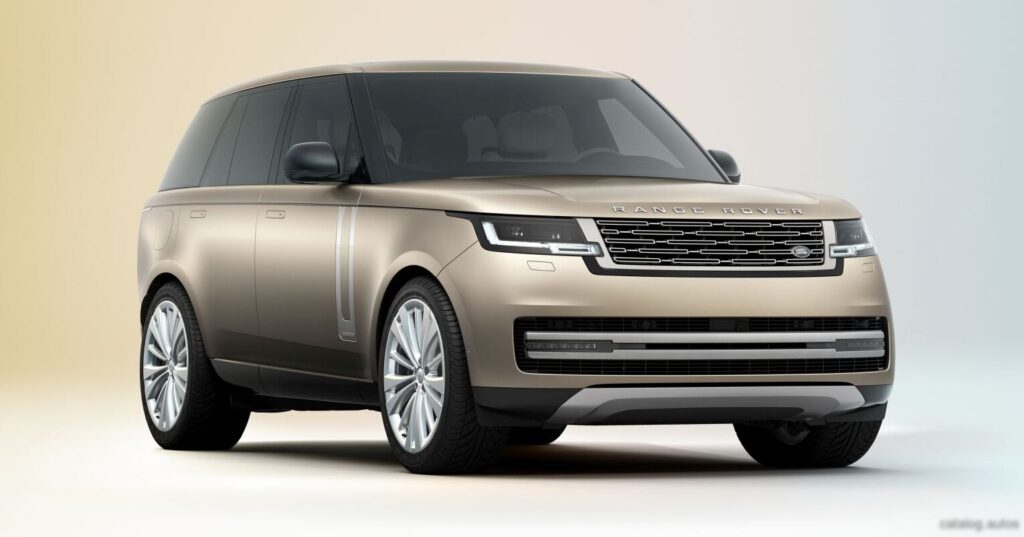
The Land Rover Range Rover V SWB 3.0 P360, introduced in October 2021, represents the fifth generation (L460) of the iconic luxury SUV. This variant, characterized by its short wheelbase (SWB) configuration and 360 horsepower (Hp) 3.0-liter inline-six engine, occupies a significant position within the Range Rover lineup, offering a balance between performance, efficiency, and practicality. It’s designed to appeal to buyers seeking the Range Rover experience in a more manageable size, particularly in urban environments or regions with narrower roads. The P360 utilizes a mild hybrid electric vehicle (MHEV) powertrain, integrating a 48-volt system to enhance fuel economy and reduce emissions.
Technical Specifications
| Brand | Land Rover |
| Model | Range Rover |
| Generation | Range Rover V SWB |
| Type (Engine) | 3.0 P360 (360 Hp) Mild Hybrid AWD Automatic |
| Start of production | October, 2021 |
| Powertrain Architecture | MHEV (Mild Hybrid Electric Vehicle) |
| Body type | SUV |
| Seats | 5 |
| Doors | 5 |
| CO2 emissions (NEDC, WLTP equivalent) | 213 g/km |
| Fuel Type | Petrol (Gasoline) |
| Acceleration 0 – 100 km/h | 6.3 sec |
| Acceleration 0 – 62 mph | 6.3 sec |
| Acceleration 0 – 60 mph | 6 sec |
| Maximum speed | 225 km/h (139.81 mph) |
| Emission standard | Euro 6d Final |
| Weight-to-power ratio | 6.6 kg/Hp, 151.3 Hp/tonne |
| Weight-to-torque ratio | 4.8 kg/Nm, 210.2 Nm/tonne |
| Power | 360 Hp |
| Power per litre | 120.2 Hp/l |
| Torque | 500 Nm (368.78 lb.-ft.) |
| Engine layout | Front, Longitudinal |
| Engine displacement | 2996 cm3 (182.83 cu. in.) |
| Number of cylinders | 6 |
| Engine configuration | Inline |
| Cylinder Bore | 83 mm (3.27 in.) |
| Piston Stroke | 92.29 mm (3.63 in.) |
| Compression ratio | 10.5:1 |
| Number of valves per cylinder | 4 |
| Fuel injection system | Direct injection |
| Engine aspiration | Turbocharger, Intercooler |
| Engine oil capacity | 9.4 l (9.93 US qt | 8.27 UK qt) |
| Kerb Weight | 2379 kg (5244.8 lbs.) |
| Trunk (boot) space – minimum | 725 l (25.6 cu. ft.) |
| Trunk (boot) space – maximum | 1841 l (65.01 cu. ft.) |
| Fuel tank capacity | 90 l (23.78 US gal | 19.8 UK gal) |
| Permitted trailer load with brakes (12%) | 3500 kg (7716.18 lbs.) |
| Permitted trailer load without brakes | 750 kg (1653.47 lbs.) |
| Length | 5052 mm (198.9 in.) |
| Width with mirrors folded | 2047 mm (80.59 in.) |
| Width including mirrors | 2209 mm (86.97 in.) |
| Height | 1870 mm (73.62 in.) |
| Wheelbase | 2997 mm (117.99 in.) |
| Front track | 1702 mm (67.01 in.) |
| Rear (Back) track | 1704 mm (67.09 in.) |
| Front overhang | 860 mm (33.86 in.) |
| Rear overhang | 1195 mm (47.05 in.) |
| Ride height (ground clearance) | 295 mm (11.61 in.) |
| Drag coefficient (Cd) | 0.30 |
| Minimum turning circle (turning diameter) | 11.37 m (37.3 ft.) |
| Approach angle | 34.7° |
| Departure angle | 29° |
| Ramp-over (brakeover) angle | 27.7° |
| Wading depth | 900 mm (35.43 in.) |
| Drivetrain Architecture | ICE and electric motor, permanent all-wheel drive |
| Drive wheel | All wheel drive (4×4) |
| Number of gears and type of gearbox | 8 gears, automatic transmission |
| Front suspension | Double wishbone |
| Rear suspension | Independent multi-link suspension |
| Front brakes | Ventilated discs, 380 mm |
| Rear brakes | Ventilated discs, 355 mm |
| Assisting systems | ABS (Anti-lock braking system) |
| Steering type | Steering rack and pinion |
| Power steering | Electric Steering |
Powertrain & Engine Architecture
The heart of the Range Rover P360 is the Ingenium 3.0-liter inline-six cylinder engine, designated as part of the JLR Ingenium engine family. This engine utilizes a sophisticated combination of technologies, including direct fuel injection, a twin-scroll turbocharger, and a continuously variable valve timing system. The mild hybrid system incorporates a 48-volt electric motor integrated with the engine, providing assistance during acceleration and enabling smoother start-stop functionality. This system contributes to improved fuel efficiency and reduced emissions without the full complexity of a plug-in hybrid. The engine’s architecture is designed for both performance and refinement, delivering a relatively flat torque curve. The eight-speed automatic transmission, sourced from ZF, is a crucial component of the powertrain. It’s known for its smooth and responsive shifts, contributing to the overall driving experience. The transmission is electronically controlled and adapts to driving conditions, optimizing gear selection for efficiency or performance.
Driving Characteristics
The Range Rover P360 offers a refined and capable driving experience. The 360 hp output and 500 Nm (368 lb-ft) of torque provide ample power for confident acceleration and effortless cruising. While not as overtly sporty as some competitors, the P360 delivers a strong 0-60 mph time of around 6 seconds. The eight-speed automatic transmission contributes to smooth progress, and the MHEV system provides a noticeable boost during initial acceleration. Compared to higher-output Range Rover variants (like the P400 or P530), the P360 prioritizes efficiency and a more relaxed driving style. It feels less urgent in its responses but remains more than capable for most driving situations. The short wheelbase of the SWB model enhances maneuverability, making it particularly well-suited for urban environments.
Equipment & Trim Levels
The Range Rover V SWB 3.0 P360 typically comes well-equipped as standard. Key features include premium leather upholstery, a touchscreen infotainment system with navigation, a panoramic sunroof, and a comprehensive suite of driver-assistance technologies. Optional extras often include upgraded audio systems (Meridian), adaptive cruise control, a head-up display, and various customization options for interior trim and exterior styling. The trim level influences the level of standard equipment and available options, with higher trims offering more luxurious appointments and advanced features.
Chassis & Braking
The Range Rover V SWB utilizes a robust chassis designed for both on-road comfort and off-road capability. It features a double-wishbone front suspension and an independent multi-link rear suspension, providing a smooth and controlled ride. Air suspension is standard, allowing for adjustable ride height and improved off-road performance. The braking system consists of ventilated discs on all four wheels, with larger discs at the front to handle the majority of the braking force. Anti-lock braking system (ABS) and electronic stability control (ESC) are standard safety features.
Market Reception & Comparison
The Range Rover V SWB 3.0 P360 has been generally well-received by automotive critics. It’s praised for its luxurious interior, comfortable ride, and capable performance. The mild hybrid system is seen as a positive step towards improved fuel efficiency. Compared to other Range Rover trims, the P360 offers a more accessible entry point into the Range Rover lineup without sacrificing too much in terms of luxury or capability. Fuel economy is respectable for a vehicle of its size and weight, although it doesn’t match the efficiency of diesel or plug-in hybrid variants. Reliability has been a concern for some Range Rover models, and owners should be aware of potential issues with the air suspension and infotainment system.
Legacy
The Range Rover V SWB 3.0 P360 represents a significant evolution in the Range Rover lineage. Its combination of a refined powertrain, luxurious interior, and advanced technology positions it as a compelling option in the luxury SUV segment. The Ingenium engine family has proven to be relatively reliable, and the eight-speed automatic transmission is known for its durability. As these vehicles enter the used car market, they are likely to hold their value well due to the enduring appeal of the Range Rover brand and the vehicle’s overall quality. Regular maintenance and adherence to the manufacturer’s recommended service schedule are crucial for ensuring the long-term reliability of this powertrain.