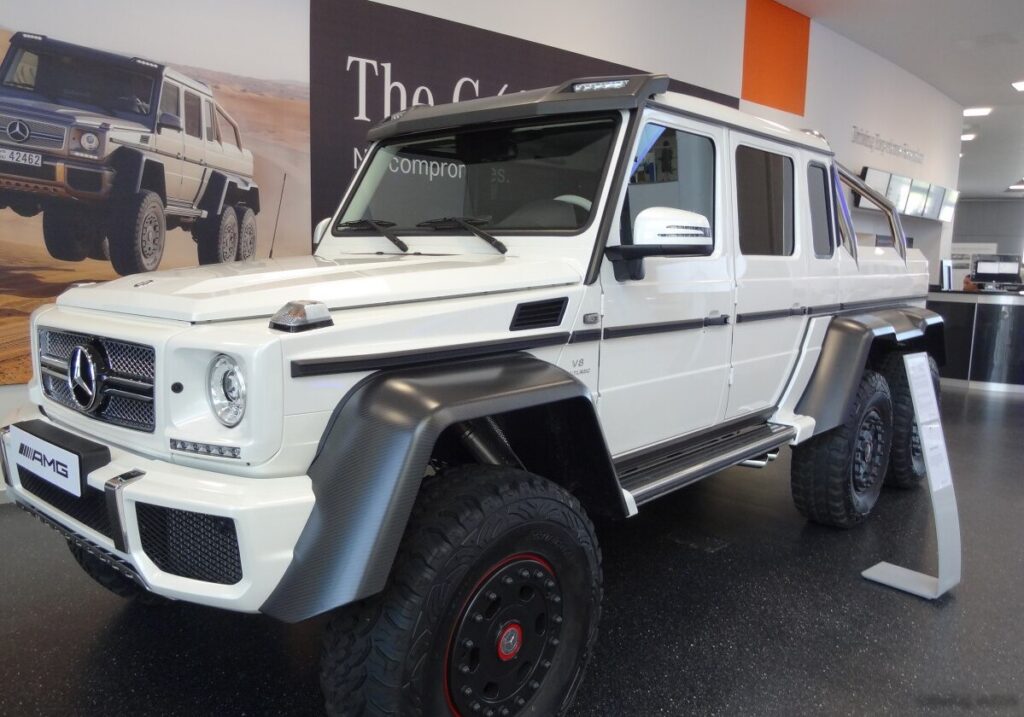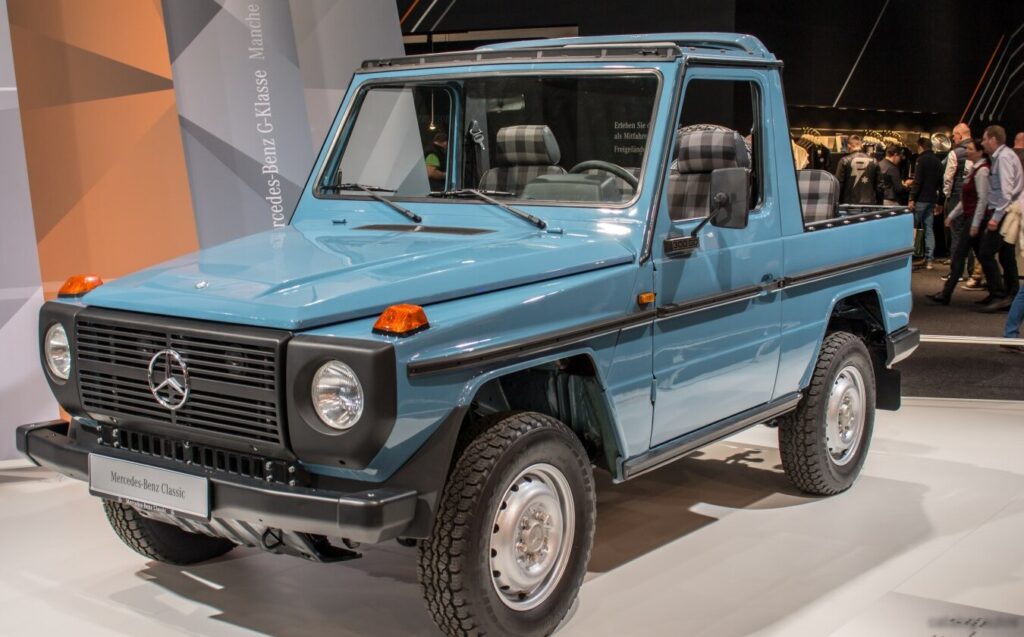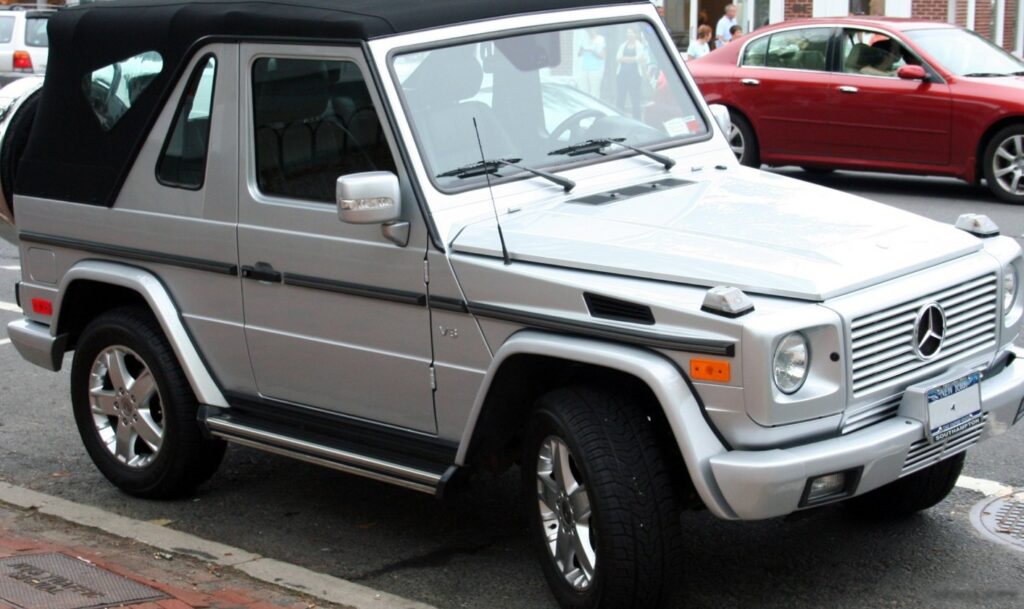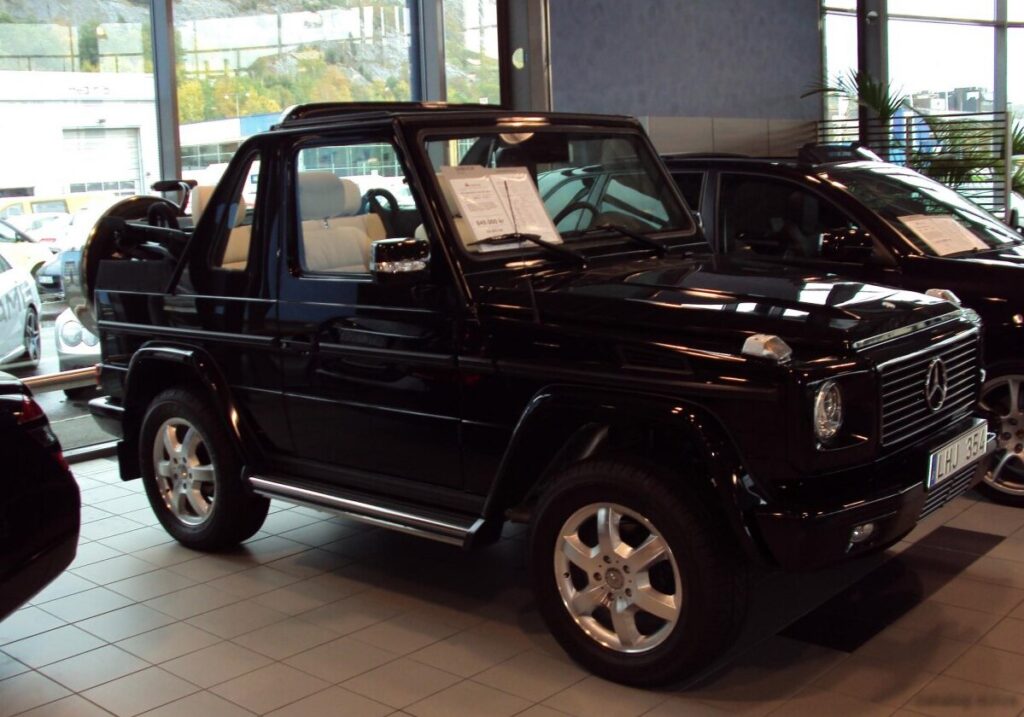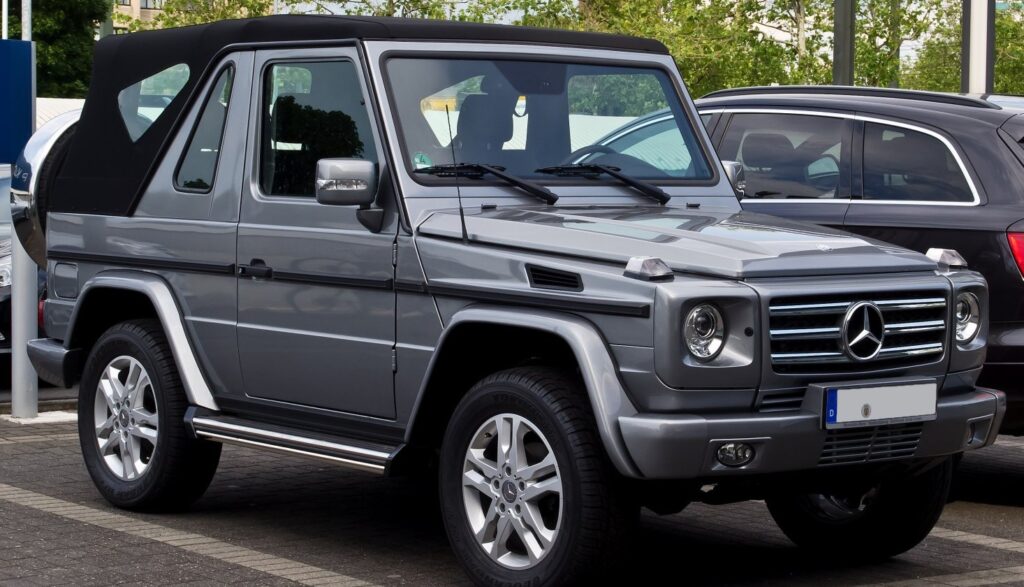
The Mercedes-Benz G 320 Long (W463), produced from May 1994 to December 1997, represents a significant iteration of the iconic G-Class, blending robust off-road capability with a degree of luxury increasingly expected in the mid-1990s. Positioned as a mid-range offering within the W463 series – which included the shorter wheelbase G 280 and the high-performance G 36 AMG – the G 320 Long catered to buyers seeking a versatile vehicle capable of both demanding terrain and comfortable long-distance travel. The “Long” designation refers to the extended wheelbase, providing increased rear passenger space and cargo capacity compared to the standard G-Class. This variant was primarily sold in Europe and other international markets, with limited official import to the United States during this period.
Technical Specifications
| Brand | Mercedes-Benz |
| Model | G-class |
| Generation | G-class Long (W463) |
| Type | G 320 (210 Hp) 4MATIC Automatic |
| Start of production | May, 1994 |
| End of production | December, 1997 |
| Powertrain Architecture | Internal Combustion engine |
| Body type | Off-road vehicle |
| Seats | 5 |
| Doors | 5 |
| Fuel consumption (urban) | 16.9 l/100 km (13.9 US mpg, 16.7 UK mpg, 5.9 km/l) |
| Fuel consumption (extra urban) | 14 l/100 km (16.8 US mpg, 20.2 UK mpg, 7.1 km/l) |
| Fuel Type | Petrol (Gasoline) |
| Acceleration 0 – 100 km/h | 12.8 sec |
| Acceleration 0 – 62 mph | 12.8 sec |
| Acceleration 0 – 60 mph | 12.2 sec |
| Maximum speed | 170 km/h (105.63 mph) |
| Emission standard | Euro 2 |
| Weight-to-power ratio | 11 kg/Hp, 90.5 Hp/tonne |
| Weight-to-torque ratio | 7.7 kg/Nm, 129.3 Nm/tonne |
| Power | 210 Hp @ 5500 rpm |
| Power per litre | 65.6 Hp/l |
| Torque | 300 Nm @ 3750 rpm (221.27 lb.-ft. @ 3750 rpm) |
| Engine layout | Front, Longitudinal |
| Engine Model/Code | M 104.996 |
| Engine displacement | 3199 cm3 (195.21 cu. in.) |
| Number of cylinders | 6 |
| Engine configuration | Inline |
| Cylinder Bore | 89.9 mm (3.54 in.) |
| Piston Stroke | 84 mm (3.31 in.) |
| Compression ratio | 9.2:1 |
| Number of valves per cylinder | 4 |
| Fuel injection system | Multi-port manifold injection |
| Engine aspiration | Naturally aspirated engine |
| Valvetrain | DOHC |
| Engine oil capacity | 8 l (8.45 US qt | 7.04 UK qt) |
| Coolant | 11.5 l (12.15 US qt | 10.12 UK qt) |
| Kerb Weight | 2320 kg (5114.72 lbs.) |
| Max. weight | 3050 kg (6724.1 lbs.) |
| Max load | 730 kg (1609.37 lbs.) |
| Trunk (boot) space – minimum | 480 l (16.95 cu. ft.) |
| Trunk (boot) space – maximum | 2250 l (79.46 cu. ft.) |
| Fuel tank capacity | 96 l (25.36 US gal | 21.12 UK gal) |
| Max. roof load | 200 kg (440.92 lbs.) |
| Permitted trailer load with brakes (12%) | 3500 kg (7716.18 lbs.) |
| Permitted trailer load without brakes | 750 kg (1653.47 lbs.) |
| Length | 4680 mm (184.25 in.) |
| Width | 1760 mm (69.29 in.) |
| Width including mirrors | 2007 mm (79.02 in.) |
| Height | 1936 mm (76.22 in.) |
| Wheelbase | 2850 mm (112.2 in.) |
| Front track | 1475 mm (58.07 in.) |
| Rear (Back) track | 1475 mm (58.07 in.) |
| Ride height (ground clearance) | 210 mm (8.27 in.) |
| Minimum turning circle (turning diameter) | 13.3 m (43.64 ft.) |
| Approach angle | 36° |
| Departure angle | 27° |
| Climb angle | 38.7° |
| Drivetrain Architecture | The Internal combustion engine (ICE) drives permanently the four wheels of the vehicle. |
| Drive wheel | All wheel drive (4×4) |
| Number of gears and type of gearbox | 4 gears, automatic transmission |
| Front suspension | Coil spring, Rigid axle suspension, Trailing arm |
| Rear suspension | Rigid axle suspension, Trailing arm, Coil spring |
| Front brakes | Ventilated discs |
| Rear brakes | Drum |
| Assisting systems | ABS (Anti-lock braking system) |
| Steering type | Cone worm with recirculation balls |
| Power steering | Hydraulic Steering |
| Tires size | 255/65 R 16 |
| Wheel rims size | 7.5 J x 16 |
Powertrain & Engine Architecture
The G 320 Long was powered by the Mercedes-Benz M 104.996, a 3.2-liter inline-six cylinder engine. This engine, a mainstay of Mercedes-Benz’s mid-range offerings in the 1990s, featured multi-port fuel injection and a double overhead camshaft (DOHC) valvetrain. The M104 was known for its smoothness and relative reliability. Producing 210 horsepower at 5500 rpm and 300 Nm (221 lb-ft) of torque at 3750 rpm, the engine provided adequate power for both on-road cruising and off-road excursions, though it wasn’t designed for outright speed. The engine’s longitudinal mounting and the vehicle’s permanent all-wheel-drive system (4MATIC) contributed to its balanced handling. The G 320 Long utilized a four-speed automatic transmission, which, while providing convenience, did slightly diminish acceleration compared to the available manual transmission options in other G-Class models.
Driving Characteristics
The G 320 Long with the automatic transmission offered a comfortable, if not particularly sporty, driving experience. Acceleration from 0-60 mph took around 12.2 seconds, and top speed was limited to 170 km/h (105.63 mph). The automatic transmission’s gear ratios were geared towards usability and fuel economy rather than performance. Compared to the shorter-wheelbase G 280, the G 320 Long felt more stable at highway speeds, while the extra weight and the automatic transmission meant it wasn’t as nimble off-road as some of its more focused siblings. The 4MATIC system provided excellent traction in various conditions, making it a capable off-roader, but the automatic transmission lacked the engine braking control offered by a manual gearbox on steep descents.
Equipment & Trim Levels
The G 320 Long typically came equipped with features considered standard for a luxury off-road vehicle of its time. This included power windows, central locking, and a basic audio system. Interior upholstery was typically cloth, with leather options available at extra cost. Optional extras included air conditioning, a sunroof, and upgraded audio systems. The extended wheelbase provided significantly more rear legroom than the standard G-Class, enhancing passenger comfort. The dashboard layout was functional and utilitarian, reflecting the G-Class’s origins as a military vehicle, though Mercedes-Benz did add some refinements to improve the overall aesthetic.
Chassis & Braking
The G 320 Long retained the traditional G-Class body-on-frame construction, providing exceptional durability and off-road capability. The suspension consisted of coil springs and rigid axles with trailing arms, offering a comfortable ride on and off-road. Front brakes were ventilated discs, while rear brakes were drums. An Anti-lock Braking System (ABS) was standard, enhancing safety. The steering was a recirculating ball system with hydraulic power assistance, providing a robust and reliable feel. The vehicle’s high ground clearance (210 mm / 8.27 inches) and generous approach and departure angles (36° and 27° respectively) made it highly capable in challenging terrain.
Market Reception & Comparison
The G 320 Long was generally well-received by automotive critics as a capable and versatile vehicle. However, its relatively high price and somewhat dated technology compared to more modern SUVs were noted. Compared to the G 280, the G 320 Long offered more power and a more refined driving experience, but at a higher cost. Against the shorter-wheelbase models, the Long offered superior passenger space and comfort. Fuel economy was a significant drawback, with combined consumption averaging around 15.5 l/100km (approximately 15 mpg). Reliability was generally good, though maintenance costs could be high due to the vehicle’s complex mechanicals and the cost of parts.
Legacy
The G 320 Long (W463) remains a sought-after vehicle among collectors and enthusiasts. The M 104 engine is known for its durability, and well-maintained examples can still provide years of reliable service. However, age-related issues such as corrosion and wear on suspension components are common. The G 320 Long represents a unique blend of ruggedness, luxury, and practicality, and its iconic design continues to appeal to a wide range of buyers in the used car market. Its enduring popularity is a testament to the G-Class’s timeless appeal and its reputation as a truly capable and distinctive vehicle.