
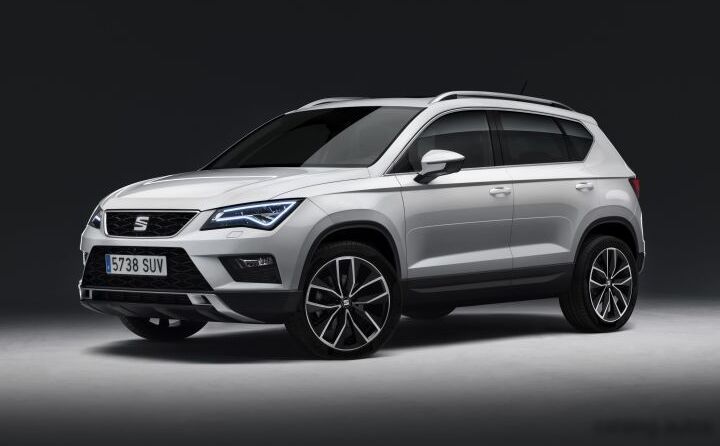
The Seat Ateca I 2.0 TSI (190 Hp) 4Drive DSG was a performance-oriented variant of the first-generation Ateca, produced between April 2017 and November 2018. Positioned as a mid-to-high-range trim, it offered a significant step up in power and all-wheel-drive capability compared to the base models. The Ateca itself was Seat’s first foray into the highly competitive compact SUV segment, built on the Volkswagen Group’s MQB platform (A3/1HX0), and aimed to provide a sporty and practical alternative to established rivals like the Nissan Qashqai and Kia Sportage. This particular variant was primarily marketed in Europe, leveraging the brand’s reputation for value and driving dynamics.
Technical Specifications
| Brand | Seat |
| Model | Ateca |
| Generation | Ateca I |
| Type (Engine) | 2.0 TSI (190 Hp) 4Drive DSG |
| Start of production | April, 2017 |
| End of production | November, 2018 |
| Powertrain Architecture | Internal Combustion engine |
| Body type | SUV |
| Seats | 5 |
| Doors | 5 |
| Fuel consumption (economy) – urban (NEDC) | 8.5 l/100 km (27.7 US mpg, 33.2 UK mpg, 11.8 km/l) |
| Fuel consumption (economy) – extra urban (NEDC) | 6 l/100 km (39.2 US mpg, 47.1 UK mpg, 16.7 km/l) |
| Fuel consumption (economy) – combined (NEDC) | 6.9-7 l/100 km (34.1 – 33.6 US mpg, 40.9 – 40.4 UK mpg, 14.5 – 14.3 km/l) |
| CO2 emissions (NEDC) | 158-159 g/km |
| Fuel Type | Petrol (Gasoline) |
| Acceleration 0 – 100 km/h | 7.9 sec |
| Acceleration 0 – 62 mph | 7.9 sec |
| Acceleration 0 – 60 mph | 7.5 sec |
| Maximum speed | 212 km/h (131.73 mph) |
| Emission standard | Euro 6 |
| Weight-to-power ratio | 7.7 kg/Hp, 130 Hp/tonne |
| Weight-to-torque ratio | 4.6 kg/Nm, 219 Nm/tonne |
| Power | 190 Hp @ 4200-6000 rpm |
| Power per litre | 95.8 Hp/l |
| Torque | 320 Nm @ 1450-4200 rpm (236.02 lb.-ft. @ 1450-4200 rpm) |
| Engine layout | Front, Transverse |
| Engine Model/Code | EA888 / CZPB |
| Engine displacement | 1984 cm3 (121.07 cu. in.) |
| Number of cylinders | 4 |
| Engine configuration | Inline |
| Cylinder Bore | 82.5 mm (3.25 in.) |
| Piston Stroke | 92.8 mm (3.65 in.) |
| Compression ratio | 11.6:1 |
| Number of valves per cylinder | 4 |
| Fuel injection system | Direct injection and Multi-port manifold injection |
| Engine aspiration | Turbocharger, Intercooler |
| Valvetrain | DOHC |
| Engine oil capacity | 5.7 l (6.02 US qt | 5.02 UK qt) |
| Coolant | 10 l (10.57 US qt | 8.8 UK qt) |
| Kerb Weight | 1461 kg (3220.95 lbs.) |
| Max. weight | 2080 kg (4585.62 lbs.) |
| Max load | 619 kg (1364.66 lbs.) |
| Trunk (boot) space – minimum | 485 l (17.13 cu. ft.) |
| Fuel tank capacity | 55 l (14.53 US gal | 12.1 UK gal) |
| Max. roof load | 75 kg (165.35 lbs.) |
| Permitted trailer load with brakes (12%) | 1900 kg (4188.78 lbs.) |
| Permitted trailer load without brakes | 750 kg (1653.47 lbs.) |
| Permitted towbar download | 80 kg (176.37 lbs.) |
| Length | 4363 mm (171.77 in.) |
| Width | 1841 mm (72.48 in.) |
| Width including mirrors | 2078 mm (81.81 in.) |
| Height | 1625 mm (63.98 in.) |
| Wheelbase | 2630 mm (103.54 in.) |
| Front track | 1572 mm (61.89 in.) |
| Rear (Back) track | 1544 mm (60.79 in.) |
| Front overhang | 868 mm (34.17 in.) |
| Rear overhang | 865 mm (34.06 in.) |
| Ride height (ground clearance) | 189 mm (7.44 in.) |
| Minimum turning circle (turning diameter) | 10.8 m (35.43 ft.) |
| Approach angle | 20.6° |
| Departure angle | 25.5° |
| Drivetrain Architecture | The Internal combustion engine (ICE) drives the front wheels permanently, and the rear wheels are driven through an electrically or mechanically operated clutch if necessary. |
| Drive wheel | All wheel drive (4×4) |
| Number of gears and type of gearbox | 7 gears, automatic transmission DSG |
| Front suspension | Independent, type McPherson with coil spring and anti-roll bar |
| Rear suspension | Independent multi-link spring suspension with stabilizer |
| Front brakes | Ventilated discs, 312×25 mm |
| Rear brakes | Disc, 272×10 mm |
| Assisting systems | ABS (Anti-lock braking system) |
| Steering type | Steering rack and pinion |
| Power steering | Electric Steering |
| Tires size | 215/55 R17; 215/50 R18; 235/40 R19 |
| Wheel rims size | 7J x 17; 7J x 18; 8J x 19 |
Powertrain & Engine Architecture
At the heart of the Ateca 2.0 TSI 4Drive DSG lies the EA888 engine, specifically the CZPB variant. This is a 1.984-liter (121.07 cubic inches) turbocharged, direct-injection four-cylinder gasoline engine. The EA888 family is a cornerstone of the Volkswagen Group’s engine strategy, known for its versatility and performance potential. The CZPB version utilizes a single-scroll turbocharger with an intercooler, delivering 190 horsepower at 4,200-6,000 rpm and 320 Nm (236 lb-ft) of torque between 1,450 and 4,200 rpm. The engine features a dual overhead camshaft (DOHC) valvetrain with four valves per cylinder. Fuel is delivered via direct injection, optimizing combustion efficiency and power output. The engine is paired with a seven-speed dual-clutch transmission (DSG), which provides quick and smooth gear changes. The 4Drive all-wheel-drive system uses a multi-plate clutch to distribute torque between the front and rear axles as needed, enhancing traction and stability.
Driving Characteristics
The 2.0 TSI 4Drive DSG offered a noticeably more engaging driving experience than the lower-powered Ateca variants. The 190 hp output, combined with the DSG transmission, resulted in brisk acceleration – 0 to 60 mph in approximately 7.5 seconds. The DSG transmission’s quick shifts and intelligent gear selection kept the engine in its optimal power band. While not a sports SUV, the 2.0 TSI provided ample power for overtaking and highway cruising. The 4Drive system instilled confidence in various road conditions, particularly in inclement weather. Compared to the manual transmission options, the DSG offered convenience and ease of use, although some purists might have preferred the greater control of a manual gearbox. The gear ratios were tuned for a balance between performance and fuel efficiency, with a relatively tall seventh gear for relaxed cruising.
Equipment & Trim Levels
The 2.0 TSI 4Drive DSG typically came with a generous level of standard equipment. This included features like automatic climate control, a touchscreen infotainment system with navigation, Bluetooth connectivity, and a suite of safety systems such as ABS, ESC, and multiple airbags. Interior upholstery was usually a combination of fabric and Alcantara, with options for full leather. Common optional extras included a panoramic sunroof, adaptive cruise control, park assist, and a premium sound system. Trim levels varied slightly depending on the market, but generally, this variant sat towards the higher end of the Ateca range, offering a more refined and feature-rich experience than the entry-level models.
Chassis & Braking
The Ateca’s chassis was tuned to provide a comfortable yet controlled ride. The front suspension utilized a McPherson strut setup, while the rear employed a multi-link independent suspension. This configuration offered a good balance between ride quality and handling precision. The 2.0 TSI models often featured slightly stiffer suspension components compared to the base models to manage the increased power. Braking duties were handled by ventilated discs at the front and solid discs at the rear. ABS (Anti-lock Braking System) was standard, along with Electronic Stability Control (ESC) to enhance safety. The steering was an electric power-assisted rack and pinion system, providing a responsive and precise feel.
Market Reception & Comparison
The Seat Ateca 2.0 TSI 4Drive DSG was generally well-received by automotive critics. It was praised for its engaging driving dynamics, spacious interior, and practical features. The 190 hp engine was considered a good compromise between performance and fuel economy. Compared to rivals like the Nissan Qashqai and Kia Sportage, the Ateca offered a more sporty driving experience and a more premium interior. However, some critics noted that the ride could be slightly firm on rough roads. Fuel economy figures were competitive for the segment, averaging around 34-35 mpg in combined driving. Reliability reports were generally positive, with the EA888 engine proving to be a robust and dependable unit.
Legacy
The Seat Ateca 2.0 TSI 4Drive DSG has proven to be a relatively reliable vehicle in the used car market. The EA888 engine is known for its longevity, provided it has been properly maintained. Common maintenance items include regular oil changes, timing belt replacement (depending on mileage), and inspection of the DSG transmission. The 4Drive system is generally robust, but it’s important to check for any signs of clutch wear or differential issues. Today, these models represent a good value proposition for buyers seeking a practical and engaging compact SUV with a decent amount of power and all-wheel-drive capability. The Ateca helped establish Seat as a serious contender in the European SUV market and paved the way for future models like the Tarraco.
