
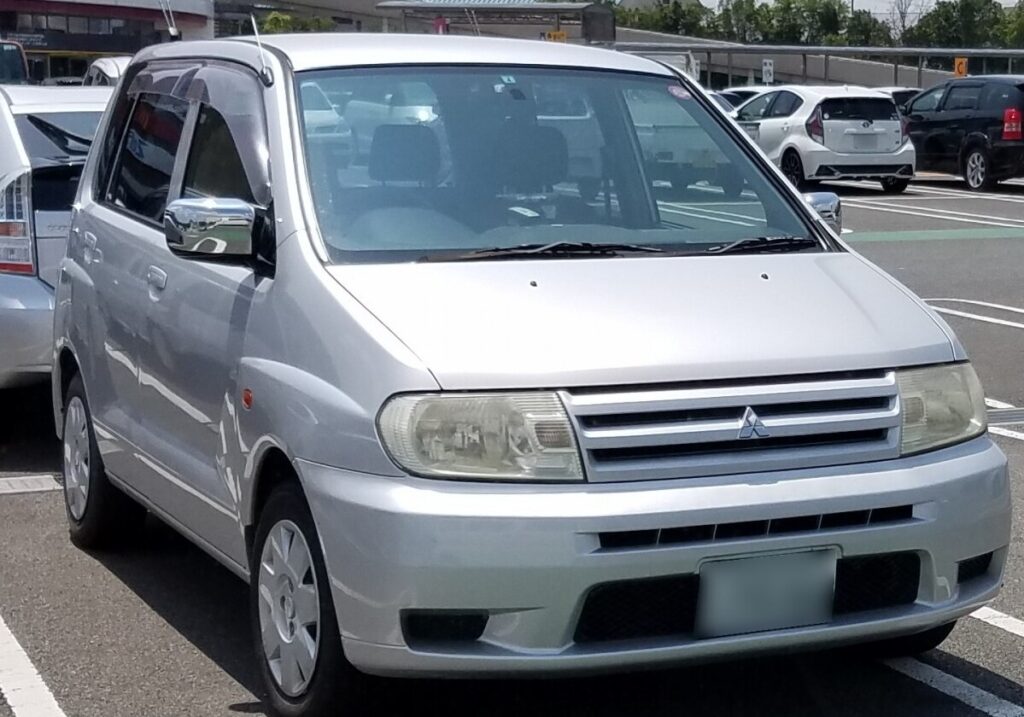
The Mitsubishi Dingo (CJ) 1.3 i 16V, produced between 1999 and 2002, was a compact hatchback marketed primarily in Japan. Positioned as an entry-level offering within the Dingo range, it represented a more affordable and fuel-efficient alternative to the higher-specification models. The Dingo itself was a unique vehicle, essentially a rebadged and significantly restyled version of the Citroën Xantia, a result of Mitsubishi’s then-partnership with the French automaker. This collaboration allowed Mitsubishi to offer a European-designed vehicle tailored to the Japanese market, blending French engineering with Japanese practicality and aesthetics. The 1.3L engine and automatic transmission combination was aimed at buyers prioritizing ease of use and economy over outright performance.
Technical Specifications
| Brand | Mitsubishi |
| Model | Dingo |
| Generation | Dingo (CJ) |
| Type (Engine) | 1.3 i 16V (80 Hp) |
| Start of production | 1999 year |
| End of production | 2002 year |
| Powertrain Architecture | Internal Combustion engine |
| Body type | Hatchback |
| Seats | 5 |
| Doors | 5 |
| Fuel Type | Petrol (Gasoline) |
| Weight-to-power ratio | 14.3 kg/Hp, 70.2 Hp/tonne |
| Weight-to-torque ratio | 9.7 kg/Nm, 103.5 Nm/tonne |
| Power | 80 Hp @ 5000 rpm |
| Power per litre | 61.6 Hp/l |
| Torque | 118 Nm @ 3000 rpm (87.03 lb.-ft. @ 3000 rpm) |
| Engine layout | Front, Transverse |
| Engine displacement | 1298 cm3 (79.21 cu. in.) |
| Number of cylinders | 4 |
| Engine configuration | Inline |
| Number of valves per cylinder | 4 |
| Fuel injection system | Multi-port manifold injection |
| Engine aspiration | Naturally aspirated engine |
| Valvetrain | OHC |
| Kerb Weight | 1140 kg (2513.27 lbs) |
| Max. weight | 1415 kg (3119.54 lbs) |
| Max load | 275 kg (606.27 lbs) |
| Fuel tank capacity | 50 l (13.21 US gal | 11 UK gal) |
| Length | 3905 mm (153.74 in) |
| Width | 1695 mm (66.73 in) |
| Height | 1635 mm (64.37 in) |
| Wheelbase | 2440 mm (96.06 in) |
| Front track | 1470 mm (57.87 in) |
| Rear (Back) track | 1470 mm (57.87 in) |
| Minimum turning circle | 9.4 m (30.84 ft) |
| Drivetrain Architecture | The Internal combustion engine (ICE) drives the front wheels of the vehicle. |
| Drive wheel | Front wheel drive |
| Number of gears and type of gearbox | 4 gears, automatic transmission |
| Front suspension | Coil spring |
| Rear suspension | Coil spring |
| Front brakes | Disc |
| Rear brakes | Drum |
| Steering type | Steering rack and pinion |
| Power steering | Hydraulic Steering |
| Tires size | 175/70 R14 |
Powertrain & Engine Architecture
The heart of the Dingo 1.3 i 16V is the 4G13 engine, a 1.3-liter inline-four cylinder gasoline engine. This engine utilizes a single overhead camshaft (OHC) valvetrain with four valves per cylinder, contributing to its relatively efficient operation. Fuel delivery is managed by a multi-point fuel injection system, ensuring precise fuel metering for optimal combustion. The engine produces 80 horsepower at 5000 rpm and 118 Nm (87 lb-ft) of torque at 3000 rpm. This engine, while not particularly powerful, was known for its reliability and relatively low fuel consumption. Paired with this engine is a four-speed automatic transmission. This transmission was a conventional hydraulic automatic, prioritizing smooth shifts over outright performance. It was chosen to appeal to drivers seeking a comfortable and convenient driving experience.
Driving Characteristics
The Dingo 1.3 i 16V with the automatic transmission offered a decidedly relaxed driving experience. Acceleration was modest, with the car prioritizing fuel efficiency over brisk performance. The four-speed automatic transmission, while smooth, lacked the responsiveness of a manual gearbox or a more modern automatic with additional gears. Gear ratios were tuned for economy, meaning the engine often felt strained during overtaking maneuvers or when climbing hills. Compared to the more powerful 1.6L or 1.8L variants, the 1.3L automatic was noticeably slower. However, it excelled in urban environments, where its compact size and easy-to-use transmission made it a practical choice for city driving. The steering was light and precise, making maneuvering in tight spaces effortless.
Equipment & Trim Levels
The 1.3 i 16V trim typically represented the base level of the Dingo range. Standard equipment generally included power steering, central locking, electric windows, and an AM/FM radio. Interior upholstery was typically cloth, with a simple and functional dashboard layout. Optional extras, depending on the year and specific package, could include air conditioning, alloy wheels, and a more advanced audio system. The interior, while not luxurious, was well-built and offered adequate space for five passengers. The focus was on practicality and affordability rather than premium features.
Chassis & Braking
The Dingo utilized a front-engine, front-wheel-drive layout. Suspension consisted of coil springs all around, providing a comfortable ride quality. The front brakes were disc brakes, offering adequate stopping power, while the rear brakes were drum brakes, a cost-saving measure common in this class of vehicle. The chassis was relatively lightweight, contributing to the car’s fuel efficiency. Stabilizer bars were present, helping to reduce body roll during cornering, but the overall handling was geared towards comfort rather than sporty dynamics.
Market Reception & Comparison
The Mitsubishi Dingo 1.3 i 16V was generally well-received in the Japanese market as an affordable and practical city car. Critics praised its fuel efficiency and ease of use, but noted its lack of outright performance. Compared to the higher-specification Dingo models, the 1.3L automatic offered significantly lower running costs but sacrificed performance and refinement. It competed with other Japanese compact hatchbacks, such as the Toyota Yaris (Vitz) and the Honda Fit (Jazz), offering a unique blend of European design and Japanese engineering. Reliability was generally good, although the automatic transmission could be prone to wear and tear with high mileage.
Legacy
The Mitsubishi Dingo, and specifically the 1.3 i 16V variant, has become a relatively sought-after vehicle among enthusiasts of Japanese domestic market (JDM) cars. Its unique styling, derived from the Citroën Xantia, and its reliable powertrain have contributed to its enduring appeal. While not a high-performance vehicle, the 1.3L automatic remains a practical and affordable option for those seeking a unique and well-built compact hatchback. Parts availability can be a challenge outside of Japan, but the engine and transmission are generally robust and can withstand years of use with proper maintenance. Today, well-maintained examples command a reasonable price in the used car market, reflecting their growing popularity among collectors and enthusiasts.
