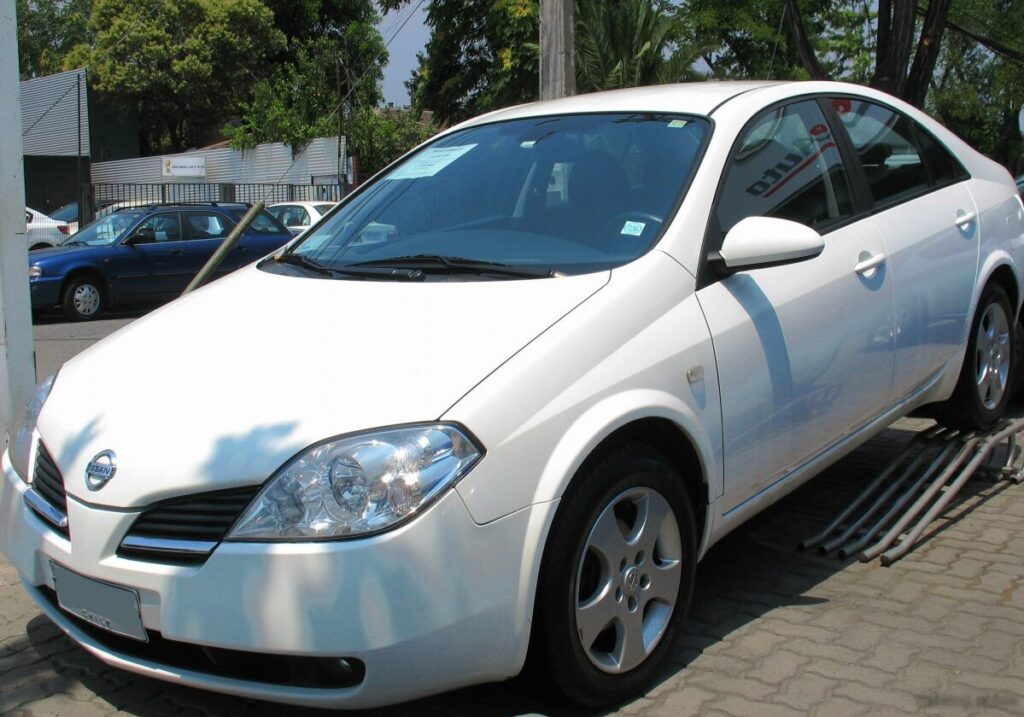
The Nissan Primera (P12) 1.9 dCi, producing 120 horsepower, was a significant offering in the European market from 2003 to 2006. Positioned as a mid-range trim level within the P12 Primera lineup, it aimed to balance fuel efficiency with respectable performance for drivers seeking a comfortable and practical family sedan. The P12 generation, built on the Nissan FF-L platform, represented a substantial evolution for the Primera, focusing on improved refinement and a more contemporary design compared to its predecessors. This variant specifically targeted buyers who prioritized diesel economy and torque for long-distance driving, while still desiring a reasonably equipped vehicle.
Technical Specifications
| Brand | Nissan |
| Model | Primera |
| Generation | Primera (P12) |
| Type (Engine) | 1.9 dCi (120 Hp) |
| Start of production | March, 2003 |
| End of production | April, 2006 |
| Powertrain Architecture | Internal Combustion engine |
| Body type | Sedan |
| Seats | 5 |
| Doors | 4 |
| Fuel consumption (urban) | 7.3 l/100 km (32.2 US mpg, 38.7 UK mpg, 13.7 km/l) |
| Fuel consumption (extra urban) | 4.8 l/100 km (49 US mpg, 58.9 UK mpg, 20.8 km/l) |
| Fuel consumption (combined) | 6.4 l/100 km (36.8 US mpg, 44.1 UK mpg, 15.6 km/l) |
| Fuel Type | Diesel |
| Acceleration 0 – 100 km/h | 10.8 sec |
| Acceleration 0 – 62 mph | 10.8 sec |
| Acceleration 0 – 60 mph | 10.3 sec |
| Maximum speed | 195 km/h (121.17 mph) |
| Weight-to-power ratio | 11.8 kg/Hp, 84.8 Hp/tonne |
| Weight-to-torque ratio | 5.2 kg/Nm, 190.8 Nm/tonne |
| Power | 120 Hp @ 4000 rpm |
| Power per litre | 64.2 Hp/l |
| Torque | 270 Nm @ 2000 rpm (199.14 lb.-ft. @ 2000 rpm) |
| Engine layout | Front, Transverse |
| Engine Model/Code | F9Q |
| Engine displacement | 1870 cm3 (114.11 cu. in.) |
| Number of cylinders | 4 |
| Engine configuration | Inline |
| Cylinder Bore | 80 mm (3.15 in.) |
| Piston Stroke | 93 mm (3.66 in.) |
| Compression ratio | 19:1 |
| Number of valves per cylinder | 2 |
| Fuel injection system | Diesel Commonrail |
| Engine aspiration | Turbocharger, Intercooler |
| Engine oil capacity | 4.66 l (4.92 US qt | 4.1 UK qt) |
| Coolant | 6.5 l (6.87 US qt | 5.72 UK qt) |
| Kerb Weight | 1415 kg (3119.54 lbs.) |
| Max. weight | 1940 kg (4276.97 lbs.) |
| Max load | 525 kg (1157.43 lbs.) |
| Trunk (boot) space – minimum | 450 l (15.89 cu. ft.) |
| Fuel tank capacity | 62 l (16.38 US gal | 13.64 UK gal) |
| Length | 4567 mm (179.8 in.) |
| Width | 1760 mm (69.29 in.) |
| Height | 1480 mm (58.27 in.) |
| Wheelbase | 2680 mm (105.51 in.) |
| Front track | 1530 mm (60.24 in.) |
| Rear (Back) track | 1535 mm (60.43 in.) |
| Drivetrain Architecture | The Internal combustion engine (ICE) drives the front wheels of the vehicle. |
| Drive wheel | Front wheel drive |
| Number of gears and type of gearbox | 6 gears, manual transmission |
| Front suspension | Double wishbone |
| Rear suspension | Coil spring |
| Front brakes | Ventilated discs |
| Rear brakes | Disc |
| Assisting systems | ABS (Anti-lock braking system) |
| Steering type | Steering rack and pinion |
| Power steering | Hydraulic Steering |
| Tires size | 205/60 R16 |
Powertrain & Engine Architecture
The heart of the Primera 1.9 dCi was the F9Q engine, a 1.9-liter inline-four cylinder diesel. This engine was a product of Renault’s diesel expertise, and was also used in other Nissan and Renault models. The F9Q featured a common rail direct injection system, delivering fuel at extremely high pressure for improved combustion efficiency and reduced emissions. A turbocharger with an intercooler was employed to boost power output and enhance torque across a wider rev range. The engine produced 120 horsepower at 4000 rpm and a substantial 270 Nm (199 lb-ft) of torque at just 2000 rpm. This torque characteristic was a key selling point for the dCi variant, providing strong pulling power for overtaking and effortless cruising. The engine’s 19:1 compression ratio was typical for a direct injection diesel, contributing to its thermal efficiency. The 6-speed manual transmission was the standard offering, providing well-spaced gear ratios to maximize the engine’s potential.
Driving Characteristics
The 1.9 dCi Primera offered a distinctly different driving experience compared to the petrol-powered variants. While lacking the outright acceleration of the higher-horsepower engines, the dCi excelled in providing strong, usable torque from low engine speeds. This made it a comfortable and relaxed cruiser, particularly well-suited for long journeys. The 6-speed gearbox allowed drivers to keep the engine within its optimal torque band, minimizing the need for frequent gear changes. The steering was light and precise, contributing to a pleasant driving experience. However, the diesel engine was noticeably louder than the petrol alternatives, and some turbo lag was present, although minimized by the turbocharger and intercooler. Compared to the 1.6L petrol engine, the 1.9 dCi offered significantly better fuel economy and a more relaxed driving style, but at the expense of some responsiveness.
Equipment & Trim Levels
The 1.9 dCi trim typically included air conditioning, power windows, central locking, and an integrated stereo system as standard equipment. Higher trim levels, often denoted by ‘SE’ or ‘Sport’ designations, added features such as alloy wheels, climate control, a trip computer, and upgraded interior trim. Interior upholstery was generally cloth, with options for leather available on higher-spec models. The dashboard layout was functional and ergonomically designed, with clear instrumentation and easy-to-use controls. Optional extras included a sunroof, parking sensors, and a CD changer.
Chassis & Braking
The Primera P12 featured a double wishbone front suspension and a coil spring rear suspension, providing a comfortable and controlled ride. The suspension was tuned to prioritize comfort over outright sportiness, making it well-suited for everyday driving. The 1.9 dCi variant, being a mid-range model, typically came equipped with ventilated front disc brakes and solid rear disc brakes. Anti-lock Braking System (ABS) was standard, enhancing braking performance and safety. The steering utilized a hydraulic power steering system, providing a light and responsive feel.
Market Reception & Comparison
The Nissan Primera 1.9 dCi was generally well-received by automotive critics for its fuel efficiency, comfortable ride, and strong torque output. It was often praised as a practical and sensible choice for drivers covering long distances. However, some critics noted the engine’s noise and the presence of some turbo lag. Compared to competitors such as the Ford Mondeo and Volkswagen Passat, the Primera offered a competitive package in terms of price, equipment, and fuel economy. The 1.9 dCi variant offered a compelling alternative to the petrol-powered models, particularly for those prioritizing running costs.
Legacy
The F9Q engine, used in the Primera 1.9 dCi, proved to be a relatively reliable unit when properly maintained. While common rail diesel engines can be susceptible to issues with fuel injectors and the high-pressure fuel pump, the F9Q generally demonstrated good longevity. Today, the Primera 1.9 dCi can be found as an affordable used car, offering a practical and economical transportation option. However, potential buyers should be aware of the age-related issues common to older vehicles, such as wear and tear on suspension components and potential corrosion. The Primera 1.9 dCi remains a testament to Nissan’s commitment to providing fuel-efficient and reliable vehicles for the European market.