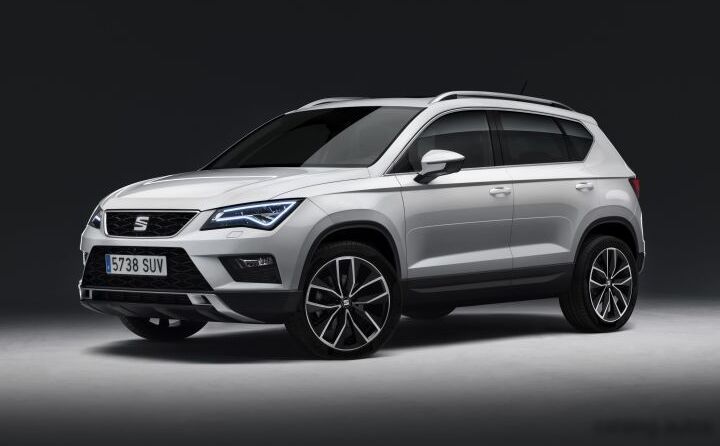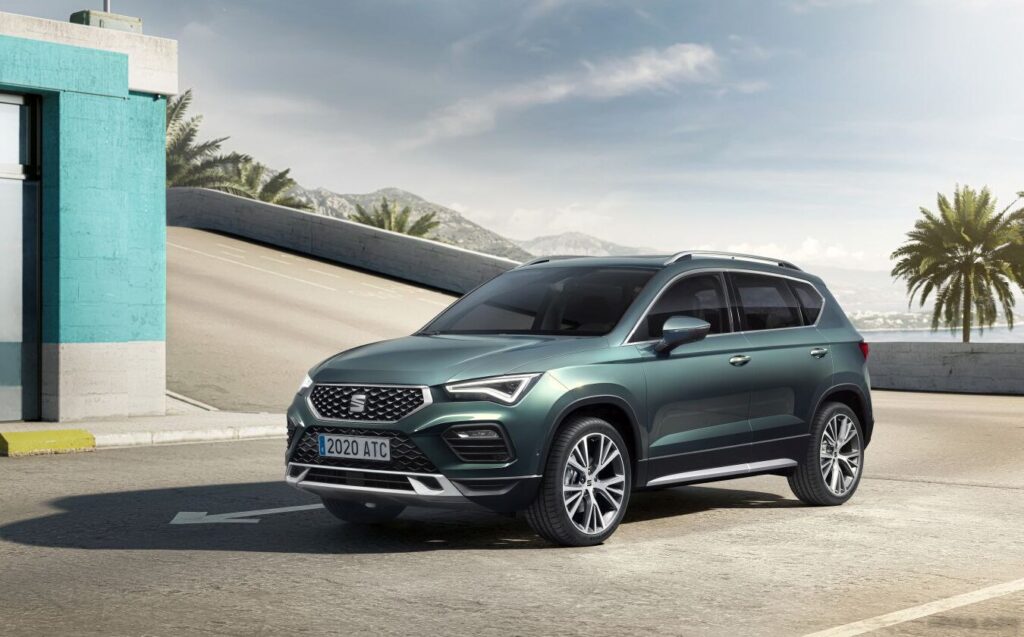
The Seat Ateca I (facelift, 2020) 1.0 TSI 110 hp represents an entry-level offering within the second generation of Seat’s popular compact SUV. Introduced in November 2020 as part of a mid-cycle refresh for the Ateca, this variant aimed to provide a more accessible price point and prioritize fuel efficiency within the Ateca range. Production continued through April 2024. Positioned below the more powerful 1.5 TSI and diesel options, the 1.0 TSI catered to buyers seeking a practical and economical family vehicle for primarily urban and suburban driving. It’s built on the Volkswagen Group’s MQB platform (A1), shared with models like the Volkswagen Tiguan, Skoda Karoq, and Audi Q3.
Technical Specifications
| Brand | Seat |
| Model | Ateca |
| Generation | Ateca I (facelift 2020) |
| Type (Engine) | 1.0 TSI (110 Hp) |
| Start of production | November, 2020 |
| End of production | April, 2024 |
| Powertrain Architecture | Internal Combustion engine |
| Body type | SUV |
| Seats | 5 |
| Doors | 5 |
| Fuel consumption at Low speed (WLTP) | 7.3-7.7 l/100 km (32.2 – 30.5 US mpg, 38.7 – 36.7 UK mpg, 13.7 – 13 km/l) |
| Fuel consumption at Medium speed (WLTP) | 5.7-6.3 l/100 km (41.3 – 37.3 US mpg, 49.6 – 44.8 UK mpg, 17.5 – 15.9 km/l) |
| Fuel consumption at high speed (WLTP) | 5.2-5.8 l/100 km (45.2 – 40.6 US mpg, 54.3 – 48.7 UK mpg, 19.2 – 17.2 km/l) |
| Fuel consumption at very high speed (WLTP) | 6.4-7.1 l/100 km (36.8 – 33.1 US mpg, 44.1 – 39.8 UK mpg, 15.6 – 14.1 km/l) |
| Combined fuel consumption (WLTP) | 5.9-6.8 l/100 km (39.9 – 34.6 US mpg, 47.9 – 41.5 UK mpg, 16.9 – 14.7 km/l) |
| CO2 emissions (WLTP) | 134-154 g/km |
| Fuel Type | Petrol (Gasoline) |
| Acceleration 0 – 100 km/h | 11.3 sec |
| Acceleration 0 – 62 mph | 11.3 sec |
| Acceleration 0 – 60 mph | 10.7 sec |
| Maximum speed | 180 km/h (111.85 mph) |
| Emission standard | Euro 6 AP |
| Weight-to-power ratio | 11.5 kg/Hp, 86.9 Hp/tonne |
| Weight-to-torque ratio | 6.3 kg/Nm, 158 Nm/tonne |
| Power | 110 Hp @ 5500 rpm |
| Power per litre | 110.1 Hp/l |
| Torque | 200 Nm @ 2000-3000 rpm (147.51 lb.-ft. @ 2000-3000 rpm) |
| Engine layout | Front, Transverse |
| Engine Model/Code | EA211 evo / DLAA |
| Engine displacement | 999 cm3 (60.96 cu. in.) |
| Number of cylinders | 3 |
| Engine configuration | Inline |
| Cylinder Bore | 74.5 mm (2.93 in.) |
| Piston Stroke | 76.4 mm (3.01 in.) |
| Compression ratio | 11.5:1 |
| Number of valves per cylinder | 4 |
| Fuel injection system | Direct injection |
| Engine aspiration | Turbocharger, Intercooler |
| Valvetrain | DOHC |
| Engine oil capacity | 4 l (4.23 US qt | 3.52 UK qt) |
| Kerb Weight | 1266-1275 kg (2791.05 – 2810.89 lbs.) |
| Max. weight | 1870-1890 kg (4122.64 – 4166.74 lbs.) |
| Max load | 604-615 kg (1331.59 – 1355.84 lbs.) |
| Trunk (boot) space – minimum | 510 l (18.01 cu. ft.) |
| Trunk (boot) space – maximum | 1604 l (56.64 cu. ft.) |
| Fuel tank capacity | 50 l (13.21 US gal | 11 UK gal) |
| Max. roof load | 75 kg (165.35 lbs.) |
| Permitted trailer load with brakes (8%) | 1500 kg (3306.93 lbs.) |
| Permitted trailer load with brakes (12%) | 1300 kg (2866.01 lbs.) |
| Permitted trailer load without brakes | 670 kg (1477.1 lbs.) |
| Permitted towbar download | 88 kg (194.01 lbs.) |
| Length | 4381 mm (172.48 in.) |
| Width | 1841 mm (72.48 in.) |
| Width including mirrors | 2078 mm (81.81 in.) |
| Height | 1615 mm (63.58 in.) |
| Wheelbase | 2638 mm (103.86 in.) |
| Front track | 1576 mm (62.05 in.) |
| Rear (Back) track | 1541 mm (60.67 in.) |
| Front overhang | 871 mm (34.29 in.) |
| Rear overhang | 872 mm (34.33 in.) |
| Minimum turning circle (turning diameter) | 10.8 m (35.43 ft.) |
| Drivetrain Architecture | The Internal combustion engine (ICE) drives the front wheels of the vehicle. |
| Drive wheel | Front wheel drive |
| Number of gears and type of gearbox | 6 gears, manual transmission |
| Front suspension | Independent, type McPherson with coil spring and anti-roll bar |
| Rear suspension | Semi-independent, coil spring |
| Front brakes | Ventilated discs, 288×25 mm |
| Rear brakes | Disc, 272×10 mm |
| Assisting systems | ABS (Anti-lock braking system) |
| Steering type | Steering rack and pinion |
| Power steering | Electric Steering |
| Tires size | 215/60 R16; 215/55 R17; 215/50 R18 |
| Wheel rims size | 6J x 16; 7J x 17; 7J x 18 |
INTRODUCTION
The Seat Ateca I (facelift, 2020) 1.0 TSI 110 hp is a front-wheel-drive compact SUV that served as an accessible entry point into the Ateca lineup. The facelift brought styling updates, enhanced technology, and refined interior materials. This variant was primarily marketed in Europe, where smaller displacement engines are favored due to tax incentives and fuel costs. It offered a balance between practicality, affordability, and the elevated driving position characteristic of the SUV segment. The 1.0 TSI engine, part of Volkswagen Group’s EA211 engine family, was chosen for its efficiency and suitability for everyday driving.
Powertrain & Engine Architecture
At the heart of the Ateca 1.0 TSI is the EA211 evo three-cylinder, 999cc turbocharged gasoline engine, designated with the code DLAA. This engine utilizes direct fuel injection, delivering fuel directly into the combustion chamber for improved efficiency and power. The engine features a single scroll turbocharger with an intercooler to manage intake air temperature. The valvetrain employs a dual overhead camshaft (DOHC) configuration with four valves per cylinder. The engine produces 110 horsepower at 5500 rpm and 200 Nm (147.51 lb-ft) of torque between 2000 and 3000 rpm. The engine is paired with a 6-speed manual transmission, sending power to the front wheels. The engine also incorporates a Start & Stop system to further enhance fuel economy and reduce emissions, and is equipped with a particulate filter to minimize particulate matter emissions.
Driving Characteristics
The 1.0 TSI engine in the Ateca provides adequate performance for everyday driving, but it’s not designed for spirited acceleration. The 0-60 mph time of around 10.7 seconds reflects this. The turbocharger provides a noticeable boost in power, but the engine can feel strained when climbing hills or carrying a full load. The 6-speed manual transmission is well-matched to the engine, offering precise shifts and allowing the driver to keep the engine in its optimal power band. Compared to the more powerful 1.5 TSI or diesel variants, the 1.0 TSI feels less responsive and requires more gear changes. However, its lighter weight contributes to nimble handling in urban environments. The gear ratios are tuned for fuel efficiency, prioritizing economy over outright performance.
Equipment & Trim Levels
The Ateca 1.0 TSI typically came with a reasonable level of standard equipment. Base models included air conditioning, a touchscreen infotainment system with Apple CarPlay and Android Auto compatibility, alloy wheels, and a suite of safety features such as ABS, ESC (Electronic Stability Control), and multiple airbags. Higher trim levels, such as Style and Xcellence, added features like automatic climate control, parking sensors, a rear-view camera, and upgraded interior upholstery. Optional extras included a panoramic sunroof, adaptive cruise control, and a premium sound system. Interior upholstery was typically cloth, with leather options available on higher trims. The dashboard layout was consistent across the Ateca range, featuring a clean and modern design.
Chassis & Braking
The Ateca 1.0 TSI utilizes a McPherson strut front suspension and a semi-independent coil spring rear suspension. This setup provides a comfortable ride quality, absorbing bumps and imperfections in the road surface effectively. The front brakes are ventilated discs measuring 288x25mm, while the rear brakes are solid discs measuring 272x10mm. ABS (Anti-lock Braking System) is standard, providing enhanced braking performance in emergency situations. The Ateca’s chassis is tuned to prioritize stability and handling, offering a secure and predictable driving experience. Stabilizer bars are fitted to both the front and rear axles to reduce body roll during cornering.
Market Reception & Comparison
The Seat Ateca 1.0 TSI was generally well-received by automotive critics as a practical and economical choice within the compact SUV segment. It was praised for its fuel efficiency, comfortable ride, and spacious interior. However, some reviewers noted that the engine could feel underpowered, particularly when fully loaded or driving on steep inclines. Compared to the 1.5 TSI, the 1.0 TSI offered lower running costs but sacrificed performance. The diesel variants provided even better fuel economy but came with a higher purchase price and potential concerns about diesel emissions. The 1.0 TSI appealed to buyers who prioritized affordability and fuel efficiency over outright performance.
Legacy
The 1.0 TSI engine has proven to be a relatively reliable unit within the Volkswagen Group. While not without its occasional issues (such as timing chain wear in some early examples), it generally offers good long-term durability. On the used car market, the Ateca 1.0 TSI represents a good value proposition, offering a well-equipped and practical SUV at a competitive price. Maintenance costs are generally reasonable, and parts availability is good. The engine’s fuel efficiency and relatively low emissions make it an attractive option for buyers seeking an economical and environmentally conscious vehicle. The Ateca, in general, has established a reputation for being a well-built and reliable SUV, contributing to the continued demand for this variant in the used car market.