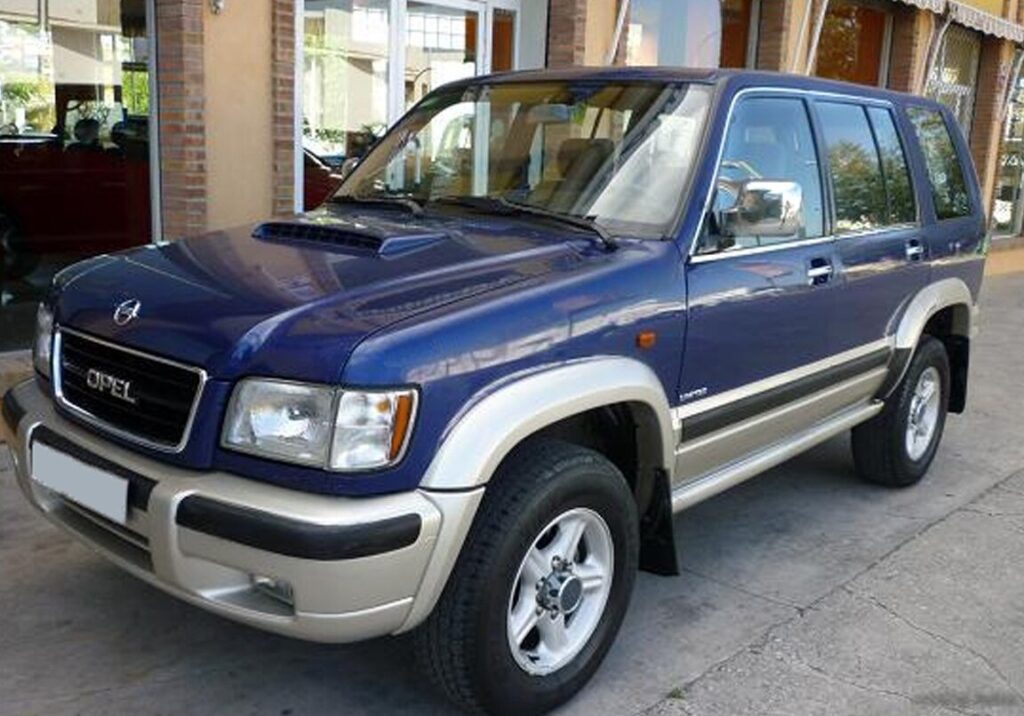
The Opel Monterey, particularly the facelifted version introduced in May 1998, represented Opel’s entry into the mid-size SUV segment. Produced through June 1999, the Monterey was largely based on the Isuzu Trooper, a result of GM’s partnership with Isuzu. The RS 3.0 DTI 4×4 variant, equipped with a 3.0-liter turbocharged diesel engine producing 159 horsepower, was positioned as the top-of-the-line model, offering a blend of off-road capability and on-road refinement. It aimed to appeal to buyers seeking a robust and spacious vehicle for both family transport and recreational activities. The Monterey, while not a massive sales success in Europe, provided Opel with a foothold in the growing SUV market.
Technical Specifications
| Brand | Opel |
| Model | Monterey |
| Generation | Monterey (facelift 1998) |
| Type (Engine) | RS 3.0 DTI (159 Hp) 4×4 |
| Start of production | May, 1998 |
| End of production | June, 1999 |
| Powertrain Architecture | Internal Combustion engine |
| Body type | SUV |
| Seats | 5 |
| Doors | 3 |
| Fuel consumption (urban) | 14 l/100 km (16.8 US mpg, 20.2 UK mpg, 7.1 km/l) |
| Fuel consumption (extra urban) | 9 l/100 km (26.1 US mpg, 31.4 UK mpg, 11.1 km/l) |
| Fuel Type | Diesel |
| Acceleration 0 – 100 km/h | 15.8 sec |
| Acceleration 0 – 62 mph | 15.8 sec |
| Acceleration 0 – 60 mph | 15 sec |
| Maximum speed | 160 km/h (99.42 mph) |
| Weight-to-power ratio | 12.4 kg/Hp, 80.9 Hp/tonne |
| Weight-to-torque ratio | 5.9 kg/Nm, 169.5 Nm/tonne |
| Power | 159 Hp @ 3900 rpm |
| Power per litre | 53 Hp/l |
| Torque | 333 Nm @ 2000 rpm (245.61 lb.-ft. @ 2000 rpm) |
| Engine layout | Front, Longitudinal |
| Engine Model/Code | 4JX1 |
| Engine displacement | 2999 cm3 (183.01 cu. in.) |
| Number of cylinders | 4 |
| Engine configuration | Inline |
| Cylinder Bore | 95.4 mm (3.76 in.) |
| Piston Stroke | 104.9 mm (4.13 in.) |
| Compression ratio | 19:1 |
| Number of valves per cylinder | 4 |
| Fuel injection system | Diesel Commonrail |
| Engine aspiration | Turbocharger |
| Valvetrain | DOHC |
| Engine oil capacity | 6 l (6.34 US qt | 5.28 UK qt) |
| Coolant | 8.6 l (9.09 US qt | 7.57 UK qt) |
| Kerb Weight | 1965 kg (4332.08 lbs.) |
| Max. weight | 2600 kg (5732.02 lbs.) |
| Max load | 635 kg (1399.94 lbs.) |
| Trunk (boot) space – minimum | 769 l (27.16 cu. ft.) |
| Trunk (boot) space – maximum | 2069 l (73.07 cu. ft.) |
| Fuel tank capacity | 85 l (22.45 US gal | 18.7 UK gal) |
| Length | 4365 mm (171.85 in.) |
| Width | 1835 mm (72.24 in.) |
| Height | 1830 mm (72.05 in.) |
| Wheelbase | 2330 mm (91.73 in.) |
| Front track | 1515 mm (59.65 in.) |
| Rear (Back) track | 1520 mm (59.84 in.) |
| Drive wheel | All wheel drive (4×4) |
| Number of gears and type of gearbox | 5 gears, manual transmission |
| Front suspension | Torsion |
| Rear suspension | Trailing arm |
| Front brakes | Ventilated discs |
| Rear brakes | Ventilated discs |
| Assisting systems | ABS (Anti-lock braking system), Hydraulic Steering |
| Tires size | 215/80 R16 |
| Wheel rims size | 16 |
Powertrain & Engine Architecture
The heart of the Monterey RS 3.0 DTI was the 4JX1, a 3.0-liter inline-four cylinder diesel engine. This engine, developed by Isuzu and shared with other GM vehicles, featured a robust cast iron block and aluminum cylinder head. The engine utilized a turbocharger with an intercooler to boost power output, and crucially, employed a Diesel Commonrail fuel injection system. This system, relatively new at the time, allowed for more precise fuel delivery, resulting in improved combustion efficiency, reduced noise, and lower emissions compared to older diesel injection technologies. The engine produced 159 horsepower at 3900 rpm and a substantial 333 Nm (245.61 lb.-ft.) of torque at 2000 rpm. The engine’s longitudinal mounting and the availability of a five-speed manual transmission (as equipped in this variant) contributed to its off-road capabilities. The 4JX1 engine was known for its durability, but also for its potential for turbo lag, a characteristic common in turbocharged diesel engines of the era.
Driving Characteristics
The Monterey RS 3.0 DTI 4×4, with its 159 hp and 333 Nm of torque, offered adequate, though not exhilarating, performance. Acceleration from 0 to 100 km/h (0-62 mph) took around 15.8 seconds, and top speed was limited to 160 km/h (99.42 mph). The manual transmission allowed for greater driver control, but the engine’s torque curve meant that most of the power was available in the mid-range. This made it well-suited for towing and off-road driving, where low-end grunt was more important than outright speed. Compared to the lower-powered versions of the Monterey, the RS 3.0 DTI provided a noticeable improvement in performance, particularly when fully loaded or tackling challenging terrain. However, it didn’t match the responsiveness of some of its gasoline-powered competitors. The 4×4 system, offering selectable four-wheel drive, enhanced traction on slippery surfaces.
Equipment & Trim Levels
The RS 3.0 DTI represented the highest trim level for the Monterey. Standard equipment included air conditioning, power windows, central locking, and an upgraded audio system. The interior featured cloth upholstery, although leather was available as an optional extra. The dashboard layout was functional but not particularly luxurious, reflecting the Monterey’s utilitarian focus. Optional extras included a sunroof, alloy wheels, and a more sophisticated sound system. The three-door body style limited rear passenger space compared to five-door SUVs, but the Monterey offered a generous cargo area, expandable by folding down the rear seats.
Chassis & Braking
The Monterey’s chassis was a body-on-frame construction, providing a robust and durable platform for off-road use. The front suspension utilized torsion bars, while the rear employed a trailing arm setup. This suspension configuration offered a reasonable balance between ride comfort and off-road capability. Braking duties were handled by ventilated discs on all four wheels, supplemented by an Anti-lock Braking System (ABS). The steering was hydraulically assisted, providing relatively light steering effort. The Monterey’s weight of 1965 kg (4332.08 lbs) contributed to its stable handling, but also limited its agility on paved roads.
Market Reception & Comparison
The Opel Monterey RS 3.0 DTI 4×4 received mixed reviews from automotive critics. While its off-road capability and spacious interior were praised, its relatively slow acceleration and somewhat agricultural diesel engine were points of criticism. Compared to other SUVs in its class, such as the Toyota Land Cruiser or the Mitsubishi Pajero, the Monterey offered a more affordable price point but lacked the same level of refinement. Fuel economy was reasonable for a vehicle of its size and type, averaging around 14 l/100 km (16.8 US mpg) in urban driving and 9 l/100 km (26.1 US mpg) on the highway. Reliability was generally good, although some owners reported issues with the turbocharger and fuel injection system.
Legacy
The Opel Monterey, while not a long-lived model, remains a relatively sought-after vehicle among enthusiasts and off-roaders. The 4JX1 diesel engine, when properly maintained, proved to be durable and long-lasting. Today, the Monterey RS 3.0 DTI 4×4 can be found in the used car market at relatively affordable prices. Its robust construction, four-wheel drive capability, and spacious interior make it a practical choice for those seeking a capable and reliable SUV for recreational purposes. However, potential buyers should be aware of the age-related issues common to older vehicles, such as corrosion and wear and tear on suspension components. The Monterey represents a unique chapter in Opel’s history, marking its foray into the increasingly popular SUV segment.