
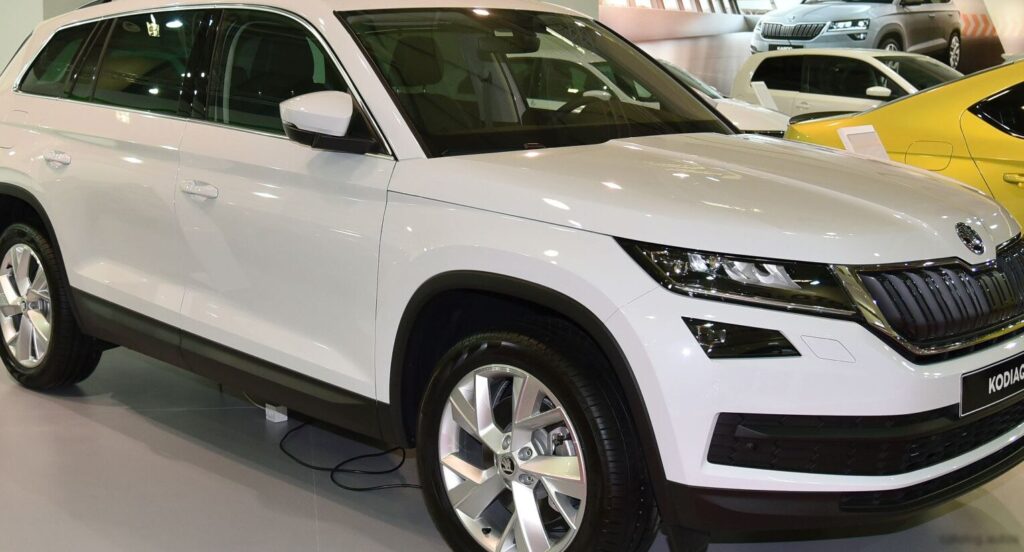
The Skoda Kodiaq, launched in 2016, marked Skoda’s entry into the highly competitive mid-size SUV segment. The Kodiaq I, produced from 2016 to 2021, quickly gained popularity in Europe, offering a compelling combination of practicality, space, and value. The 2.0 TDI 177 horsepower (Hp) 4×4 DSG 7-seat variant, introduced in 2018, occupied a mid-to-upper position within the Kodiaq lineup, appealing to families and drivers needing all-weather capability and ample passenger space. This model aimed to provide a balance between performance, fuel efficiency, and the versatility of a seven-passenger vehicle.
Technical Specifications
| Brand | Skoda |
| Model | Kodiaq |
| Generation | Kodiaq I |
| Type | 2.0 TDI (177 Hp) 4×4 DSG 7 Seat |
| Start of production | 2018 |
| End of production | April, 2021 |
| Powertrain Architecture | Internal Combustion engine |
| Body type | SUV |
| Seats | 7 |
| Doors | 5 |
| Fuel Type | Diesel |
| Acceleration 0 – 100 km/h | 8.8 sec |
| Acceleration 0 – 62 mph | 8.8 sec |
| Acceleration 0 – 60 mph | 8.4 sec |
| Maximum speed | 203 km/h (126.14 mph) |
| Weight-to-power ratio | 9.9 kg/Hp, 101.1 Hp/tonne |
| Weight-to-torque ratio | 4.6 kg/Nm, 217.1 Nm/tonne |
| Power | 177 Hp @ 3500-4000 rpm |
| Power per litre | 89.9 Hp/l |
| Torque | 380 Nm @ 1750-3000 rpm (280.27 lb.-ft. @ 1750-3000 rpm) |
| Engine layout | Front, Transverse |
| Engine Model/Code | EA288 / CRGB |
| Engine displacement | 1968 cm3 (120.09 cu. in.) |
| Number of cylinders | 4 |
| Engine configuration | Inline |
| Number of valves per cylinder | 4 |
| Fuel injection system | Diesel Commonrail |
| Engine aspiration | Turbocharger, Intercooler |
| Engine oil capacity | 4.7 l (4.97 US qt | 4.14 UK qt) |
| Coolant | 8 l (8.45 US qt | 7.04 UK qt) |
| Kerb Weight | 1750 kg (3858.09 lbs) |
| Fuel tank capacity | 60 l (15.85 US gal | 13.2 UK gal) |
| Length | 4697 mm (184.92 in) |
| Width | 1882 mm (74.09 in) |
| Width including mirrors | 2087 mm (82.17 in) |
| Height | 1659 mm (65.31 in) |
| Wheelbase | 2791 mm (109.88 in) |
| Front track | 1586 mm (62.44 in) |
| Rear track | 1576 mm (62.05 in) |
| Ride height (ground clearance) | 191-192 mm (7.52 – 7.56 in) |
| Minimum turning circle | 11.6 m (38.06 ft) |
| Drive wheel | All wheel drive (4×4) |
| Number of gears and type of gearbox | 7 gears, automatic transmission DSG |
| Front suspension | Independent, type McPherson with coil spring and anti-roll bar |
| Rear suspension | Independent multi-link suspension |
| Front brakes | Ventilated discs |
| Rear brakes | Disc |
| Tires size | 215/65 R17 |
| Wheel rims size | 17 |
Powertrain & Engine Architecture
The heart of the Kodiaq 2.0 TDI 177 Hp is the Volkswagen Group’s EA288 engine family. Specifically, the CRGB engine code designates a 2.0-liter four-cylinder diesel engine. This engine utilizes a common rail direct injection system, delivering fuel at extremely high pressures for optimized combustion. A turbocharger with an intercooler is employed to boost power and torque, providing a broader powerband. The engine features four valves per cylinder, contributing to efficient gas exchange. The 177 Hp output is achieved through careful calibration of the engine management system. Paired with this engine is a seven-speed dual-clutch transmission (DSG). The DSG provides quick and smooth gear changes, enhancing both performance and fuel economy. The 4×4 system is a sophisticated all-wheel-drive setup, utilizing a multi-plate clutch to distribute torque between the front and rear axles as needed, providing enhanced traction in various conditions.
Driving Characteristics
The 2.0 TDI 177 Hp with the DSG automatic transmission delivers a comfortable and capable driving experience. Acceleration from 0-60 mph in around 8.4 seconds is respectable for a mid-size SUV, though noticeably slower than the petrol-powered variants or those equipped with more powerful diesel engines. The DSG transmission is a key contributor to the driving feel, offering seamless shifts and keeping the engine within its optimal power range. The 380 Nm (280 lb-ft) of torque, available from 1750-3000 rpm, provides ample pulling power for everyday driving and towing. The all-wheel-drive system inspires confidence in slippery conditions, providing enhanced stability and grip. Compared to the lower-powered 1.6 TDI Kodiaq, the 2.0 TDI offers a significant improvement in performance, particularly when fully loaded or tackling inclines. However, it doesn’t possess the outright sportiness of the petrol-powered models.
Equipment & Trim Levels
The 2.0 TDI 177 Hp 4×4 DSG 7-seat variant typically came well-equipped, reflecting its position as a mid-range to upper-mid-range trim. Standard features often included alloy wheels, automatic climate control, a touchscreen infotainment system with Apple CarPlay and Android Auto compatibility, parking sensors, and a suite of safety features like ABS, ESC, and multiple airbags. Interior upholstery was typically cloth or a combination of cloth and leatherette. Optional extras included leather seats, a panoramic sunroof, adaptive cruise control, a premium sound system, and a tow hitch. The seven-seat configuration provided flexibility for families, although the third-row seats were best suited for children or shorter adults.
Chassis & Braking
The Kodiaq I utilizes a robust chassis designed to handle the weight and dimensions of the vehicle. The front suspension employs a McPherson strut setup with coil springs and an anti-roll bar, while the rear features an independent multi-link suspension. This configuration provides a good balance between ride comfort and handling. Braking duties are handled by ventilated discs at the front and solid discs at the rear. The ABS (Anti-lock Braking System) and ESC (Electronic Stability Control) are standard features, enhancing safety and control. The suspension tuning is geared towards comfort, prioritizing a smooth ride over sporty handling. Stabilizer bar thickness was tuned to balance body roll with ride quality.
Market Reception & Comparison
The Skoda Kodiaq 2.0 TDI 177 Hp 4×4 DSG received generally positive reviews from automotive critics. It was praised for its spacious interior, comfortable ride, and strong diesel engine. Fuel economy was a key selling point, with the 2.0 TDI achieving respectable figures for a vehicle of its size and capability. Compared to the lower-powered 1.6 TDI Kodiaq, the 2.0 TDI offered a noticeable performance improvement, making it a more suitable choice for drivers who frequently carry passengers or tow trailers. However, some critics noted that the DSG transmission could occasionally feel hesitant at low speeds. Compared to competitors like the Nissan X-Trail and Hyundai Santa Fe, the Kodiaq offered a compelling value proposition, often undercutting them on price while offering similar levels of equipment and practicality.
Legacy
The EA288 engine family, including the CRGB variant found in the Kodiaq 2.0 TDI, has proven to be relatively reliable, although preventative maintenance is crucial. Regular oil changes and adherence to the manufacturer’s service schedule are essential to avoid potential issues with the diesel particulate filter (DPF) and turbocharger. The DSG transmission, while generally robust, can require servicing at specific intervals to ensure smooth operation. On the used car market, the Kodiaq 2.0 TDI 177 Hp 4×4 DSG remains a popular choice, offering a practical and well-equipped SUV at a competitive price. Its reputation for reliability and spaciousness continues to attract buyers looking for a versatile family vehicle.
