
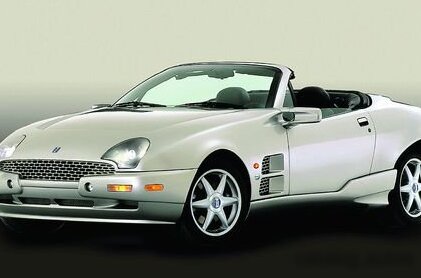
The Qvale Mangusta was a short-lived but striking Italian-American sports car produced between 1999 and 2002. A collaboration between Italian design house Atelier Alesi and American businessman Bruce Qvale, the Mangusta aimed to blend Italian flair with American V8 power. It was positioned as a high-performance, two-seat roadster, competing with established marques like Porsche and Ferrari in the upper echelon of the sports car market. The car was initially unveiled in 1999 and production continued until 2002, with approximately 282 examples built. The name “Mangusta” (Italian for mongoose) was a nod to the classic De Tomaso Mangusta of the 1960s and 70s, though the two cars share little beyond the name and general concept.
Technical Specifications
| Brand | Qvale |
| Model | Mangusta |
| Generation | Mangusta |
| Type (Engine) | 4.6 i V8 32V (322 Hp) |
| Start of production | 1999 |
| End of production | 2002 |
| Powertrain Architecture | Internal Combustion engine |
| Body type | Cabriolet |
| Seats | 2 |
| Doors | 2 |
| Fuel consumption (urban) | 21.3 l/100 km (11 US mpg, 13.3 UK mpg, 4.7 km/l) |
| Fuel consumption (extra urban) | 11.4 l/100 km (20.6 US mpg, 24.8 UK mpg, 8.8 km/l) |
| Fuel Type | Petrol (Gasoline) |
| Acceleration 0 – 100 km/h | 5.8 sec |
| Acceleration 0 – 62 mph | 5.8 sec |
| Acceleration 0 – 60 mph | 5.5 sec |
| Maximum speed | 260 km/h (161.56 mph) |
| Weight-to-power ratio | 4.3 kg/Hp, 230 Hp/tonne |
| Weight-to-torque ratio | 3.3 kg/Nm, 303.6 Nm/tonne |
| Power | 322 Hp @ 6000 rpm |
| Power per litre | 70 Hp/l |
| Torque | 425 Nm @ 4800 rpm (313.46 lb.-ft. @ 4800 rpm) |
| Engine Model/Code | Modular |
| Engine displacement | 4601 cm3 (280.77 cu. in.) |
| Number of cylinders | 8 |
| Engine configuration | V-engine |
| Number of valves per cylinder | 4 |
| Fuel injection system | Multi-port manifold injection |
| Engine aspiration | Naturally aspirated engine |
| Valvetrain | DOHC |
| Engine oil capacity | 5.7 l (6.02 US qt | 5.02 UK qt) |
| Kerb Weight | 1400 kg (3086.47 lbs.) |
| Max. weight | 1670 kg (3681.72 lbs.) |
| Max load | 270 kg (595.25 lbs.) |
| Fuel tank capacity | 80 l (21.13 US gal | 17.6 UK gal) |
| Length | 4190 mm (164.96 in.) |
| Width | 1900 mm (74.8 in.) |
| Height | 1270 mm (50 in.) |
| Wheelbase | 2670 mm (105.12 in.) |
| Front track | 1590 mm (62.6 in.) |
| Rear track | 1590 mm (62.6 in.) |
| Number of gears and type of gearbox | 5 gears, manual transmission |
| Front suspension | Coil spring |
| Rear suspension | Coil spring |
| Front brakes | Ventilated discs |
| Rear brakes | Ventilated discs |
| Assisting systems | ABS (Anti-lock braking system) |
| Tires size | 225/45 R17 |
| Wheel rims size | 17 |
Powertrain & Engine Architecture
The heart of the Qvale Mangusta was a 4.6-liter Modular V8 engine, sourced from Ford. This engine, also found in various Ford and Lincoln vehicles of the era (like the Mustang GT and Lincoln Mark VIII), was chosen for its readily available power and relatively compact size. The engine featured a 32-valve dual overhead camshaft (DOHC) design and multi-port fuel injection. It produced 322 horsepower at 6000 rpm and 425 Nm (313 lb-ft) of torque at 4800 rpm. The engine’s architecture was a 90-degree V8, known for its inherent balance and smooth operation. The Mangusta exclusively came with a 5-speed manual transmission, providing a direct connection between the engine and the rear wheels. The transmission was sourced from Tremec, a well-respected manufacturer of performance gearboxes.
Driving Characteristics
The Mangusta’s driving experience was heavily influenced by its potent V8 engine and relatively lightweight construction. Acceleration was brisk, with 0-60 mph times consistently in the mid-5-second range. The 5-speed manual transmission offered precise shifts, and the rear-wheel-drive layout provided a traditional sports car feel. The suspension, utilizing coil springs all around, was tuned for a balance between comfort and handling. While not as razor-sharp as some European sports cars, the Mangusta offered a compliant ride suitable for both spirited driving and longer journeys. The power delivery was linear and predictable, making the car accessible to drivers of varying skill levels. The lack of traction control meant that careful throttle modulation was required, especially in wet conditions.
Equipment & Trim Levels
The Qvale Mangusta was relatively well-equipped, even by the standards of the early 2000s. Standard features included leather upholstery, air conditioning, power windows and locks, and an Alpine stereo system. The interior design was minimalist and driver-focused, with a prominent center console and well-placed controls. Optional extras included a premium sound system, upgraded wheels, and various cosmetic enhancements. The interior was available in a range of colors, allowing buyers to personalize their vehicles. The dashboard featured a combination of analog gauges and a digital display providing information such as speed, engine rpm, and coolant temperature.
Chassis & Braking
The Mangusta utilized a steel space frame chassis, providing a rigid and lightweight foundation for the vehicle. The suspension consisted of independent coil springs at all four corners. Braking duties were handled by ventilated disc brakes on all four wheels, providing ample stopping power. An Anti-lock Braking System (ABS) was standard, enhancing safety and control during hard braking. The car rode on 17-inch wheels, fitted with 225/45 R17 tires. The suspension geometry was tuned to minimize body roll and maximize grip, contributing to the car’s balanced handling characteristics.
Market Reception & Comparison
The Qvale Mangusta received mixed reviews from automotive critics. While praised for its striking design, powerful engine, and engaging driving experience, it was also criticized for its relatively high price and limited production run. Compared to its rivals, such as the Porsche Boxster and BMW Z8, the Mangusta offered a more raw and visceral driving experience, but lacked the established brand recognition and refinement of its competitors. Fuel economy was also a concern, with the V8 engine consuming a significant amount of gasoline. Reliability was generally good, although sourcing parts could be challenging due to the car’s limited production and reliance on Ford components.
Legacy
The Qvale Mangusta, despite its short production run, has gained a cult following among automotive enthusiasts. Its unique design and powerful V8 engine have made it a desirable collectible. The car’s relatively simple mechanicals, based on readily available Ford components, make it relatively easy to maintain, although finding specialized parts can still be a challenge. Today, the Mangusta represents a unique chapter in automotive history – a bold attempt to combine Italian design with American muscle. Values have been steadily increasing in recent years, reflecting the car’s growing desirability and rarity. The Mangusta serves as a reminder of a time when independent automakers dared to challenge the established order and create truly distinctive vehicles.
