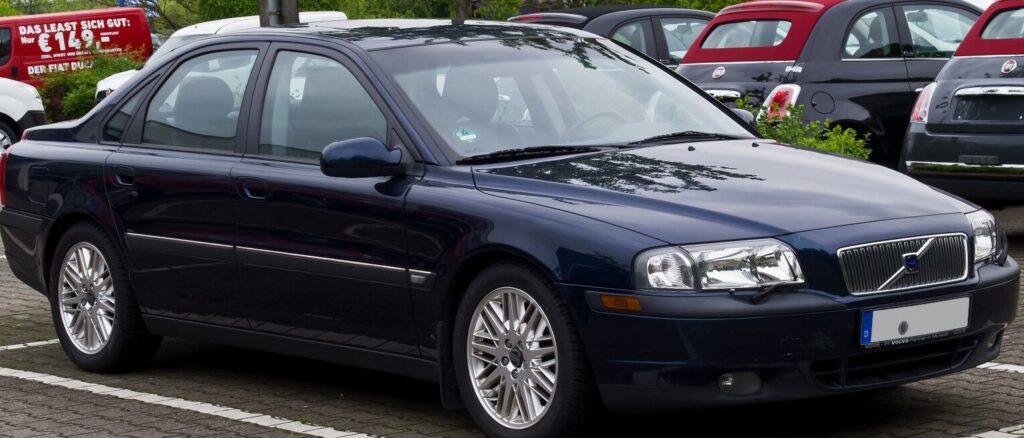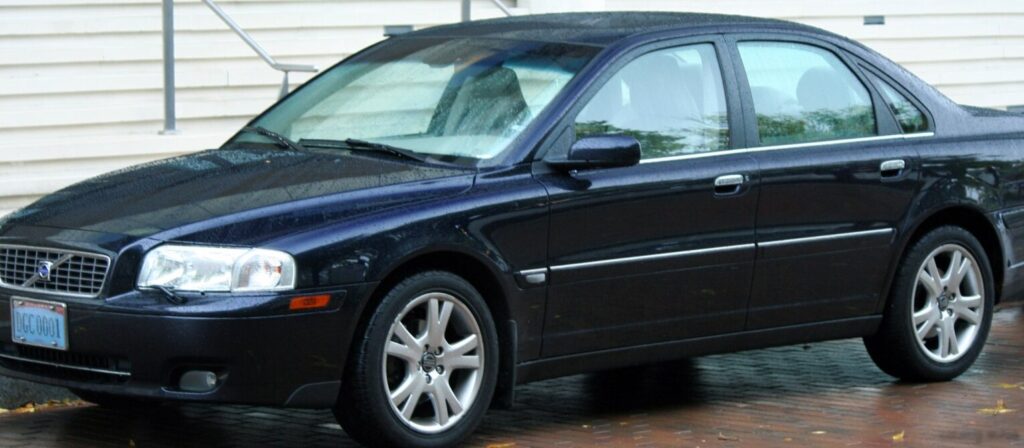
The Volvo S80 2.4 20V (140 hp) represents a significant iteration of Volvo’s flagship sedan, produced from 2003 to 2006 as part of the second-generation S80 (facelift). This variant occupied a middle-ground position within the S80 lineup, offering a balance between performance and affordability. It aimed to provide comfortable, safe transportation for families and business travelers, leveraging Volvo’s reputation for reliability and Scandinavian design. The S80, in general, was Volvo’s attempt to compete directly with established luxury sedans from German manufacturers like BMW, Mercedes-Benz, and Audi, and the 2.4-liter model was a key volume seller in many European and North American markets.
Technical Specifications
| Brand | Volvo |
| Model | S80 |
| Generation | S80 (facelift 2003) |
| Type (Engine) | 2.4 20V (140 Hp) |
| Start of production | 2003 |
| End of production | 2006 |
| Powertrain Architecture | Internal Combustion engine |
| Body type | Sedan |
| Seats | 5 |
| Doors | 4 |
| Fuel consumption (urban) | 12.6 l/100 km (18.7 US mpg, 22.4 UK mpg, 7.9 km/l) |
| Fuel consumption (extra urban) | 6.9 l/100 km (34.1 US mpg, 40.9 UK mpg, 14.5 km/l) |
| Fuel consumption (combined) | 9 l/100 km (26.1 US mpg, 31.4 UK mpg, 11.1 km/l) |
| CO2 emissions | 215 g/km |
| Fuel Type | Petrol (Gasoline) |
| Acceleration 0 – 100 km/h | 10.5 sec |
| Acceleration 0 – 62 mph | 10.5 sec |
| Acceleration 0 – 60 mph | 10 sec |
| Maximum speed | 205 km/h (127.38 mph) |
| Emission standard | Euro 4 |
| Weight-to-power ratio | 10.9 kg/Hp, 92 Hp/tonne |
| Weight-to-torque ratio | 6.9 kg/Nm, 144.6 Nm/tonne |
| Power | 140 Hp @ 4500 rpm |
| Power per litre | 57.5 Hp/l |
| Torque | 220 Nm @ 3300 rpm (162.26 lb.-ft. @ 3300 rpm) |
| Engine layout | Front, Transverse |
| Engine Model/Code | B5244S2 |
| Engine displacement | 2435 cm3 (148.59 cu. in.) |
| Number of cylinders | 5 |
| Engine configuration | Inline |
| Cylinder Bore | 83 mm (3.27 in.) |
| Piston Stroke | 90 mm (3.54 in.) |
| Compression ratio | 10.3:1 |
| Number of valves per cylinder | 4 |
| Fuel injection system | Multi-port manifold injection |
| Engine aspiration | Naturally aspirated engine |
| Valvetrain | DOHC |
| Engine oil capacity | 5.5 l (5.81 US qt | 4.84 UK qt) |
| Coolant | 8 l (8.45 US qt | 7.04 UK qt) |
| Kerb Weight | 1521 kg (3353.23 lbs.) |
| Max. weight | 2020 kg (4453.34 lbs.) |
| Max load | 499 kg (1100.11 lbs.) |
| Trunk (boot) space – minimum | 460 l (16.24 cu. ft.) |
| Trunk (boot) space – maximum | 1126 l (39.76 cu. ft.) |
| Fuel tank capacity | 70 l (18.49 US gal | 15.4 UK gal) |
| Max. roof load | 100 kg (220.46 lbs.) |
| Permitted trailer load with brakes (12%) | 1800 kg (3968.32 lbs.) |
| Permitted trailer load without brakes | 750 kg (1653.47 lbs.) |
| Permitted towbar download | 75 kg (165.35 lbs.) |
| Length | 4822 mm (189.84 in.) |
| Width | 1832 mm (72.13 in.) |
| Height | 1452 mm (57.17 in.) |
| Wheelbase | 2791 mm (109.88 in.) |
| Front track | 1570 mm (61.81 in.) |
| Rear (Back) track | 1548 mm (60.94 in.) |
| Front overhang | 964 mm (37.95 in.) |
| Rear overhang | 1067 mm (42.01 in.) |
| Minimum turning circle (turning diameter) | 11.6 m (38.06 ft.) |
| Drivetrain Architecture | The Internal combustion engine (ICE) drives the front wheels of the vehicle. |
| Drive wheel | Front wheel drive |
| Number of gears and type of gearbox | 5 gears, manual transmission |
| Front suspension | Independent type McPherson |
| Rear suspension | Independent multi-link suspension |
| Front brakes | Ventilated discs |
| Rear brakes | Disc |
| Assisting systems | ABS (Anti-lock braking system) |
| Steering type | Steering rack and pinion |
| Power steering | Hydraulic Steering |
| Tires size | 215/55 R16; 225/50 R17 |
| Wheel rims size | 7J x 16; 7J x 17 |
INTRODUCTION
The Volvo S80 2.4 20V (140 hp), produced between 2003 and 2006, was a facelifted version of the second-generation S80, internally designated as the 1HX0 platform. This update brought revised styling, improved safety features, and refinements to the interior. The 2.4-liter engine, identified by the B5244S2 engine code, was a mainstay of the S80 range, offering a compromise between performance and fuel economy. It was positioned as an accessible entry point into the S80 lineup, appealing to buyers who prioritized comfort and safety over outright speed. This model aimed to provide a premium experience without the higher price tag of the more powerful T6 variants.
Powertrain & Engine Architecture
The heart of the S80 2.4 is Volvo’s naturally aspirated, 2.4-liter inline-five cylinder engine (B5244S2). This engine is characterized by its smooth operation and relatively robust construction. It features a double overhead camshaft (DOHC) valvetrain with 20 valves (four per cylinder) and multi-port fuel injection. The engine’s 140 horsepower peak is achieved at 4500 rpm, while its 220 Nm (162 lb-ft) of torque is available at 3300 rpm. The engine’s transverse mounting and front-wheel drive configuration were standard for this generation of S80. The 2.4-liter engine was typically paired with a 5-speed automatic transmission, although a 5-speed manual was also available in some markets. The automatic transmission was designed for smooth shifts and comfortable cruising, prioritizing ease of use over sporty responsiveness.
Driving Characteristics
The S80 2.4 with the automatic transmission delivers a comfortable and refined driving experience. Acceleration from 0-60 mph takes around 10 seconds, which is adequate for everyday driving but doesn’t offer particularly brisk performance. The automatic transmission’s gear ratios are tuned for fuel efficiency and smooth cruising, rather than aggressive acceleration. Compared to the more powerful T6 models with their turbocharged engines, the 2.4 feels noticeably less responsive. However, the 2.4’s linear power delivery makes it predictable and easy to control. The suspension is tuned for comfort, absorbing bumps and imperfections in the road well. Steering is light and precise, making the S80 easy to maneuver in urban environments.
Equipment & Trim Levels
The S80 2.4 typically came equipped with a generous array of standard features, reflecting Volvo’s commitment to safety and comfort. These included power windows, power locks, air conditioning, a CD stereo system, and ABS brakes. Higher trim levels added features such as leather upholstery, heated front seats, a sunroof, and upgraded audio systems. Optional extras included navigation systems, premium sound systems, and parking sensors. Interior upholstery was typically cloth on the base models, with leather available as an upgrade. The dashboard layout was clean and functional, with a focus on ergonomics and ease of use.
Chassis & Braking
The S80 2.4 utilizes an independent McPherson strut suspension at the front and an independent multi-link suspension at the rear. This setup provides a good balance between ride comfort and handling. The front brakes are ventilated discs, while the rear brakes are solid discs. ABS (Anti-lock Braking System) is standard, enhancing braking performance and stability. The chassis is designed to provide a stable and secure driving experience, with a focus on minimizing body roll and maximizing grip. Stabilizer bars are fitted to both the front and rear axles to further improve handling.
Market Reception & Comparison
The S80 2.4 was generally well-received by critics as a comfortable, safe, and reliable family sedan. However, it was often criticized for its relatively modest performance compared to its German rivals. Fuel economy was considered average for its class. Compared to the higher-output T6 models, the 2.4 offered a more affordable entry point into the S80 range, but at the expense of performance. The 2.4 was also seen as a more sensible choice than the diesel variants, particularly in markets where gasoline fuel quality was a concern. Its main competitors included the BMW 5 Series, Mercedes-Benz E-Class, and Audi A6.
Legacy
The Volvo S80 2.4 20V (140 hp) has proven to be a relatively reliable and durable vehicle. The B5244S2 engine is known for its longevity, and the automatic transmission is generally dependable. However, like all vehicles of this age, regular maintenance is essential to prevent issues. Common problems include oil leaks, worn suspension components, and electrical glitches. In the used car market, the S80 2.4 represents a good value proposition for buyers seeking a comfortable, safe, and well-equipped sedan at an affordable price. Its reputation for reliability and its relatively low running costs make it an attractive option for those looking for a practical and dependable vehicle.