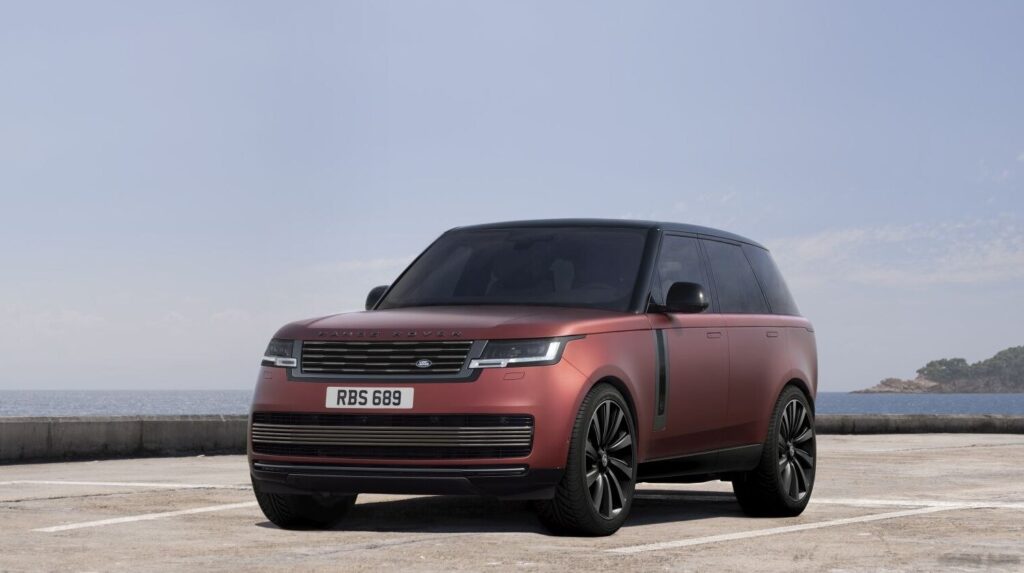
The Land Rover Range Rover V SWB SV 3.0 P510e represents a sophisticated entry into the luxury plug-in hybrid SUV market. Produced from January 2022 to May 2023, this variant sits within the fifth-generation Range Rover (L460) family, specifically the short wheelbase (SWB) SV trim level. It combines a 3.0-liter inline-six cylinder engine with an electric motor, delivering a total system output of 510 horsepower. This model aimed to provide a balance of performance, refinement, and electric driving capability, appealing to buyers seeking a premium SUV with reduced emissions.
Technical Specifications
| Brand | Land Rover |
| Model | Range Rover |
| Generation | Range Rover V SWB |
| Type (Engine) | SV 3.0 P510e (510 Hp) Plug-in Hybrid AWD Automatic |
| Start of production | January, 2022 |
| End of production | May, 2023 |
| Powertrain Architecture | PHEV (Plug-in Hybrid Electric Vehicle) |
| Body type | SUV |
| Seats | 5 |
| Doors | 5 |
| Combined fuel consumption (WLTP) | 0.87-0.92 l/100 km (270.4 – 255.7 US mpg, 324.7 – 307 UK mpg, 114.9 – 108.7 km/l) |
| CO2 emissions (WLTP) | 20-21 g/km |
| Fuel Type | Petrol / electricity |
| Acceleration 0 – 100 km/h | 5.5 sec |
| Acceleration 0 – 62 mph | 5.5 sec |
| Acceleration 0 – 60 mph | 5.2 sec |
| Maximum speed | 242 km/h (150.37 mph) |
| Emission standard | Euro 6d Final |
| Weight-to-power ratio | 5.4 kg/Hp, 186.5 Hp/tonne |
| Weight-to-torque ratio | 3.9 kg/Nm, 255.9 Nm/tonne |
| Gross battery capacity | 38.2 kWh |
| Net (usable) battery capacity | 31.8 kWh |
| Battery technology | Lithium-ion (Li-Ion) |
| Battery location | Below the floor, between front and rear seats |
| All-electric range (WLTP) | 113 km (70.21 mi) |
| Electric motor power | 143 Hp |
| Electric motor location | Between the combustion engine and the transmission |
| System power | 510 Hp |
| System torque | 700 Nm (516.29 lb.-ft.) |
| Power | 400 Hp |
| Power per litre | 133.5 Hp/l |
| Engine layout | Front, Longitudinal |
| Engine displacement | 2996 cm3 (182.83 cu. in.) |
| Number of cylinders | 6 |
| Engine configuration | Inline |
| Cylinder Bore | 83 mm (3.27 in.) |
| Piston Stroke | 92.29 mm (3.63 in.) |
| Compression ratio | 10.5:1 |
| Number of valves per cylinder | 4 |
| Fuel injection system | Direct injection |
| Engine aspiration | Turbocharger, Intercooler |
| Engine oil capacity | 9.4 l (9.93 US qt | 8.27 UK qt) |
| Kerb Weight | 2735 kg (6029.64 lbs.) |
| Trunk (boot) space – minimum | 725 l (25.6 cu. ft.) |
| Trunk (boot) space – maximum | 1841 l (65.01 cu. ft.) |
| Fuel tank capacity | 71.5 l (18.89 US gal | 15.73 UK gal) |
| Permitted trailer load with brakes (12%) | 2500 kg (5511.56 lbs.) |
| Permitted trailer load without brakes | 750 kg (1653.47 lbs.) |
| Length | 5058 mm (199.13 in.) |
| Width with mirrors folded | 2047 mm (80.59 in.) |
| Width including mirrors | 2209 mm (86.97 in.) |
| Height | 1870 mm (73.62 in.) |
| Wheelbase | 2997 mm (117.99 in.) |
| Front track | 1702 mm (67.01 in.) |
| Rear (Back) track | 1704 mm (67.09 in.) |
| Front overhang | 866 mm (34.09 in.) |
| Rear overhang | 1195 mm (47.05 in.) |
| Ride height (ground clearance) | 284 mm (11.18 in.) |
| Drag coefficient (Cd) | 0.317 |
| Minimum turning circle (turning diameter) | 11.37 m (37.3 ft.) |
| Approach angle | 32.1° |
| Departure angle | 29° |
| Ramp-over (brakeover) angle | 25.2° |
| Wading depth | 900 mm (35.43 in.) |
| Drivetrain Architecture | The Internal combustion engine (ICE) and the electric motor permanently drive the four wheels of the car with the ability to work in full electric or mixed mode. |
| Drive wheel | All wheel drive (4×4) |
| Number of gears and type of gearbox | 8 gears, automatic transmission |
| Front suspension | Double wishbone |
| Rear suspension | Independent multi-link suspension |
| Front brakes | Ventilated discs, 400 mm |
| Rear brakes | Ventilated discs, 370 mm |
| Steering type | Steering rack and pinion |
| Power steering | Electric Steering |
Powertrain & Engine Architecture
The heart of the P510e is Land Rover’s Ingenium 3.0-liter inline-six cylinder engine, designated as the P400. This engine utilizes a turbocharger and direct fuel injection to produce 400 horsepower. Crucially, it’s paired with a 38.2 kWh lithium-ion battery pack and a 143 horsepower electric motor integrated between the engine and the eight-speed automatic transmission. This configuration allows for both all-electric driving and a combined output of 510 horsepower and 700 Nm (516 lb-ft) of torque. The electric motor draws power from the battery pack, enabling a WLTP-certified all-electric range of 113 km (70.21 miles). The transmission is a ZF 8HP75 eight-speed automatic, known for its smooth shifts and efficiency. The powertrain management system intelligently blends power from the engine and motor, optimizing for performance or fuel economy depending on driving conditions.
Driving Characteristics
The 3.0 P510e delivers a markedly different driving experience compared to Range Rover models equipped with solely gasoline or diesel engines. In electric mode, the vehicle offers near-silent operation and instant torque, providing brisk acceleration for urban driving. When the engine engages, the transition is seamless. The combined output results in a 0-60 mph time of around 5.2 seconds. The eight-speed automatic transmission is well-tuned, providing smooth and responsive gear changes. While the added weight of the battery pack (approximately 450 kg) does slightly impact handling agility compared to lighter Range Rover variants, the sophisticated air suspension system effectively mitigates body roll and maintains a comfortable ride. The all-wheel-drive system provides excellent traction in various conditions.
Equipment & Trim Levels
As an SV trim level, the P510e came standard with a high level of luxury appointments. Standard features included premium leather upholstery, heated and ventilated front and rear seats, a panoramic sunroof, a Meridian sound system, and a comprehensive suite of driver-assistance technologies. The SV trim also allowed for extensive customization options, including unique paint colors, bespoke interior finishes, and personalized detailing. Optional extras included executive rear seating with massage functions, a rear entertainment system, and advanced off-road packages.
Chassis & Braking
The Range Rover V SWB SV utilizes a lightweight aluminum body structure. The suspension system consists of a double-wishbone front suspension and an independent multi-link rear suspension, both with air springs and adaptive dampers. This setup provides a comfortable ride and excellent off-road capability. The braking system features ventilated discs on all four wheels, with 400mm discs at the front and 370mm discs at the rear. The vehicle is equipped with ABS, electronic brake-force distribution, and brake assist.
Market Reception & Comparison
The Range Rover P510e was generally well-received by automotive critics. It was praised for its luxurious interior, refined driving experience, and impressive electric range. However, some reviewers noted the high price tag and the added weight of the battery pack. Compared to the Range Rover P400 (gasoline) and D350 (diesel) variants, the P510e offered lower running costs for drivers who frequently utilize the electric driving mode. The P510e also appealed to environmentally conscious buyers seeking a luxury SUV with reduced emissions.
Legacy
The Land Rover Range Rover V SWB SV 3.0 P510e represents a significant step in Land Rover’s electrification strategy. While production was relatively short-lived, the model demonstrated the brand’s ability to integrate plug-in hybrid technology into its flagship SUV. On the used car market, these models hold their value well, appealing to buyers seeking a luxurious and technologically advanced SUV with a degree of electric capability. The Ingenium powertrain, while complex, has proven to be relatively reliable, although regular maintenance and battery health monitoring are crucial for long-term ownership.