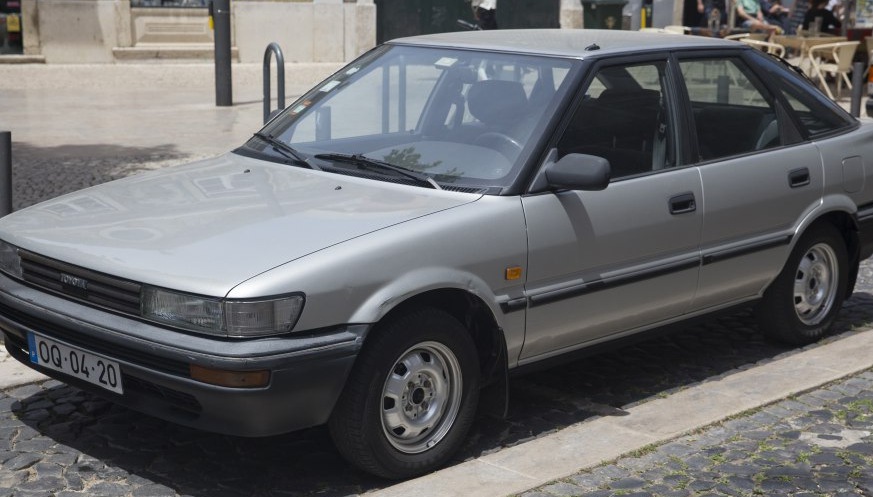
The Toyota Corolla Compact VI, designated the E90 series, represented a significant evolution of Toyota’s globally successful Corolla line. Produced between 1989 and 1992, the E90 shifted the Corolla towards a more modern and rounded aesthetic, while continuing its reputation for reliability and affordability. Within the E90 range, the 1.3 i (EE90) variant, powered by the 2E-E engine and producing 75 horsepower, served as the entry point into the Corolla lineup, particularly in European and Asian markets. This model was offered in both 3-door and 5-door hatchback configurations, catering to buyers seeking a practical and economical city car.
Technical Specifications
| Brand | Toyota |
| Model | Corolla |
| Generation | Corolla Compact VI (E90) |
| Type (Engine) | 1.3 i (EE90) (75 Hp) |
| Start of production | 1989 |
| End of production | 1992 |
| Powertrain Architecture | Internal Combustion engine |
| Body type | Hatchback |
| Seats | 5 |
| Doors | 3-5 |
| Fuel Type | Petrol (Gasoline) |
| Power | 75 Hp |
| Engine Model/Code | 2E-E |
| Engine aspiration | Naturally aspirated engine |
| Engine oil capacity | 3.2 l (3.38 US qt | 2.82 UK qt) |
| Coolant capacity | 4.9 l (5.18 US qt | 4.31 UK qt) |
Powertrain & Engine Architecture
The heart of the Corolla 1.3 i (EE90) was the 2E-E engine, a 1.3-liter (1298 cc) inline-four cylinder gasoline engine. This engine featured a single overhead camshaft (SOHC) valvetrain with eight valves. The 2E-E was known for its simplicity and durability, characteristics that contributed to the Corolla’s overall reliability. Fuel delivery was managed by a carburetor in many markets, though some later versions incorporated electronic fuel injection (EFI) for improved efficiency and emissions control. The engine’s modest 75 horsepower output was achieved at 6,000 rpm, with peak torque of approximately 88 lb-ft (120 Nm) at 3,600 rpm. The transmission paired with the 2E-E was typically a 4-speed automatic, though a 5-speed manual transmission was also available. The automatic transmission was designed for smooth, comfortable operation, prioritizing fuel economy over outright performance. It was a relatively conventional hydraulic automatic, lacking the electronic controls found in more modern transmissions.
Driving Characteristics
The 1.3 i automatic Corolla offered a comfortable, if uninspiring, driving experience. Acceleration was modest, with 0-60 mph times estimated around 13-15 seconds. The automatic transmission’s gear ratios were geared towards maximizing fuel efficiency, resulting in a somewhat sluggish response during overtaking maneuvers. However, for typical city driving, the powertrain proved adequate. The automatic transmission’s shift points were calibrated for smooth transitions, minimizing jerkiness. Compared to the 1.6-liter versions of the E90 Corolla, the 1.3 i felt noticeably less powerful, particularly when fully loaded or tackling inclines. The manual transmission offered a more engaging driving experience and slightly improved acceleration, but the automatic was favored by buyers prioritizing convenience.
Equipment & Trim Levels
The Corolla 1.3 i (EE90) typically represented the base trim level within the E90 range. Standard equipment generally included cloth upholstery, a basic stereo system, and manual windows and door locks. Power steering was often an optional extra, as was air conditioning. Interior trim was functional and durable, prioritizing practicality over luxury. The dashboard layout was straightforward and easy to use. Higher trim levels, such as the 1.6 Si, offered features like alloy wheels, upgraded interior trim, and more powerful audio systems. The 1.3 i was often seen as a blank canvas for buyers who wanted a reliable and affordable car that they could customize to their liking.
Chassis & Braking
The E90 Corolla utilized a front-engine, front-wheel-drive layout. Suspension consisted of MacPherson struts at the front and a torsion beam axle at the rear. This setup provided a comfortable ride, though handling was not particularly sporty. The 1.3 i models typically featured drum brakes on the rear wheels and disc brakes on the front, providing adequate stopping power for its weight class. Stabilizer bars were often omitted on the base 1.3 i trim to reduce cost, further contributing to its softer handling characteristics. The chassis was relatively lightweight, contributing to the car’s fuel efficiency.
Market Reception & Comparison
The Corolla 1.3 i (EE90) was well-received in markets where affordability and fuel economy were paramount. Critics praised its reliability and low running costs, but noted its lack of performance compared to higher-spec models. Compared to rivals like the Volkswagen Golf and Ford Escort, the Corolla offered a more refined and reliable experience, though it often lacked the sporty handling of the European competitors. Fuel economy was a strong point, with the 1.3 i achieving around 35-40 mpg in mixed driving conditions. The 1.6-liter Corolla offered significantly more performance, but at a higher price point and with slightly reduced fuel economy. The 1.3 i appealed to a broad range of buyers, including first-time car owners, families, and those seeking a dependable commuter vehicle.
Legacy
The 2E-E engine and the E90 Corolla platform, in general, have earned a reputation for exceptional longevity. Many examples of the 1.3 i (EE90) are still on the road today, a testament to Toyota’s engineering and build quality. The powertrain is known for its ability to withstand high mileage with minimal maintenance, though regular servicing is still essential. In the used car market, the E90 Corolla 1.3 i remains a popular choice for buyers seeking an affordable and reliable vehicle. Parts availability is generally good, and the car’s simple mechanical design makes it relatively easy to repair. While not a performance icon, the Corolla 1.3 i (EE90) played a crucial role in solidifying Toyota’s reputation as a manufacturer of dependable and economical vehicles.