
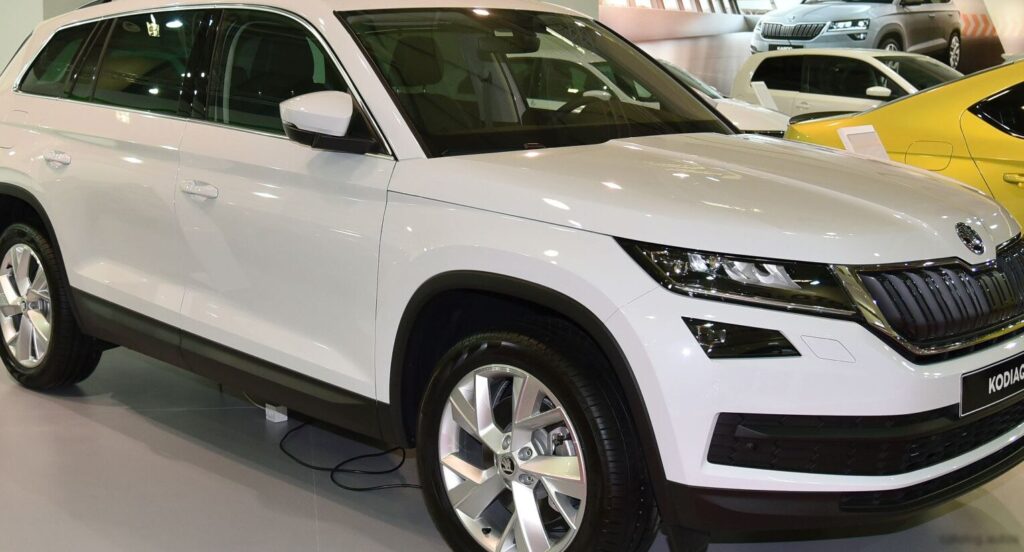
Technical Specifications
| Brand | Skoda |
| Model | Kodiaq |
| Generation | Kodiaq I |
| Type | 2.0 TSI (180 Hp) 4×4 DSG 7 Seat |
| Start of production | 2016 |
| End of production | 2018 |
| Powertrain Architecture | Internal Combustion engine |
| Body type | SUV |
| Seats | 7 |
| Doors | 5 |
| Fuel consumption (urban) | 9 l/100 km (26.1 US mpg, 31.4 UK mpg, 11.1 km/l) |
| Fuel consumption (extra urban) | 6.3 l/100 km (37.3 US mpg, 44.8 UK mpg, 15.9 km/l) |
| Fuel consumption (combined) | 7.3 l/100 km (32.2 US mpg, 38.7 UK mpg, 13.7 km/l) |
| CO2 emissions | 168 g/km |
| Fuel Type | Petrol (Gasoline) |
| Acceleration 0 – 100 km/h | 8 sec |
| Acceleration 0 – 62 mph | 8 sec |
| Acceleration 0 – 60 mph | 7.6 sec |
| Maximum speed | 205 km/h (127.38 mph) |
| Emission standard | Euro 6 |
| Weight-to-power ratio | 9.3 kg/Hp, 107.8 Hp/tonne |
| Weight-to-torque ratio | 5.2 kg/Nm, 191.7 Nm/tonne |
| Power | 180 Hp @ 3900-6000 rpm |
| Power per litre | 90.7 Hp/l |
| Torque | 320 Nm @ 1400-3940 rpm (236.02 lb.-ft. @ 1400-3940 rpm) |
| Engine layout | Front, Transverse |
| Engine Model/Code | EA888 / CZPA |
| Engine displacement | 1984 cm3 (121.07 cu. in.) |
| Number of cylinders | 4 |
| Engine configuration | Inline |
| Cylinder Bore | 82.5 mm (3.25 in.) |
| Piston Stroke | 92.8 mm (3.65 in.) |
| Compression ratio | 11.65:1 |
| Number of valves per cylinder | 4 |
| Fuel injection system | Direct injection and Multi-port manifold injection |
| Engine aspiration | Turbocharger, Intercooler |
| Valvetrain | DOHC |
| Engine oil capacity | 5.7 l (6.02 US qt | 5.02 UK qt) |
| Coolant | 10 l (10.57 US qt | 8.8 UK qt) |
| Kerb Weight | 1669 kg (3679.52 lbs.) |
| Max. weight | 2373 kg (5231.57 lbs.) |
| Max load | 704 kg (1552.05 lbs.) |
| Trunk (boot) space – minimum | 560 l (19.78 cu. ft.) |
| Trunk (boot) space – maximum | 2005 l (70.81 cu. ft.) |
| Fuel tank capacity | 60 l (15.85 US gal | 13.2 UK gal) |
| Max. roof load | 75 kg (165.35 lbs.) |
| Permitted trailer load with brakes (8%) | 2000 kg (4409.25 lbs.) |
| Permitted trailer load with brakes (12%) | 2000 kg (4409.25 lbs.) |
| Permitted trailer load without brakes | 750 kg (1653.47 lbs.) |
| Permitted towbar download | 80 kg (176.37 lbs.) |
| Length | 4697 mm (184.92 in.) |
| Width | 1882 mm (74.09 in.) |
| Width including mirrors | 2087 mm (82.17 in.) |
| Height | 1655 mm (65.16 in.) |
| Wheelbase | 2791 mm (109.88 in.) |
| Front track | 1586 mm (62.44 in.) |
| Rear (Back) track | 1576 mm (62.05 in.) |
| Front overhang | 898 mm (35.35 in.) |
| Rear overhang | 1009 mm (39.72 in.) |
| Ride height (ground clearance) | 188 mm (7.4 in.) |
| Drag coefficient (Cd) | 0.34 |
| Minimum turning circle (turning diameter) | 11.6 m (38.06 ft.) |
| Approach angle | 19.1° |
| Departure angle | 15.3° |
| Drivetrain Architecture | The Internal combustion engine (ICE) drives the front wheels permanently, and the rear wheels are driven through an electrically or mechanically operated clutch if necessary. |
| Drive wheel | All wheel drive (4×4) |
| Number of gears and type of gearbox | 7 gears, automatic transmission DSG |
| Front suspension | Independent, type McPherson with coil spring and anti-roll bar |
| Rear suspension | Independent multi-link spring suspension with stabilizer |
| Front brakes | Ventilated discs |
| Rear brakes | Disc |
| Assisting systems | ABS (Anti-lock braking system) |
| Steering type | Steering rack and pinion |
| Power steering | Electric Steering |
| Tires size | 215/65 R17 |
| Wheel rims size | 7J x 17 |
The Skoda Kodiaq 2.0 TSI 4×4 DSG with seven seats, produced between 2016 and 2018, was a significant model for Skoda. It marked the brand’s first foray into the seven-seater SUV market, aiming to provide a practical and spacious vehicle for families. Powered by the EA888 2.0-liter turbocharged engine, this variant offered a compelling blend of performance and efficiency, particularly when paired with the seven-speed dual-clutch DSG transmission and all-wheel drive. It sat comfortably in the middle of the Kodiaq range, offering more power and capability than the lower-spec 1.4 TSI models, but remaining more accessible than the range-topping diesel variants.
Powertrain & Engine Architecture
At the heart of the Kodiaq 2.0 TSI 4×4 lies the EA888 engine, specifically the CZPA code variant. This is a 1984cc, inline-four cylinder engine featuring direct fuel injection and a turbocharger with an intercooler. The engine utilizes a DOHC (Dual Overhead Camshaft) valvetrain with four valves per cylinder, optimizing airflow for increased power output. The direct injection system delivers fuel directly into the combustion chamber, improving efficiency and reducing emissions. The turbocharger provides a significant boost in power, delivering 180 horsepower at 3900-6000 rpm and 320 Nm (236 lb-ft) of torque between 1400-3940 rpm. The seven-speed DSG (Direct-Shift Gearbox) transmission offers quick and smooth gear changes, enhancing both performance and fuel economy. The 4×4 system employs a multi-plate clutch to distribute power between the front and rear axles as needed, providing enhanced traction in various conditions.
Driving Characteristics
The Kodiaq 2.0 TSI 4×4 DSG delivers a refined driving experience. The 180 hp engine provides ample power for everyday driving and overtaking maneuvers. While not a sports SUV, the combination of the turbocharged engine and the DSG transmission results in brisk acceleration – 0-60 mph in approximately 7.6 seconds. The DSG transmission is well-tuned, offering seamless shifts and contributing to a smooth ride. The all-wheel-drive system provides excellent stability and grip, particularly on slippery surfaces. Compared to the lower-powered 1.4 TSI variants, the 2.0 TSI offers noticeably more responsive performance. However, it doesn’t quite match the outright punch of the higher-output diesel models. The gear ratios in the DSG transmission are optimized for both fuel efficiency and performance, providing a good balance between the two.
Equipment & Trim Levels
The Kodiaq 2.0 TSI 4×4 7-seat typically came well-equipped, reflecting its mid-range positioning. Standard features often included alloy wheels, automatic climate control, a touchscreen infotainment system with Apple CarPlay and Android Auto compatibility, rear parking sensors, and a suite of safety features like ABS, ESC (Electronic Stability Control), and multiple airbags. Interior upholstery was typically cloth or a combination of cloth and Alcantara, depending on optional packages. Optional extras included leather upholstery, a panoramic sunroof, adaptive cruise control, a premium sound system, and a tow hitch. Trim levels varied slightly depending on the market, but generally offered progressive upgrades in terms of comfort and convenience features.
Chassis & Braking
The Kodiaq I utilizes an independent suspension setup on both the front and rear axles. The front suspension employs a McPherson strut design with coil springs and an anti-roll bar, while the rear features a multi-link setup, also with coil springs and a stabilizer bar. This configuration provides a comfortable ride and good handling characteristics. Braking duties are handled by ventilated discs on the front wheels and solid discs on the rear. ABS (Anti-lock Braking System) is standard, ensuring effective braking performance in emergency situations. The steering is an electric power-assisted rack and pinion system, providing precise and responsive steering feel.
Market Reception & Comparison
The Skoda Kodiaq 2.0 TSI 4×4 7-seat was generally well-received by automotive critics. It was praised for its spacious interior, comfortable ride, and strong engine performance. The DSG transmission was also lauded for its smoothness and responsiveness. Compared to rivals like the Nissan X-Trail and Hyundai Santa Fe, the Kodiaq offered a more refined driving experience and a more premium interior. Fuel economy was respectable for a vehicle of its size and capability, averaging around 32.2 US mpg in combined driving. Reliability reports have been generally positive, although some owners have reported minor issues with the DSG transmission. Compared to the 1.4 TSI Kodiaq, the 2.0 TSI offered a significant performance upgrade, justifying the higher price tag for drivers prioritizing power and responsiveness.
Legacy
The Skoda Kodiaq 2.0 TSI 4×4 DSG 7-seat has proven to be a reliable and durable vehicle. The EA888 engine is known for its robustness, and the DSG transmission, while requiring occasional maintenance, is generally dependable. On the used car market, these Kodiaqs hold their value reasonably well, reflecting their practicality, spaciousness, and overall quality. They remain a popular choice for families seeking a versatile and well-equipped SUV. The Kodiaq established Skoda as a serious contender in the mid-size SUV segment, paving the way for future models and solidifying the brand’s reputation for value and reliability.
