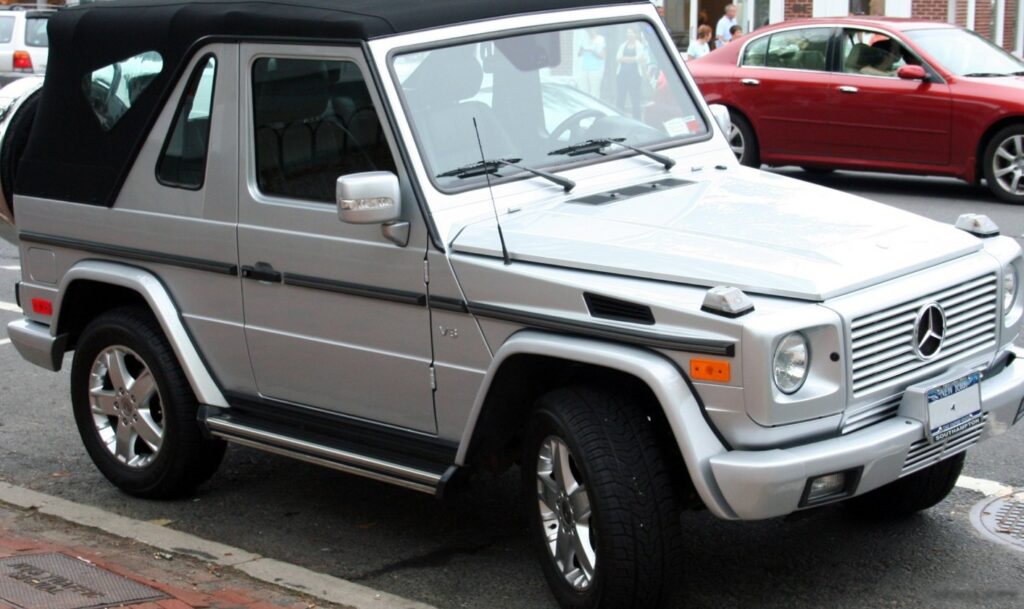
The Mercedes-Benz G-class (W460) 300 GD, powered by the OM 617.931 engine producing 88 horsepower, represents a pivotal point in the G-Wagen’s early development. Produced from 1979 to 1991, this variant was a mainstay of the initial G-Wagen lineup, designed primarily for utilitarian purposes and off-road capability. It served as a robust and dependable vehicle for military, agricultural, and civilian use, establishing the G-class’s reputation for toughness. The 300 GD occupied a middle ground in the W460 range, offering a balance between affordability, fuel efficiency, and respectable performance for its intended applications. While more powerful gasoline-fueled versions existed, the 300 GD’s diesel engine provided superior torque and economy, making it a popular choice for demanding tasks.
Technical Specifications
| Brand | Mercedes-Benz |
| Model | G-class |
| Generation | G-class (W460) |
| Type (Engine) | 300 GD (88 Hp) 4WD |
| Start of production | 1979 year |
| End of production | 1991 year |
| Powertrain Architecture | Internal Combustion engine |
| Body type | Off-road vehicle |
| Seats | 5 |
| Doors | 3 |
| Fuel consumption (economy) – urban | 14.6 l/100 km (16.1 US mpg, 19.3 UK mpg, 6.8 km/l) |
| Fuel consumption (economy) – extra urban | 11.7 l/100 km (20.1 US mpg, 24.1 UK mpg, 8.5 km/l) |
| Fuel Type | Diesel |
| Maximum speed | 127 km/h (78.91 mph) |
| Weight-to-power ratio | 21 kg/Hp, 47.7 Hp/tonne |
| Weight-to-torque ratio | 10.7 kg/Nm, 93.2 Nm/tonne |
| Power | 88 Hp @ 4400 rpm |
| Power per litre | 29.4 Hp/l |
| Torque | 172 Nm @ 2400 rpm (126.86 lb.-ft. @ 2400 rpm) |
| Engine layout | Front, Longitudinal |
| Engine Model/Code | OM 617.931 |
| Engine displacement | 2998 cm3 (182.95 cu. in.) |
| Number of cylinders | 5 |
| Engine configuration | Inline |
| Cylinder Bore | 90.9 mm (3.58 in.) |
| Piston Stroke | 92.4 mm (3.64 in.) |
| Compression ratio | 21:1 |
| Number of valves per cylinder | 2 |
| Fuel injection system | Precombustion chamber injection |
| Engine aspiration | Naturally aspirated engine |
| Valvetrain | SOHC |
| Engine oil capacity | 7 l (7.4 US qt | 6.16 UK qt) |
| Coolant | 10.7 l (11.31 US qt | 9.41 UK qt) |
| Kerb Weight | 1845 kg (4067.53 lbs.) |
| Max. weight | 2500 kg (5511.56 lbs.) |
| Max load | 655 kg (1444.03 lbs.) |
| Trunk (boot) space – minimum | 743 l (26.24 cu. ft.) |
| Trunk (boot) space – maximum | 1730 l (61.09 cu. ft.) |
| Fuel tank capacity | 75 l (19.81 US gal | 16.5 UK gal) |
| Permitted trailer load with brakes (12%) | 2500 kg (5511.56 lbs.) |
| Permitted trailer load without brakes | 750 kg (1653.47 lbs.) |
| Length | 4145 mm (163.19 in.) |
| Width | 1700 mm (66.93 in.) |
| Height | 1985 mm (78.15 in.) |
| Wheelbase | 2400 mm (94.49 in.) |
| Front track | 1425 mm (56.1 in.) |
| Rear (Back) track | 1425 mm (56.1 in.) |
| Front overhang | 745 mm (29.33 in.) |
| Rear overhang | 800 mm (31.5 in.) |
| Ride height (ground clearance) | 215 mm (8.46 in.) |
| Minimum turning circle (turning diameter) | 11.4 m (37.4 ft.) |
| Approach angle | 45° |
| Departure angle | 40° |
| Ramp-over (brakeover) angle | 31° |
| Climb angle | 38.7° |
| Wading depth | 600 mm (23.62 in.) |
| Drivetrain Architecture | The Internal combustion engine (ICE) drives the rear wheels permanently, and the front wheels are driven through an electrically or mechanically operated clutch if necessary. |
| Drive wheel | All wheel drive (4×4) |
| Number of gears and type of gearbox | 4 gears, manual transmission |
| Front suspension | Coil spring, Rigid axle suspension, Transverse stabilizer, Trailing arm |
| Rear suspension | Rigid axle suspension, Trailing arm, Coil spring |
| Front brakes | Disc, 303 mm |
| Rear brakes | Drum, 260 mm |
| Steering type | Cone worm with recirculation balls |
| Power steering | Hydraulic Steering |
| Tires size | 205/80 R16 |
| Wheel rims size | 5.5J x 16 |
Powertrain & Engine Architecture
The heart of the 300 GD is the OM 617.931, a 3.0-liter inline five-cylinder diesel engine. This engine is renowned for its durability and relatively simple design. It utilizes precombustion chamber injection, a system where fuel is injected into a small pre-chamber connected to the main combustion chamber, promoting more complete combustion and reducing engine noise. The engine features a single overhead camshaft (SOHC) operating two valves per cylinder. The 88 horsepower output, while modest by modern standards, is delivered with a substantial 172 Nm (126.86 lb.-ft.) of torque at 2400 rpm. This torque characteristic is crucial for off-road driving and towing. The engine is longitudinally mounted in the chassis. The W460 300 GD was typically equipped with a four-speed manual transmission, delivering power to all four wheels via a selectable four-wheel-drive system. This system allowed the driver to switch between rear-wheel drive for on-road efficiency and four-wheel drive for enhanced traction in challenging terrain.
Driving Characteristics
The 300 GD’s driving experience is defined by its robust nature rather than outright speed. Acceleration is leisurely, but the engine’s torque provides ample pulling power, especially at lower speeds. The four-speed manual transmission requires deliberate shifting, and the gear ratios are spaced to maximize fuel economy and off-road capability. Compared to the gasoline-powered G-class models, the 300 GD offers significantly better fuel economy and a more relaxed driving experience. However, it lacks the responsiveness and higher top speed of its petrol counterparts. The 300 GD’s relatively simple mechanicals and robust construction make it a capable and reliable off-road performer, able to tackle challenging terrain with confidence.
Equipment & Trim Levels
The 300 GD was generally sparsely equipped, reflecting its utilitarian origins. Standard features typically included basic steel wheels, vinyl upholstery, and a simple dashboard layout. Optional extras were available, such as upgraded upholstery, a sunroof, and auxiliary lighting. The interior was functional and durable, designed to withstand the rigors of off-road use. Trim levels were minimal; the 300 GD was primarily differentiated by optional equipment rather than distinct trim packages.
Chassis & Braking
The W460 chassis is a body-on-frame construction, providing exceptional strength and durability. The suspension consists of coil springs and rigid axles front and rear, offering substantial wheel travel for off-road capability. A transverse stabilizer bar is fitted to the front axle to reduce body roll. Braking duties are handled by disc brakes at the front and drum brakes at the rear. The steering system is a recirculating ball type, providing a direct but somewhat heavy steering feel. The 300 GD’s robust chassis and suspension contribute to its exceptional off-road performance and load-carrying capacity.
Market Reception & Comparison
The 300 GD was well-received in markets where diesel engines were popular and off-road capability was highly valued. Critics praised its durability, fuel efficiency, and off-road prowess. Compared to the more expensive and less fuel-efficient gasoline-powered G-class models, the 300 GD offered a more practical and affordable option for those seeking a rugged and reliable vehicle. Its simplicity also meant lower maintenance costs compared to the more complex gasoline variants. However, its modest performance and basic interior were points of criticism for some.
Legacy
The 300 GD has earned a reputation as one of the most reliable and durable G-Wagens ever produced. The OM 617 engine is known for its longevity, and many examples are still in service today, often with very high mileage. In the used car market, the W460 300 GD is highly sought after by enthusiasts and collectors, particularly those interested in classic off-road vehicles. Its simple mechanicals and readily available parts make it relatively easy to maintain and repair. The 300 GD’s enduring popularity is a testament to its robust design and timeless appeal, solidifying its place as a significant chapter in the G-class’s storied history.