
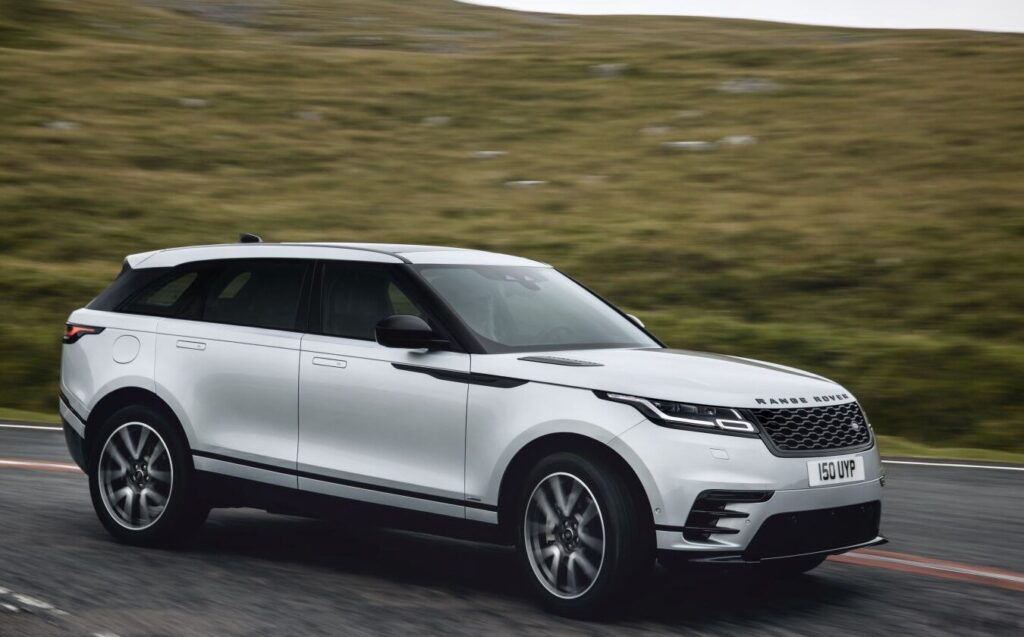
The Land Rover Range Rover Velar, introduced in 2017, quickly established itself as a stylish and technologically advanced mid-size luxury SUV. The 2020 facelift brought refinements to both the exterior and interior, along with updated powertrain options. The 2.0 D200 AWD Automatic, produced from September 2020 to February 2023, represented a key volume seller within the Velar range, offering a balance of performance, efficiency, and standard features. It occupied a mid-range position in the lineup, slotting below the more powerful petrol variants and the higher-specification diesel models.
Technical Specifications
| Brand | Land Rover |
| Model | Range Rover Velar |
| Generation | Range Rover Velar (facelift 2020) |
| Type (Engine) | 2.0 D200 (204 Hp) AWD Automatic |
| Start of production | September, 2020 |
| End of production | February, 2023 |
| Powertrain Architecture | Internal Combustion engine |
| Body type | SUV |
| Seats | 5 |
| Doors | 5 |
| Fuel Type | Diesel |
| Acceleration 0 – 100 km/h | 8.2 sec |
| Acceleration 0 – 62 mph | 8.2 sec |
| Acceleration 0 – 60 mph | 7.7 sec |
| Maximum speed | 210 km/h (130.49 mph) |
| Emission standard | Euro 5 |
| Weight-to-power ratio | 9.2 kg/Hp, 109 Hp/tonne |
| Weight-to-torque ratio | 4.4 kg/Nm, 229.8 Nm/tonne |
| Power | 204 Hp @ 4250 rpm |
| Power per litre | 102.2 Hp/l |
| Torque | 430 Nm @ 1750-2500 rpm (317.15 lb.-ft. @ 1750-2500 rpm) |
| Engine layout | Front, Longitudinal |
| Engine Model/Code | Ingenium / AJ20D4 |
| Engine displacement | 1997 cm3 (121.86 cu. in.) |
| Number of cylinders | 4 |
| Engine configuration | Inline |
| Cylinder Bore | 83 mm (3.27 in.) |
| Piston Stroke | 92.31 mm (3.63 in.) |
| Compression ratio | 16.5:1 |
| Number of valves per cylinder | 4 |
| Fuel injection system | Diesel Commonrail |
| Engine aspiration | Turbocharger, Intercooler |
| Engine oil capacity | 6.5 l (6.87 US qt | 5.72 UK qt) |
| Kerb Weight | 1871 kg (4124.85 lbs.) |
| Trunk (boot) space – minimum | 748 l (26.42 cu. ft.) |
| Trunk (boot) space – maximum | 1811 l (63.95 cu. ft.) |
| Fuel tank capacity | 60 l (15.85 US gal | 13.2 UK gal) |
| AdBlue tank | 17 l (4.49 US gal | 3.74 UK gal) |
| Permitted trailer load with brakes (12%) | 2400 kg (5291.09 lbs.) |
| Permitted trailer load without brakes | 750 kg (1653.47 lbs.) |
| Length | 4797 mm (188.86 in.) |
| Width with mirrors folded | 2041 mm (80.35 in.) |
| Width including mirrors | 2147 mm (84.53 in.) |
| Height | 1678-1683 mm (66.06 – 66.26 in.) |
| Wheelbase | 2874 mm (113.15 in.) |
| Front track | 1640-1644 mm (64.57 – 64.72 in.) |
| Rear (Back) track | 1657-1663 mm (65.24 – 65.47 in.) |
| Front overhang | 834 mm (32.83 in.) |
| Rear overhang | 1089 mm (42.87 in.) |
| Ride height (ground clearance) | 205-251 mm (8.07 – 9.88 in.) |
| Drag coefficient (Cd) | 0.32 |
| Minimum turning circle (turning diameter) | 11.94 m (39.17 ft.) |
| Approach angle | 22.5-27.5° |
| Departure angle | 24.8-29.5° |
| Ramp-over (brakeover) angle | 18.3-23.5° |
| Wading depth | 530-580 mm (20.87 – 22.83 in.) |
| Drivetrain Architecture | The Internal combustion engine (ICE) drives the rear wheels permanently, and the front wheels are driven through an electrically or mechanically operated clutch if necessary. |
| Drive wheel | All wheel drive (4×4) |
| Number of gears and type of gearbox | 8 gears, automatic transmission |
| Front suspension | Double wishbone |
| Rear suspension | Independent multi-link suspension |
| Front brakes | Ventilated discs, 350 mm |
| Rear brakes | Ventilated discs, 325 mm |
| Assisting systems | ABS (Anti-lock braking system) |
| Steering type | Steering rack and pinion |
| Power steering | Electric Steering |
INTRODUCTION
The Land Rover Range Rover Velar 2.0 D200 AWD Automatic, launched with the 2020 facelift, is a five-door, five-seat luxury SUV built on the Premium Longitudinal Architecture (PLA) platform, also known as the 1HX0/A3 platform. This variant aimed to provide a compelling entry point into the Velar range, offering a blend of refinement, capability, and fuel efficiency. The facelift brought subtle styling updates, a more modern interior with improved technology, and revisions to the engine lineup, including enhancements to the Ingenium diesel engines. This model was primarily targeted at the European and North American markets, where demand for premium diesel SUVs remained strong.
Powertrain & Engine Architecture
At the heart of the D200 lies Land Rover’s Ingenium engine family, specifically the AJ20D4 2.0-liter inline-four cylinder diesel. This engine utilizes a sophisticated common-rail direct injection system, delivering fuel at pressures up to 2,500 bar for optimized combustion. A single turbocharger with an intercooler provides forced induction, contributing to the engine’s 204 horsepower at 4,250 rpm and 430 Nm (317 lb-ft) of torque between 1,750 and 2,500 rpm. The engine features a cast aluminum block and cylinder head, designed for lightweight construction and efficient heat dissipation. The eight-speed automatic transmission, sourced from ZF, is a key component of the powertrain. This transmission is known for its smooth shifting characteristics and wide gear ratios, contributing to both fuel economy and performance. The transmission features a torque converter and is electronically controlled for optimal shift points based on driving conditions.
Driving Characteristics
The 2.0 D200 Automatic delivers a comfortable and refined driving experience. While not as overtly sporty as the higher-powered petrol variants, it provides ample power for everyday driving and highway cruising. The 0-60 mph acceleration time of around 7.7 seconds is respectable for a vehicle of this size and weight. The eight-speed automatic transmission contributes to relaxed cruising, with well-chosen gear ratios that keep the engine within its optimal torque band. Compared to the manual transmission options available on other Velar models, the automatic prioritizes convenience and smoothness over outright driver engagement. The all-wheel-drive system provides excellent traction in various conditions, enhancing stability and confidence. However, the D200’s weight (1871 kg / 4125 lbs) is noticeable, particularly during more spirited driving.
Equipment & Trim Levels
The 2.0 D200 typically came equipped with a generous level of standard features. These included leather upholstery, a touchscreen infotainment system with Apple CarPlay and Android Auto compatibility, navigation, automatic climate control, and a suite of driver-assistance systems such as lane departure warning, emergency braking, and front and rear parking sensors. Optional extras included a panoramic sunroof, premium audio systems, adaptive cruise control, and a head-up display. Interior trim options varied, with choices in wood veneers, aluminum accents, and different leather color combinations. The Velar’s interior design emphasized minimalism and a high-tech aesthetic.
Chassis & Braking
The Velar’s chassis is designed to provide a balance of comfort and handling. The front suspension utilizes a double wishbone setup, while the rear features an independent multi-link suspension. This configuration contributes to a smooth ride quality and controlled body roll. The D200 variant is equipped with ventilated disc brakes on all four wheels, providing ample stopping power. Front brake discs measure 350mm, while the rear discs are 325mm. The electronic stability control (ESC) system and anti-lock braking system (ABS) work in conjunction to enhance safety and stability. The steering is electrically assisted, providing a light and precise feel.
Market Reception & Comparison
The Range Rover Velar 2.0 D200 Automatic was generally well-received by automotive critics. It was praised for its stylish design, luxurious interior, and comfortable ride. The diesel engine was noted for its fuel efficiency and ample torque. However, some reviewers pointed out that the performance wasn’t as exhilarating as the higher-powered petrol variants. Compared to the Velar D300, the D200 offered a more affordable entry point, but with a noticeable reduction in power and performance. Fuel economy was a strong point, with combined cycle figures typically around 40-45 mpg (depending on driving conditions and wheel size). Reliability reports have been mixed, with some owners reporting issues with the infotainment system and occasional electrical glitches.
Legacy
The 2.0 D200 variant of the Range Rover Velar has become a popular choice in the used car market. Its blend of style, comfort, and efficiency continues to appeal to buyers seeking a premium SUV. The Ingenium engine has proven to be relatively durable, although regular maintenance is crucial. Potential buyers should be aware of the potential for issues with the infotainment system and the diesel particulate filter (DPF), particularly on vehicles that have primarily been used for short journeys. Overall, the 2.0 D200 represents a well-rounded and capable SUV that offers a compelling ownership experience.


