
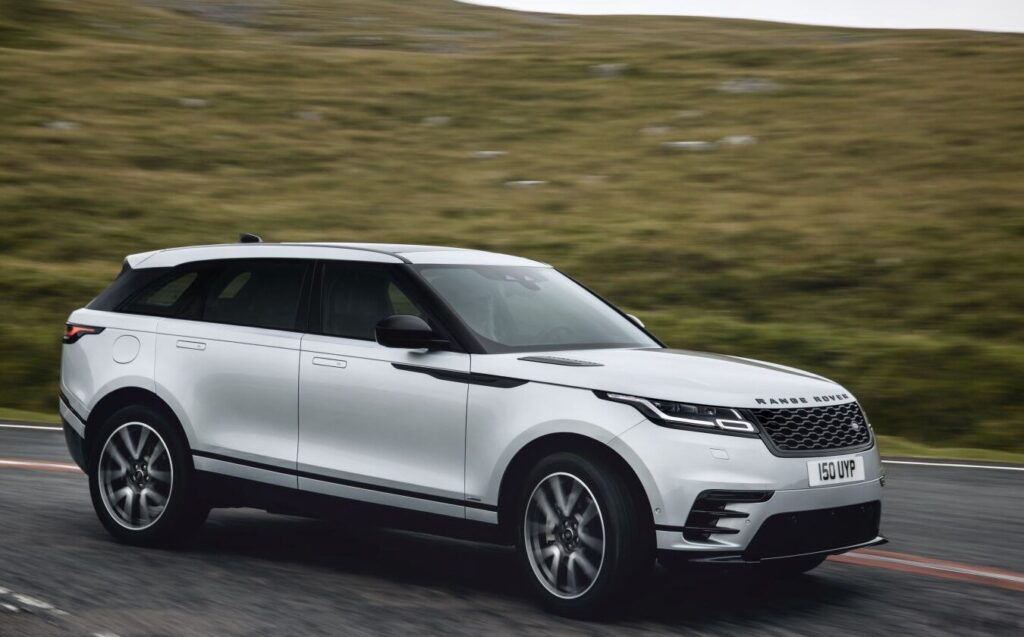
The Land Rover Range Rover Velar, introduced in 2017, quickly established itself as a stylish and technologically advanced mid-size luxury SUV. The facelifted version, launched in September 2020, brought refinements to the exterior design, interior technology, and powertrain options. Among these, the 2.0 D200 Mild Hybrid AWD Automatic variant occupied a significant position in the lineup, offering a balance of performance, efficiency, and price. Production of this specific configuration continued through February 2023. This model is part of the second generation Velar, built on the Premium Lightweight Architecture (PLA) platform, shared with other Jaguar Land Rover vehicles.
Technical Specifications
| Brand | Land Rover |
| Model | Range Rover Velar |
| Generation | Range Rover Velar (facelift 2020) |
| Type (Engine) | 2.0 D200 (204 Hp) Mild Hybrid AWD Automatic |
| Start of production | September, 2020 |
| End of production | February, 2023 |
| Powertrain Architecture | MHEV (Mild Hybrid Electric Vehicle) |
| Body type | SUV |
| Seats | 5 |
| Doors | 5 |
| Combined fuel consumption (WLTP) | 6.3-7 l/100 km (37.3 – 33.6 US mpg, 44.8 – 40.4 UK mpg, 15.9 – 14.3 km/l) |
| CO2 emissions (WLTP) | 165-183 g/km |
| Fuel consumption (NEDC, WLTP equivalent) | 5.3 l/100 km (44.4 US mpg, 53.3 UK mpg, 18.9 km/l) |
| CO2 emissions (NEDC, WLTP equivalent) | 139 g/km |
| Fuel Type | Diesel |
| Acceleration 0 – 100 km/h | 8.2 sec |
| Acceleration 0 – 62 mph | 8.2 sec |
| Acceleration 0 – 60 mph | 7.7 sec |
| Maximum speed | 210 km/h (130.49 mph) |
| Emission standard | Euro 6d |
| Weight-to-power ratio | 9.5 kg/Hp, 105.8 Hp/tonne |
| Weight-to-torque ratio | 4.5 kg/Nm, 223 Nm/tonne |
| Power | 204 Hp @ 4250 rpm |
| Power per litre | 102.2 Hp/l |
| Torque | 430 Nm @ 1750-2500 rpm (317.15 lb.-ft. @ 1750-2500 rpm) |
| Engine layout | Front, Longitudinal |
| Engine Model/Code | Ingenium / AJ20D4 |
| Engine displacement | 1997 cm3 (121.86 cu. in.) |
| Number of cylinders | 4 |
| Engine configuration | Inline |
| Cylinder Bore | 83 mm (3.27 in.) |
| Piston Stroke | 92.31 mm (3.63 in.) |
| Compression ratio | 16.5:1 |
| Number of valves per cylinder | 4 |
| Fuel injection system | Diesel Commonrail |
| Engine aspiration | Turbocharger, Intercooler |
| Engine oil capacity | 6.5 l (6.87 US qt | 5.72 UK qt) |
| Kerb Weight | 1928 kg (4250.51 lbs.) |
| Trunk (boot) space – minimum | 748 l (26.42 cu. ft.) |
| Trunk (boot) space – maximum | 1811 l (63.95 cu. ft.) |
| Fuel tank capacity | 60 l (15.85 US gal | 13.2 UK gal) |
| AdBlue tank | 17 l (4.49 US gal | 3.74 UK gal) |
| Permitted trailer load with brakes (12%) | 2400 kg (5291.09 lbs.) |
| Permitted trailer load without brakes | 750 kg (1653.47 lbs.) |
| Length | 4797 mm (188.86 in.) |
| Width with mirrors folded | 2041 mm (80.35 in.) |
| Width including mirrors | 2147 mm (84.53 in.) |
| Height | 1678-1683 mm (66.06 – 66.26 in.) |
| Wheelbase | 2874 mm (113.15 in.) |
| Front track | 1640-1644 mm (64.57 – 64.72 in.) |
| Rear (Back) track | 1657-1663 mm (65.24 – 65.47 in.) |
| Front overhang | 834 mm (32.83 in.) |
| Rear overhang | 1089 mm (42.87 in.) |
| Ride height (ground clearance) | 205-251 mm (8.07 – 9.88 in.) |
| Drag coefficient (Cd) | 0.32 |
| Minimum turning circle (turning diameter) | 11.94 m (39.17 ft.) |
| Approach angle | 22.5-27.5° |
| Departure angle | 24.8-29.5° |
| Ramp-over (brakeover) angle | 18.3-23.5° |
| Wading depth | 530-580 mm (20.87 – 22.83 in.) |
| Drivetrain Architecture | ICE and electric motor drive rear wheels, front wheels engaged via clutch |
| Drive wheel | All wheel drive (4×4) |
| Number of gears and type of gearbox | 8 gears, automatic transmission |
| Front suspension | Double wishbone |
| Rear suspension | Independent multi-link suspension |
| Front brakes | Ventilated discs, 350 mm |
| Rear brakes | Ventilated discs, 325 mm |
| Assisting systems | ABS (Anti-lock braking system) |
| Steering type | Steering rack and pinion |
| Power steering | Electric Steering |
INTRODUCTION
The 2020 facelift of the Range Rover Velar saw the introduction of the 2.0 D200 Mild Hybrid AWD Automatic variant. This model aimed to provide a more accessible entry point into the Velar range while still delivering the luxury and capability expected of the Land Rover brand. Positioned as a mid-range option, it slotted in below the more powerful D240 and D300 diesel models, and the petrol-powered P250 and P340 variants. The “Mild Hybrid” designation indicates the inclusion of a 48-volt electrical system and a Belt integrated Starter Generator (BiSG) which assists the engine during acceleration and enables smoother stop/start functionality, improving fuel economy.
Powertrain & Engine Architecture
At the heart of the D200 lies Land Rover’s Ingenium engine family, specifically the AJ20D4 2.0-liter four-cylinder diesel. This engine utilizes a sophisticated turbocharger and direct injection system to produce 204 horsepower at 4250 rpm and 430 Nm (317 lb-ft) of torque between 1750 and 2500 rpm. The mild hybrid system, featuring the BiSG, recovers energy during deceleration and stores it in a small battery, providing a boost during acceleration and allowing for a more refined stop/start experience. The engine employs a cast aluminum block and cylinder head, contributing to its relatively lightweight construction. The eight-speed automatic transmission, sourced from ZF, is a key component of the powertrain. It’s known for its smooth and responsive shifts, and is calibrated to prioritize fuel efficiency in normal driving conditions.
Driving Characteristics
The 2.0 D200 Automatic offers a comfortable and composed driving experience. While not as overtly sporty as some of its higher-powered siblings, it provides ample power for everyday driving and highway cruising. The eight-speed transmission is well-matched to the engine’s torque curve, delivering smooth acceleration. The mild hybrid system contributes to a more responsive feel, particularly during initial acceleration. Compared to the manual transmission options available on other Velar models, the automatic prioritizes ease of use and refinement. Against the D240, the D200 feels noticeably less urgent in its acceleration, but the difference is often negligible in real-world driving scenarios. The all-wheel-drive system provides excellent traction in various conditions, enhancing stability and confidence.
Equipment & Trim Levels
The D200 typically came equipped with a generous level of standard features, including leather upholstery, a touchscreen infotainment system with Apple CarPlay and Android Auto compatibility, automatic climate control, and a suite of driver-assistance systems such as lane keep assist and emergency braking. Optional extras included a panoramic sunroof, premium audio systems, adaptive cruise control, and a head-up display. Trim levels varied depending on the market, but generally included options like ‘S’, ‘SE’, and ‘HSE’, with each step up offering more luxurious appointments and additional features. Interior color schemes and material choices were also customizable, allowing buyers to personalize their Velar.
Chassis & Braking
The Velar’s chassis is designed to balance ride comfort and handling. The D200 variant utilizes double wishbone suspension at the front and an independent multi-link setup at the rear. The suspension is tuned to provide a smooth and controlled ride, absorbing bumps and imperfections in the road surface effectively. Braking duties are handled by ventilated discs on all four wheels, providing ample stopping power. The front discs measure 350mm in diameter, while the rear discs are 325mm. Anti-lock braking system (ABS) and electronic stability control (ESC) are standard features, enhancing safety and control.
Market Reception & Comparison
The Range Rover Velar 2.0 D200 Mild Hybrid AWD Automatic was generally well-received by automotive critics. It was praised for its stylish design, comfortable interior, and refined driving experience. The mild hybrid system was seen as a positive addition, improving fuel economy and reducing emissions. Compared to the more powerful diesel variants, the D200 offered a more affordable entry point into the Velar range, making it appealing to a wider audience. Fuel economy figures of 6.3-7 l/100 km (37.3-33.6 US mpg) were competitive for its class. Reliability reports have been generally positive, although, like all modern vehicles, it’s susceptible to issues with the complex electronic systems.
Legacy
The 2.0 D200 Mild Hybrid AWD Automatic Velar represents a significant step in Land Rover’s efforts to improve fuel efficiency and reduce emissions. The Ingenium engine and mild hybrid technology have proven to be reliable and durable. On the used car market, these models hold their value reasonably well, reflecting the enduring appeal of the Range Rover brand and the Velar’s stylish design. While newer Velar models have introduced more advanced hybrid and electric powertrains, the D200 remains a compelling option for buyers seeking a luxurious and capable SUV with a balance of performance and efficiency.


