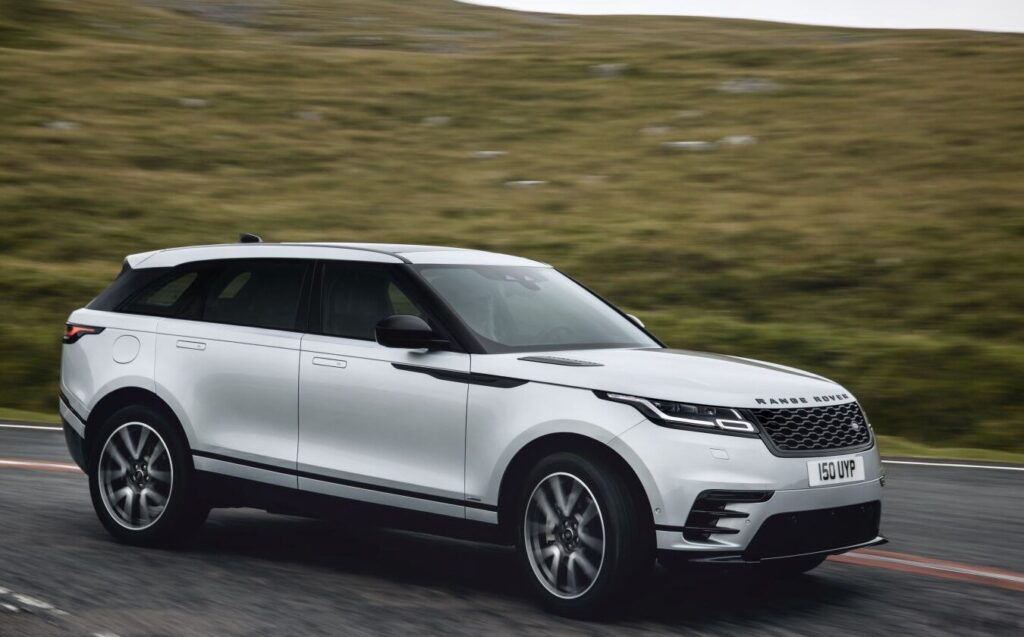
The Land Rover Range Rover Velar, introduced for the 2018 model year, quickly established itself as a stylish and technologically advanced mid-size luxury SUV. The 2020 facelift brought refinements to the exterior design, interior technology, and powertrain options. The 2.0 P250 AWD Automatic, produced from September 2020 to February 2023, represented a key entry point into the Velar range, offering a balance of performance, efficiency, and luxury features. It occupied the mid-range position within the lineup, slotting below the more powerful P300 and P400 variants, and above any potential base-level trims offered in some markets.
Technical Specifications
| Brand | Land Rover |
| Model | Range Rover Velar |
| Generation | Range Rover Velar (facelift 2020) |
| Type (Engine) | 2.0 P250 (250 Hp) AWD Automatic |
| Start of production | September, 2020 |
| End of production | February, 2023 |
| Powertrain Architecture | Internal Combustion engine |
| Body type | SUV |
| Seats | 5 |
| Doors | 5 |
| Combined fuel consumption (WLTP) | 9.4-10.4 l/100 km (25 – 22.6 US mpg, 30.1 – 27.2 UK mpg, 10.6 – 9.6 km/l) |
| CO2 emissions (WLTP) | 211-235 g/km |
| Fuel consumption (NEDC, WLTP equivalent) | 7.7 l/100 km (30.5 US mpg, 36.7 UK mpg, 13 km/l) |
| CO2 emissions (NEDC, WLTP equivalent) | 174 g/km |
| Fuel Type | Petrol (Gasoline) |
| Acceleration 0 – 100 km/h | 7.5 sec |
| Acceleration 0 – 62 mph | 7.5 sec |
| Acceleration 0 – 60 mph | 7.1 sec |
| Maximum speed | 217 km/h (134.84 mph) |
| Emission standard | Euro 6 |
| Weight-to-power ratio | 7.5 kg/Hp, 133.3 Hp/tonne |
| Weight-to-torque ratio | 5.1 kg/Nm, 194.7 Nm/tonne |
| Power | 250 Hp @ 5000 rpm |
| Power per litre | 125.2 Hp/l |
| Torque | 365 Nm @ 1300-4500 rpm (269.21 lb.-ft. @ 1300-4500 rpm) |
| Engine layout | Front, Longitudinal |
| Engine Model/Code | Ingenium / PT204 |
| Engine displacement | 1997 cm3 (121.86 cu. in.) |
| Number of cylinders | 4 |
| Engine configuration | Inline |
| Cylinder Bore | 83.01 mm (3.27 in.) |
| Piston Stroke | 92.28 mm (3.63 in.) |
| Compression ratio | 10.5:1 |
| Number of valves per cylinder | 4 |
| Fuel injection system | Direct injection |
| Engine aspiration | Twin-scroll turbo, Intercooler |
| Engine oil capacity | 7 l (7.4 US qt | 6.16 UK qt) |
| Coolant | 14.7 l (15.53 US qt | 12.93 UK qt) |
| Kerb Weight | 1875 kg (4133.67 lbs.) |
| Trunk (boot) space – minimum | 748 l (26.42 cu. ft.) |
| Trunk (boot) space – maximum | 1811 l (63.95 cu. ft.) |
| Fuel tank capacity | 82 l (21.66 US gal | 18.04 UK gal) |
| Permitted trailer load with brakes (12%) | 2400 kg (5291.09 lbs.) |
| Permitted trailer load without brakes | 750 kg (1653.47 lbs.) |
| Length | 4797 mm (188.86 in.) |
| Width with mirrors folded | 2041 mm (80.35 in.) |
| Width including mirrors | 2147 mm (84.53 in.) |
| Height | 1678-1683 mm (66.06 – 66.26 in.) |
| Wheelbase | 2874 mm (113.15 in.) |
| Front track | 1640-1644 mm (64.57 – 64.72 in.) |
| Rear (Back) track | 1657-1663 mm (65.24 – 65.47 in.) |
| Front overhang | 834 mm (32.83 in.) |
| Rear overhang | 1089 mm (42.87 in.) |
| Ride height (ground clearance) | 205-251 mm (8.07 – 9.88 in.) |
| Drag coefficient (Cd) | 0.32 |
| Minimum turning circle (turning diameter) | 11.94 m (39.17 ft.) |
| Approach angle | 22.5-27.5° |
| Departure angle | 24.8-29.5° |
| Ramp-over (brakeover) angle | 18.3-23.5° |
| Wading depth | 530-580 mm (20.87 – 22.83 in.) |
| Drivetrain Architecture | The Internal combustion engine (ICE) drives the rear wheels permanently, and the front wheels are driven through an electrically or mechanically operated clutch if necessary. |
| Drive wheel | All wheel drive (4×4) |
| Number of gears and type of gearbox | 8 gears, automatic transmission |
| Front suspension | Double wishbone |
| Rear suspension | Independent multi-link suspension |
| Front brakes | Ventilated discs, 350 mm |
| Rear brakes | Ventilated discs, 325 mm |
| Assisting systems | ABS (Anti-lock braking system) |
| Steering type | Steering rack and pinion |
| Power steering | Electric Steering |
Powertrain & Engine Architecture
The 2.0 P250 utilizes Land Rover’s Ingenium engine family, specifically the PT204 four-cylinder gasoline engine. This engine is a longitudinal inline-four, displacing 1997cc. It features direct fuel injection, a twin-scroll turbocharger, and an intercooler to enhance performance and efficiency. The engine produces 250 horsepower at 5000 rpm and 365 Nm (269.21 lb-ft) of torque between 1300 and 4500 rpm. The Ingenium engine is known for its relatively lightweight construction, contributing to the Velar’s overall balanced handling. The engine is paired with an 8-speed automatic transmission, providing smooth gear changes and contributing to refined cruising. This transmission is a ZF 8HP series unit, renowned for its durability and efficiency.
Driving Characteristics
The 2.0 P250 AWD offers a comfortable and capable driving experience. While not as overtly sporty as the higher-powered variants, it provides ample power for everyday driving and highway cruising. Acceleration from 0-60 mph takes approximately 7.1 seconds. The eight-speed automatic transmission is well-tuned, offering quick and seamless shifts. The all-wheel-drive system provides excellent traction in various conditions. Compared to the P300, the P250 feels less urgent in its acceleration, but the difference is often subtle in normal driving. The P250’s torque curve is relatively flat, providing good responsiveness across a wide range of engine speeds. The gear ratios are optimized for a balance of fuel economy and performance.
Equipment & Trim Levels
The 2.0 P250 typically came equipped with a generous level of standard features, including leather upholstery, a touchscreen infotainment system with Apple CarPlay and Android Auto compatibility, automatic climate control, and a suite of advanced driver-assistance systems (ADAS) such as lane departure warning and emergency braking. Optional extras included a panoramic sunroof, premium audio systems, adaptive cruise control, and various cosmetic enhancements. Trim levels within the P250 range often varied based on market, but generally offered increasing levels of luxury and technology.
Chassis & Braking
The Velar utilizes a lightweight aluminum-intensive chassis, contributing to its overall agility. The suspension consists of double wishbones at the front and an independent multi-link setup at the rear. This configuration provides a comfortable ride while maintaining good handling characteristics. The 2.0 P250 typically features ventilated disc brakes on all four wheels, with front discs measuring 350mm and rear discs measuring 325mm. The braking system is assisted by ABS and electronic stability control. Stabilizer bars are fitted front and rear to reduce body roll during cornering.
Market Reception & Comparison
The 2.0 P250 Velar was generally well-received by automotive critics. It was praised for its stylish design, comfortable interior, and refined driving experience. However, some reviewers noted that the four-cylinder engine could feel strained when pushed hard, and that the fuel economy, while respectable, wasn’t class-leading. Compared to the P300, the P250 offered a more affordable entry point into the Velar range, making it appealing to buyers who prioritized value and efficiency over outright performance. The P250 also offered a more economical alternative to the diesel-powered variants available in some markets.
Legacy
The Ingenium engine family has proven to be relatively reliable, although preventative maintenance is crucial. Common issues reported with the Ingenium engines include occasional oil leaks and timing chain wear, but these are not widespread. The ZF 8-speed automatic transmission is known for its durability and is generally considered a strong point of the Velar. As a used car, the 2.0 P250 Velar represents a compelling option for buyers seeking a stylish and capable luxury SUV. Its balance of performance, features, and price makes it a popular choice in the used market. Regular servicing and adherence to Land Rover’s recommended maintenance schedule are essential to ensure long-term reliability.