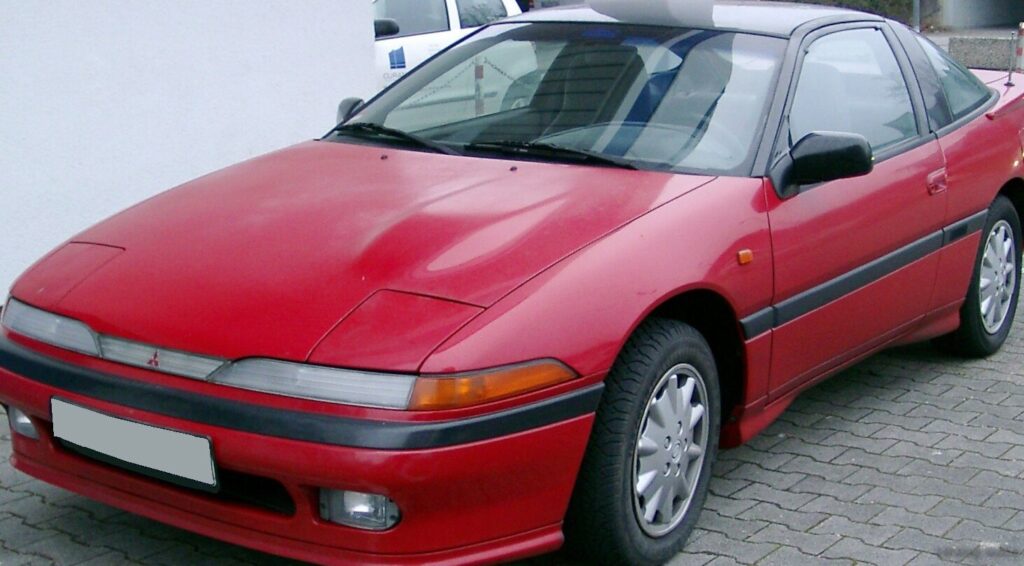
The Mitsubishi Eclipse first generation (1G), produced from 1990 to 1992, represented Mitsubishi’s entry into the increasingly popular compact coupe and liftback market. Positioned as an affordable and stylish alternative to established players like the Toyota Celica and Honda Prelude, the 1.8-liter (93 hp) variant served as the entry point to the Eclipse range. This model, available in both coupe and liftback body styles, aimed to attract buyers seeking a sporty appearance and reasonable fuel economy. It was a key component of Mitsubishi’s strategy to broaden its appeal in the North American market, where the Eclipse was particularly well-received.
Technical Specifications
| Brand | Mitsubishi |
| Model | Eclipse |
| Generation | Eclipse I (1G) |
| Type (Engine) | 1.8 (93 Hp) |
| Start of production | 1990 |
| End of production | 1992 |
| Powertrain Architecture | Internal Combustion engine |
| Body type | Coupe, Liftback |
| Seats | 4 |
| Doors | 2 |
| Fuel consumption (urban) | 10 l/100 km (23.5 US mpg) |
| Fuel consumption (extra urban) | 6 l/100 km (39.2 US mpg) |
| Fuel Type | Petrol (Gasoline) |
| Maximum speed | 175 km/h (108.74 mph) |
| Weight-to-power ratio | 12.3 kg/Hp |
| Weight-to-torque ratio | 8.1 kg/Nm |
| Power | 93 Hp @ 5000 rpm |
| Power per litre | 53 Hp/l |
| Torque | 142 Nm @ 3500 rpm (104.73 lb.-ft. @ 3500 rpm) |
| Engine layout | Front, Transverse |
| Engine displacement | 1755 cm3 (107.1 cu. in.) |
| Number of cylinders | 4 |
| Engine configuration | Inline |
| Cylinder Bore | 80.6 mm (3.17 in.) |
| Piston Stroke | 86 mm (3.39 in.) |
| Compression ratio | 9:1 |
| Number of valves per cylinder | 2 |
| Fuel injection system | Multi-port manifold injection |
| Engine aspiration | Naturally aspirated engine |
| Valvetrain | OHC |
| Kerb Weight | 1145 kg (2524.29 lbs.) |
| Trunk (boot) space – minimum | 290 l (10.24 cu. ft.) |
| Trunk (boot) space – maximum | 730 l (25.78 cu. ft.) |
| Fuel tank capacity | 60 l (15.85 US gal | 13.2 UK gal) |
| Length | 4340 mm (170.87 in.) |
| Width | 1690 mm (66.54 in.) |
| Height | 1305 mm (51.38 in.) |
| Wheelbase | 2470 mm (97.24 in.) |
| Front track | 1465 mm (57.68 in.) |
| Rear (Back) track | 1450 mm (57.09 in.) |
| Drivetrain Architecture | The Internal combustion engine (ICE) drives the front wheels of the vehicle. |
| Drive wheel | Front wheel drive |
| Number of gears and type of gearbox | 5 gears, manual transmission |
| Front suspension | Coil spring |
| Rear suspension | Coil spring |
| Front brakes | Ventilated discs |
| Rear brakes | Disc |
| Assisting systems | ABS (Anti-lock braking system) |
| Steering type | Steering rack and pinion |
| Power steering | Hydraulic Steering |
| Tires size | 185/70 R14 |
Powertrain & Engine Architecture
The heart of the 1.8-liter Eclipse was the 4G37 engine, a naturally aspirated, inline-four cylinder powerplant. This engine featured a single overhead camshaft (SOHC) valvetrain with two valves per cylinder. Fuel delivery was handled by a multi-port fuel injection system, contributing to improved efficiency and smoother operation compared to carbureted engines of the era. The 93 horsepower output at 5000 rpm and 142 Nm (104.73 lb-ft) of torque at 3500 rpm were respectable for its displacement, but not particularly groundbreaking. The engine’s 9:1 compression ratio was a common figure for the time, balancing performance and fuel economy. The 4G37 engine was known for its relative simplicity and durability, making it a reasonably reliable unit. The standard transmission for this variant was a five-speed manual, although a four-speed automatic transmission was also offered, impacting performance slightly.
Driving Characteristics
The 1.8-liter Eclipse with the five-speed manual transmission offered adequate, though not exhilarating, performance. Acceleration to 60 mph took approximately 10-11 seconds. The automatic transmission version was noticeably slower. The gear ratios were tuned for fuel efficiency and everyday drivability rather than outright speed. The front-wheel-drive configuration provided predictable handling, but lacked the dynamic capabilities of rear-wheel-drive competitors. Compared to the higher-performance 2.0-liter turbocharged models, the 1.8-liter felt significantly less powerful, particularly during highway merging and overtaking maneuvers. However, the lighter weight of the 1.8-liter model did contribute to slightly better fuel economy and a more nimble feel in city driving.
Equipment & Trim Levels
The base 1.8-liter Eclipse typically came with a fairly basic level of equipment. Standard features included cloth upholstery, a basic AM/FM radio, and manual windows and locks. Air conditioning was often an optional extra. The interior design was functional and straightforward, prioritizing practicality over luxury. Higher trim levels, such as the RS, offered upgrades like power windows and locks, upgraded audio systems, and sportier interior trim. The liftback body style provided increased cargo versatility compared to the coupe, making it a more practical choice for those needing to transport larger items.
Chassis & Braking
The Eclipse 1G utilized a front-engine, front-wheel-drive layout with independent coil spring suspension at all four corners. The front suspension featured MacPherson struts, while the rear employed a multi-link setup. This suspension configuration provided a comfortable ride quality, although it wasn’t particularly sporty. Braking duties were handled by ventilated discs at the front and solid discs at the rear. An anti-lock braking system (ABS) was available as an option, enhancing safety. The steering was rack-and-pinion with hydraulic power assistance, providing light and responsive steering feel.
Market Reception & Comparison
The 1.8-liter Eclipse was generally well-received as an affordable and stylish entry-level coupe. Critics praised its attractive design and reasonable fuel economy. However, the engine’s performance was often criticized as being underpowered, especially when compared to competitors like the Toyota Celica and Honda Prelude. The automatic transmission version was particularly criticized for its sluggish acceleration. Compared to the more powerful 2.0-liter turbocharged models within the Eclipse lineup, the 1.8-liter offered a significantly lower price point, making it accessible to a wider range of buyers. The 1.8L was often seen as a good first car or a practical daily driver.
Legacy
The first-generation Mitsubishi Eclipse, particularly the 1.8-liter variant, established the Eclipse nameplate as a viable contender in the compact coupe market. While not known for blistering performance, the 4G37 engine proved to be relatively reliable, and many examples are still on the road today. In the used car market, the 1.8-liter Eclipse is often sought after by enthusiasts looking for an affordable and easily maintained classic. Parts availability is generally good, and the engine’s simplicity makes it relatively easy to work on. The 1G Eclipse laid the foundation for the subsequent generations of the Eclipse, which would become known for their more powerful engines and sporty handling.