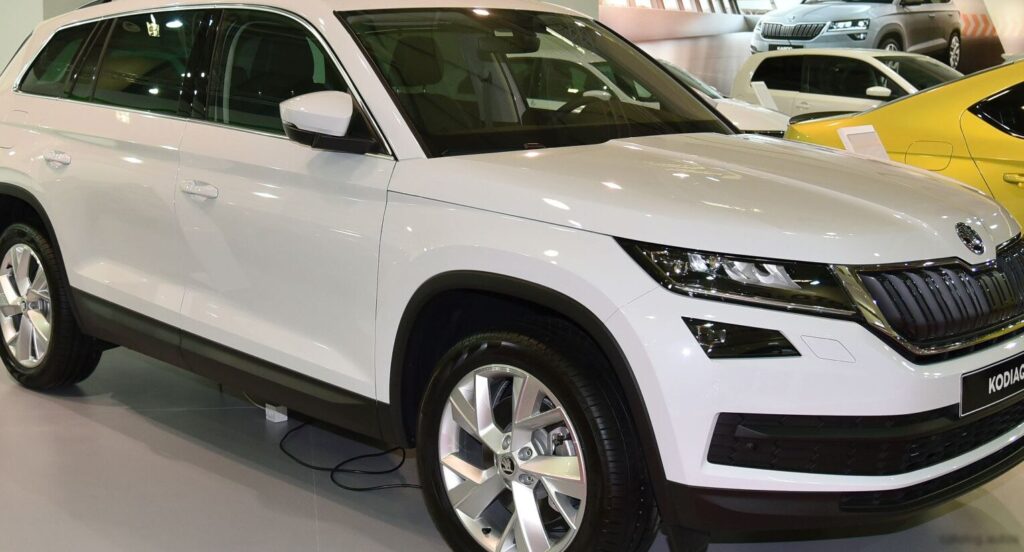
The Skoda Kodiaq I, specifically the 2.0 TDI (150 hp) 4×4 DSG variant produced from 2021 to 2023, represents a mid-range offering within the first generation of Skoda’s flagship SUV. Introduced as part of the facelifted Kodiaq range, this model aimed to balance fuel efficiency, practicality, and all-weather capability for European families. Positioned between the lower-powered diesel options and the more potent petrol variants, the 2.0 TDI 4×4 DSG catered to buyers seeking a versatile and comfortable SUV for both daily commuting and longer journeys. It builds upon the foundation of the original Kodiaq, which debuted in 2016, and utilizes the Volkswagen Group’s MQB platform (A7 variant), shared with models like the Volkswagen Tiguan and SEAT Ateca.
Technical Specifications
| Brand | Skoda |
| Model | Kodiaq |
| Generation | Kodiaq I (facelift 2021) |
| Type (Engine) | 2.0 TDI (150 Hp) 4×4 DSG |
| Start of production | 2021 |
| End of production | 2023 |
| Powertrain Architecture | Internal Combustion engine |
| Body type | SUV |
| Seats | 5 |
| Doors | 5 |
| Fuel consumption at Low speed (WLTP) | 7.5 l/100 km (31.4 US mpg, 37.7 UK mpg, 13.3 km/l) |
| Fuel consumption at Medium speed (WLTP) | 5.7 l/100 km (41.3 US mpg, 49.6 UK mpg, 17.5 km/l) |
| Fuel consumption at high speed (WLTP) | 5 l/100 km (47 US mpg, 56.5 UK mpg, 20 km/l) |
| Fuel consumption at very high speed (WLTP) | 6 l/100 km (39.2 US mpg, 47.1 UK mpg, 16.7 km/l) |
| Combined fuel consumption (WLTP) | 5.9 l/100 km (39.9 US mpg, 47.9 UK mpg, 16.9 km/l) |
| CO2 emissions (WLTP) | 153 g/km |
| Fuel consumption (economy) – urban (NEDC) | 5.9 l/100 km (39.9 US mpg, 47.9 UK mpg, 16.9 km/l) |
| Fuel consumption (economy) – extra urban (NEDC) | 4.4 l/100 km (53.5 US mpg, 64.2 UK mpg, 22.7 km/l) |
| Fuel consumption (economy) – combined (NEDC) | 5 l/100 km (47 US mpg, 56.5 UK mpg, 20 km/l) |
| CO2 emissions (NEDC) | 131 g/km |
| Fuel Type | Diesel |
| Maximum speed | 200 km/h (124.27 mph) |
| Weight-to-power ratio | 11.4 kg/Hp, 87.7 Hp/tonne |
| Weight-to-torque ratio | 4.8 kg/Nm, 210.5 Nm/tonne |
| Power | 150 Hp |
| Power per litre | 76.2 Hp/l |
| Torque | 360 Nm @ 1600-2750 rpm (265.52 lb.-ft. @ 1600-2750 rpm) |
| Engine layout | Front, Transverse |
| Engine Model/Code | EA288 / DFGA |
| Engine displacement | 1968 cm3 (120.09 cu. in.) |
| Number of cylinders | 4 |
| Engine configuration | Inline |
| Cylinder Bore | 81.1 mm (3.19 in.) |
| Piston Stroke | 95.5 mm (3.76 in.) |
| Number of valves per cylinder | 4 |
| Fuel injection system | Diesel Commonrail |
| Engine aspiration | Turbocharger, Intercooler |
| Valvetrain | DOHC |
| Engine oil capacity | 4.7 l (4.97 US qt | 4.14 UK qt) |
| Kerb Weight | 1710 kg (3769.9 lbs.) |
| Max. weight | 2430 kg (5357.23 lbs.) |
| Max load | 720 kg (1587.33 lbs.) |
| Trunk (boot) space – minimum | 835 l (29.49 cu. ft.) |
| Trunk (boot) space – maximum | 2065 l (72.92 cu. ft.) |
| Fuel tank capacity | 60 l (15.85 US gal | 13.2 UK gal) |
| Max. roof load | 75 kg (165.35 lbs.) |
| Permitted trailer load with brakes (12%) | 2300 kg (5070.63 lbs.) |
| Permitted trailer load without brakes | 750 kg (1653.47 lbs.) |
| Permitted towbar download | 100 kg (220.46 lbs.) |
| Length | 4697 mm (184.92 in.) |
| Width | 1882 mm (74.09 in.) |
| Height | 1681 mm (66.18 in.) |
| Wheelbase | 2788 mm (109.76 in.) |
| Front track | 1585 mm (62.4 in.) |
| Rear (Back) track | 1575 mm (62.01 in.) |
| Minimum turning circle (turning diameter) | 12.2 m (40.03 ft.) |
| Drivetrain Architecture | The Internal combustion engine (ICE) drives the front wheels permanently, and the rear wheels are driven through an electrically or mechanically operated clutch if necessary. |
| Drive wheel | All wheel drive (4×4) |
| Number of gears and type of gearbox | 7 gears, automatic transmission DSG |
| Front suspension | Independent type McPherson, Transverse stabilizer |
| Rear suspension | Independent multi-link suspension, Transverse stabilizer |
| Front brakes | Ventilated discs |
| Rear brakes | Disc |
| Assisting systems | ABS (Anti-lock braking system) |
| Steering type | Steering rack and pinion |
| Power steering | Electric Steering |
| Tires size | 215/65 R17; 235/55 R18 |
| Wheel rims size | 7J x 17; 7J x 18 |
INTRODUCTION
The Skoda Kodiaq I facelift, launched in 2021, brought subtle styling updates and technological enhancements to Skoda’s popular seven-seater SUV. The 2.0 TDI 4×4 DSG variant, powered by a four-cylinder diesel engine producing 150 horsepower, occupied a sweet spot in the lineup, offering a compelling blend of performance, efficiency, and all-weather traction. This version was particularly aimed at families and drivers who frequently undertake long journeys, or live in regions with challenging road conditions. It represented a significant upgrade over the entry-level petrol engines, providing more torque for effortless cruising and towing, while remaining more affordable and fuel-efficient than the higher-output petrol options.
Powertrain & Engine Architecture
At the heart of the Kodiaq 2.0 TDI 4×4 DSG lies the Volkswagen Group’s EA288 engine family. Specifically, the DFGA code designates this particular iteration of the 2.0-liter turbocharged diesel. This engine utilizes a common-rail direct injection system, delivering fuel at extremely high pressure for optimized combustion. The engine features a single turbocharger with an intercooler to increase air density and boost power output. The DOHC (Double Overhead Camshaft) valvetrain, with four valves per cylinder, contributes to efficient gas exchange. The engine is transversely mounted in the front of the vehicle. The seven-speed DSG (Direct-Shift Gearbox) is a dual-clutch transmission known for its quick and smooth gear changes. It offers both fully automatic operation and the ability for the driver to manually select gears via paddle shifters or the gear lever. The DSG’s programming is tuned for a balance of fuel economy and responsiveness.
Driving Characteristics
The 150 hp and 360 Nm (265 lb-ft) of torque delivered by the 2.0 TDI engine provide adequate performance for everyday driving and long-distance cruising. While not a sports-oriented SUV, the Kodiaq 2.0 TDI 4×4 DSG offers a respectable 0-62 mph (0-100 km/h) time of around 9.5 seconds. The DSG transmission contributes to smooth acceleration, and the all-wheel-drive system provides excellent traction in slippery conditions. The gear ratios are optimized for fuel efficiency at highway speeds, while still providing enough grunt for overtaking maneuvers. Compared to the lower-powered 1.5 TSI petrol engine, the 2.0 TDI offers significantly more torque, resulting in a more relaxed driving experience, especially when fully loaded or towing. However, it lacks the outright punch of the 2.0 TSI petrol variants.
Equipment & Trim Levels
The Kodiaq 2.0 TDI 4×4 DSG typically came equipped with a generous level of standard features. These included automatic climate control, an 8-inch touchscreen infotainment system with Apple CarPlay and Android Auto compatibility, and a suite of safety features such as automatic emergency braking, lane departure warning, and adaptive cruise control. Higher trim levels offered additional features like leather upholstery, heated front seats, a panoramic sunroof, and a premium sound system. Optional extras included a tow bar, parking sensors, and a rear-view camera. Interior upholstery was typically fabric in lower trims, upgrading to leather or Alcantara in higher specifications. The dashboard layout was clean and functional, with a focus on user-friendliness.
Chassis & Braking
The Kodiaq’s chassis is tuned for comfort and stability. The front suspension utilizes McPherson struts, while the rear features a multi-link setup. Both ends are equipped with transverse stabilizer bars to reduce body roll. The 4×4 system employs a multi-plate clutch to distribute torque between the front and rear axles as needed. The braking system consists of ventilated discs at the front and solid discs at the rear. ABS (Anti-lock Braking System) and electronic stability control are standard features. The steering is electrically assisted, providing a light and precise feel.
Market Reception & Comparison
The Skoda Kodiaq 2.0 TDI 4×4 DSG was generally well-received by automotive critics. It was praised for its spacious interior, comfortable ride, and fuel efficiency. The all-wheel-drive system was also highlighted as a significant advantage, particularly for drivers in colder climates. Compared to rivals like the Nissan X-Trail and Hyundai Santa Fe, the Kodiaq offered a more refined driving experience and a more premium interior. Fuel economy was competitive, averaging around 39.9 US mpg (combined WLTP cycle). Reliability reports suggest that the EA288 engine is generally robust, although regular maintenance is essential.
Legacy
The Skoda Kodiaq 2.0 TDI 4×4 DSG has proven to be a reliable and practical SUV, maintaining a solid reputation in the used car market. The EA288 engine, while subject to some early issues with diesel particulate filter (DPF) regeneration, has been refined over the years and is generally considered durable. The DSG transmission, if properly maintained with regular fluid changes, is also known for its longevity. The Kodiaq’s spacious interior and versatile configuration continue to appeal to families, making it a popular choice for those seeking a comfortable and capable SUV.