
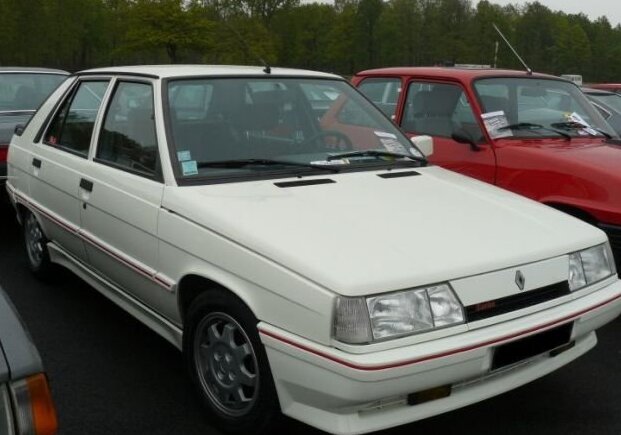
The Renault 11 1.4 Turbo, designated internally as the B/C375, was a performance-oriented variant of the popular Renault 11 hatchback produced between 1986 and 1988. Positioned as a more engaging alternative to the standard 1.4 and 1.7 liter models, the 1.4 Turbo aimed to capture buyers seeking a blend of practicality and spirited driving. It represented a relatively short-lived but significant addition to the B/C37 series, which was Renault’s entry in the small family car segment, competing with vehicles like the Peugeot 205 and Volkswagen Golf. The Renault 11, overall, was a key model for Renault, modernizing their offerings and providing a more contemporary alternative to the aging Renault 9 and 11.
Technical Specifications
| Brand | Renault |
| Model | 11 |
| Generation | 11 (B/C37) |
| Type (Engine) | 1.4 Turbo (B/C375) (115 Hp) |
| Start of production | 1986 |
| End of production | 1988 |
| Powertrain Architecture | Internal Combustion engine |
| Body type | Hatchback |
| Fuel Type | Petrol (Gasoline) |
| Power | 115 Hp |
| Engine Model/Code | C1J |
| Engine aspiration | Turbocharger |
| Engine oil capacity | 3.5 l (3.7 US qt | 3.08 UK qt) |
| Coolant capacity | 5.8 l (6.13 US qt | 5.1 UK qt) |
| Fuel tank capacity | 47 l (12.42 US gal | 10.34 UK gal) |
Powertrain & Engine Architecture
The heart of the Renault 11 1.4 Turbo was the C1J engine, a 1397cc inline-four cylinder unit. This engine was notable for its single overhead camshaft (SOHC) valvetrain and, crucially, a Garrett T2 turbocharger. The turbocharger significantly boosted power output compared to the naturally aspirated 1.4-liter engine, increasing horsepower to 115 hp. Fuel delivery was managed by Bosch mechanical fuel injection, a system common for the era, providing a balance between performance and reliability. The engine featured a relatively modest compression ratio, optimized for use with lower octane fuel available in many European markets. The turbocharger’s integration wasn’t without its challenges; turbo lag was noticeable, but the subsequent power surge provided a distinct performance advantage. The engine was typically paired with a five-speed manual transmission, although a three-speed automatic transmission was also offered, albeit less commonly. The automatic transmission, while offering convenience, did noticeably diminish the car’s acceleration and responsiveness.
Driving Characteristics
The Renault 11 1.4 Turbo offered a noticeably more engaging driving experience than its lower-powered siblings. While not a true hot hatch in the vein of the Peugeot 205 GTI, it provided a respectable level of performance for its time. The turbocharger’s boost came on strong around 2000-2500 rpm, providing a surge of acceleration that made overtaking and merging onto highways considerably easier. The five-speed manual transmission allowed drivers to keep the engine within its optimal power band. The automatic transmission, however, felt sluggish, with wider gear ratios that didn’t fully exploit the engine’s potential. Handling was typical for a front-wheel-drive hatchback of the 1980s – safe and predictable, but not particularly sporty. The suspension, while comfortable for everyday driving, exhibited some body roll during cornering. Steering was light and precise, making the car easy to maneuver in urban environments.
Equipment & Trim Levels
The Renault 11 1.4 Turbo generally occupied a mid-range position within the Renault 11 lineup. Standard equipment typically included cloth upholstery, a basic stereo system, and central locking. Higher trim levels, often denoted by “TXE” badging, added features such as alloy wheels, electric windows, a sunroof, and upgraded interior trim. The dashboard layout was functional and straightforward, with clearly labeled controls. Optional extras included a more sophisticated stereo system, metallic paint, and a rear window wiper. The interior space was comparable to other hatchbacks in its class, offering adequate room for passengers and luggage. The build quality, while not luxurious, was generally considered acceptable for a car in its price range.
Chassis & Braking
The Renault 11 1.4 Turbo utilized a MacPherson strut front suspension and a torsion beam rear suspension. This setup provided a reasonable balance between ride comfort and handling. Braking systems varied depending on the trim level. Base models typically featured drum brakes on the rear wheels, while higher-spec versions were equipped with disc brakes all around. Front brakes were ventilated discs. Power steering was not standard on all models, and many examples were equipped with manual steering. The chassis was relatively lightweight, contributing to the car’s nimble handling. Stabilizer bars were fitted to both the front and rear axles to reduce body roll. The braking performance was adequate for everyday driving, but lacked the stopping power of more modern vehicles.
Market Reception & Comparison
The Renault 11 1.4 Turbo was generally well-received by automotive critics, who praised its performance and value for money. It was seen as a more exciting alternative to the standard Renault 11 models, offering a significant boost in power without a substantial increase in price. However, some critics noted the turbo lag and the somewhat basic interior. Compared to the naturally aspirated 1.7-liter Renault 11, the 1.4 Turbo offered superior acceleration and a more engaging driving experience, but at the cost of slightly lower fuel economy. The 1.7-liter model was often preferred by buyers prioritizing fuel efficiency and refinement. Against competitors like the Peugeot 205, the Renault 11 1.4 Turbo offered a comparable level of performance and practicality, but lacked the Peugeot’s reputation for sporty handling.
Legacy
The Renault 11 1.4 Turbo, while a relatively short-lived model, has gained a following among classic car enthusiasts. The C1J engine, when properly maintained, proved to be reasonably reliable. However, the turbocharger itself could be a source of problems if not serviced regularly. Rust is a common issue with these cars, particularly in regions with harsh winters. Today, well-maintained examples of the Renault 11 1.4 Turbo are becoming increasingly collectible. The car represents a significant moment in Renault’s history, showcasing their ability to produce affordable and enjoyable performance cars. Finding parts can be challenging, but a dedicated community of owners and suppliers exists to support the preservation of these vehicles. The 1.4 Turbo remains a testament to the era of turbocharged engines and a reminder of a time when small hatchbacks offered a compelling blend of practicality and performance.
