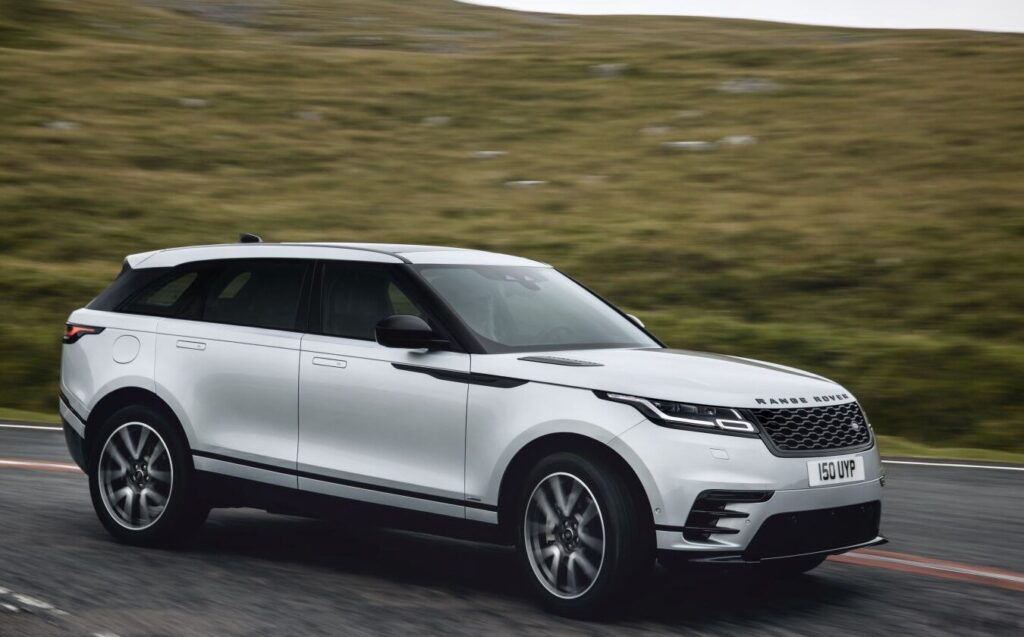
The Land Rover Range Rover Velar 2.0 P400e, a plug-in hybrid variant of the Velar model, was produced from September 2020 to February 2023. Positioned as a mid-to-premium trim within the facelifted (2020+) Velar range, it offered a blend of performance, efficiency, and luxury. This variant aimed to appeal to buyers seeking a sophisticated SUV with the capability of electric-only driving for shorter commutes, while retaining the long-distance practicality of a gasoline engine. It falls within the L563 Velar generation, utilizing the Premium Longitudinal Architecture (PLA) platform shared with other Jaguar Land Rover vehicles.
Technical Specifications
| Brand | Land Rover |
| Model | Range Rover Velar |
| Generation | Range Rover Velar (facelift 2020) |
| Type (Engine) | 2.0 P400e (404 Hp) Plug-in Hybrid AWD Automatic |
| Start of production | September, 2020 |
| End of production | February, 2023 |
| Powertrain Architecture | PHEV (Plug-in Hybrid Electric Vehicle) |
| Body type | SUV |
| Seats | 5 |
| Doors | 5 |
| Combined fuel consumption (WLTP) | 2.2-2.6 l/100 km (106.9 – 90.5 US mpg, 128.4 – 108.6 UK mpg, 45.5 – 38.5 km/l) |
| CO2 emissions (WLTP) | 49-58 g/km |
| Fuel consumption (NEDC, WLTP equivalent) | 2.3 l/100 km (102.3 US mpg, 122.8 UK mpg, 43.5 km/l) |
| CO2 emissions (NEDC, WLTP equivalent) | 52 g/km |
| Fuel Type | Petrol / electricity |
| Acceleration 0 – 100 km/h | 5.4 sec |
| Acceleration 0 – 62 mph | 5.4 sec |
| Acceleration 0 – 60 mph | 5.1 sec |
| Maximum speed | 240 km/h (149.13 mph) |
| Emission standard | Euro 6d |
| Weight-to-power ratio | 5.3 kg/Hp, 187.2 Hp/tonne |
| Weight-to-torque ratio | 3.4 kg/Nm, 296.6 Nm/tonne |
| Gross battery capacity | 17.1 kWh |
| Net (usable) battery capacity | 13.7 kWh |
| Battery technology | Lithium-ion (Li-Ion) |
| Battery location | Under the trunk |
| All-electric range (WLTP) | 53 km (32.93 mi) |
| All-electric range (NEDC, WLTP equivalent) | 61 km (37.9 mi) |
| Average Energy consumption (NEDC, WLTP equivalent) | 17.1-17.2 kWh/100 km (27.52 – 27.68 kWh/100 mi, 122 – 122 MPGe, 5.8 – 5.8 km/kWh, 3.6 – 3.6 mi/kWh) |
| Max speed (electric) | 140 km/h (86.99 mph) |
| Electric motor power | 143 Hp |
| Electric motor Torque | 275 Nm (202.83 lb.-ft.) |
| Electric motor location | Between the combustion engine and the transmission |
| System power | 404 Hp @ 5500 rpm |
| System torque | 640 Nm @ 1500-4400 rpm (472.04 lb.-ft. @ 1500-4400 rpm) |
| Power | 300 Hp |
| Power per litre | 150.2 Hp/l |
| Torque | 400 Nm (295.02 lb.-ft.) |
| Engine layout | Front, Longitudinal |
| Engine Model/Code | Ingenium / PT204 |
| Engine displacement | 1997 cm3 (121.86 cu. in.) |
| Number of cylinders | 4 |
| Engine configuration | Inline |
| Cylinder Bore | 83.01 mm (3.27 in.) |
| Piston Stroke | 92.28 mm (3.63 in.) |
| Compression ratio | 9.5:1 |
| Number of valves per cylinder | 4 |
| Fuel injection system | Direct injection |
| Engine aspiration | Turbocharger, Intercooler |
| Valvetrain | DOHC |
| Engine oil capacity | 7 l (7.4 US qt | 6.16 UK qt) |
| Coolant | 16.8 l (17.75 US qt | 14.78 UK qt) |
| Kerb Weight | 2158 kg (4757.58 lbs.) |
| Max. weight | 2720 kg (5996.57 lbs.) |
| Max load | 562 kg (1239 lbs.) |
| Trunk (boot) space – minimum | 625 l (22.07 cu. ft.) |
| Trunk (boot) space – maximum | 1693 l (59.79 cu. ft.) |
| Fuel tank capacity | 69 l (18.23 US gal | 15.18 UK gal) |
| Max. roof load | 79 kg (174.17 lbs.) |
| Permitted trailer load with brakes (12%) | 2000 kg (4409.25 lbs.) |
| Permitted trailer load without brakes | 750 kg (1653.47 lbs.) |
| Permitted towbar download | 175 kg (385.81 lbs.) |
| Length | 4797 mm (188.86 in.) |
| Width with mirrors folded | 2041 mm (80.35 in.) |
| Width including mirrors | 2147 mm (84.53 in.) |
| Height | 1683 mm (66.26 in.) |
| Wheelbase | 2874 mm (113.15 in.) |
| Front track | 1640 mm (64.57 in.) |
| Rear (Back) track | 1657 mm (65.24 in.) |
| Front overhang | 834 mm (32.83 in.) |
| Rear overhang | 1089 mm (42.87 in.) |
| Ride height (ground clearance) | 214 mm (8.43 in.) |
| Drag coefficient (Cd) | 0.33 |
| Minimum turning circle (turning diameter) | 12.35 m (40.52 ft.) |
| Approach angle | 23.6° |
| Departure angle | 25° |
| Ramp-over (brakeover) angle | 19.1° |
| Wading depth | 530 mm (20.87 in.) |
| Drivetrain Architecture | The Internal combustion engine (ICE) and the electric motor permanently drive the rear wheels of the vehicle, capable of running in full electric or mixed mode, and if necessary through the electrically or mechanically controlled clutch, the front wheels are driven. |
| Drive wheel | All wheel drive (4×4) |
| Number of gears and type of gearbox | 8 gears, automatic transmission |
| Front suspension | Coil spring, Double wishbone, Transverse stabilizer |
| Rear suspension | Independent multi-link suspension, Transverse stabilizer, Coil spring |
| Front brakes | Ventilated discs, 370 mm |
| Rear brakes | Ventilated discs, 325 mm |
| Assisting systems | ABS (Anti-lock braking system) |
| Steering type | Steering rack and pinion |
| Power steering | Electric Steering |
| Tires size | 235/65 R18; 255/55 R19; 255/50 R20; 265/45 R21; 265/40 R22 |
| Wheel rims size | 18; 19; 20; 21; 22 |
INTRODUCTION
The Land Rover Range Rover Velar 2.0 P400e, introduced in September 2020 as part of the Velar facelift, represents Land Rover’s entry into the premium plug-in hybrid SUV segment. Built on the PLA platform, it combines a 2.0-liter turbocharged Ingenium four-cylinder gasoline engine with an electric motor and a 17.1 kWh battery pack. This configuration delivers a combined output of 404 horsepower and 472 lb-ft of torque, offering a balance between performance and fuel efficiency. The P400e aimed to broaden the Velar’s appeal, attracting environmentally conscious buyers without compromising the brand’s reputation for luxury and off-road capability.
Powertrain & Engine Architecture
At the heart of the 2.0 P400e lies Land Rover’s Ingenium engine family, specifically the PT204 2.0-liter four-cylinder gasoline engine. This engine utilizes direct injection and a single twin-scroll turbocharger to produce 300 horsepower and 295 lb-ft of torque. The engine features a relatively high compression ratio of 9.5:1 and a DOHC valvetrain. Integrated with the engine is a 143 horsepower electric motor, powered by a 13.7 kWh (usable) lithium-ion battery pack located under the trunk floor. The electric motor is positioned between the engine and the eight-speed automatic transmission, allowing for both electric-only driving and blended operation. The transmission itself is a ZF 8HP75 unit, known for its smooth shifting and efficiency. The powertrain management system seamlessly switches between electric, gasoline, and combined power modes, optimizing for efficiency or performance as needed.
Driving Characteristics
The Velar 2.0 P400e delivers a noticeably different driving experience compared to its gasoline-only counterparts. In electric-only mode, it offers near-silent acceleration and a range of up to 33 miles (WLTP), suitable for typical daily commutes. When the gasoline engine engages, the combined output of 404 hp provides brisk acceleration, achieving 0-60 mph in around 5.1 seconds. The eight-speed automatic transmission is well-tuned, providing smooth and responsive gear changes. However, the added weight of the battery pack (approximately 300 lbs) is noticeable in handling, making the P400e feel slightly less agile than lighter Velar models. The gear ratios are optimized for both electric efficiency and combined performance, with a focus on maximizing torque delivery at lower speeds.
Equipment & Trim Levels
The 2.0 P400e typically came well-equipped, reflecting its position as a mid-to-premium trim level. Standard features included leather upholstery, a touchscreen infotainment system with Apple CarPlay and Android Auto compatibility, a panoramic sunroof, and a suite of advanced driver-assistance systems (ADAS) such as adaptive cruise control, lane keep assist, and automatic emergency braking. Optional extras included upgraded audio systems (Meridian), premium leather options, configurable ambient lighting, and various exterior styling packages. The interior design mirrored that of other Velar models, emphasizing minimalist aesthetics and high-quality materials.
Chassis & Braking
The Velar 2.0 P400e utilizes a double-wishbone front suspension and an independent multi-link rear suspension, providing a comfortable and controlled ride. The suspension is tuned to balance on-road comfort with off-road capability, a hallmark of the Range Rover brand. Brakes consist of ventilated discs all around, with 370mm front rotors and 325mm rear rotors. The braking system is augmented by ABS, electronic brake-force distribution, and brake assist. Stabilizer bars are fitted to both the front and rear axles to minimize body roll during cornering. The added weight of the battery pack necessitated slightly stiffer spring rates compared to non-hybrid Velar models.
Market Reception & Comparison
The Range Rover Velar 2.0 P400e received generally positive reviews from automotive critics. It was praised for its refined driving experience, luxurious interior, and impressive fuel efficiency, particularly in electric mode. However, some reviewers noted the added weight of the battery pack and its impact on handling. Compared to the Velar P300 (2.0-liter gasoline) and P380 (3.0-liter supercharged V6) models, the P400e offered a unique combination of performance and efficiency. The P300 was more affordable but less powerful, while the P380 provided more exhilarating performance but significantly lower fuel economy. The P400e positioned itself as a compelling alternative for buyers seeking a balance between the two.
Legacy
The Land Rover Range Rover Velar 2.0 P400e represents an important step in Land Rover’s electrification strategy. While production ended in February 2023, the powertrain has proven to be relatively reliable, with few widespread issues reported. On the used car market, the P400e commands a premium over comparable gasoline-only Velar models, reflecting its fuel efficiency and environmental benefits. The long-term durability of the battery pack remains a key consideration for potential buyers, but Land Rover offers an eight-year/100,000-mile warranty on the battery, providing some peace of mind. The Velar P400e paved the way for Land Rover’s broader range of plug-in hybrid and fully electric vehicles.