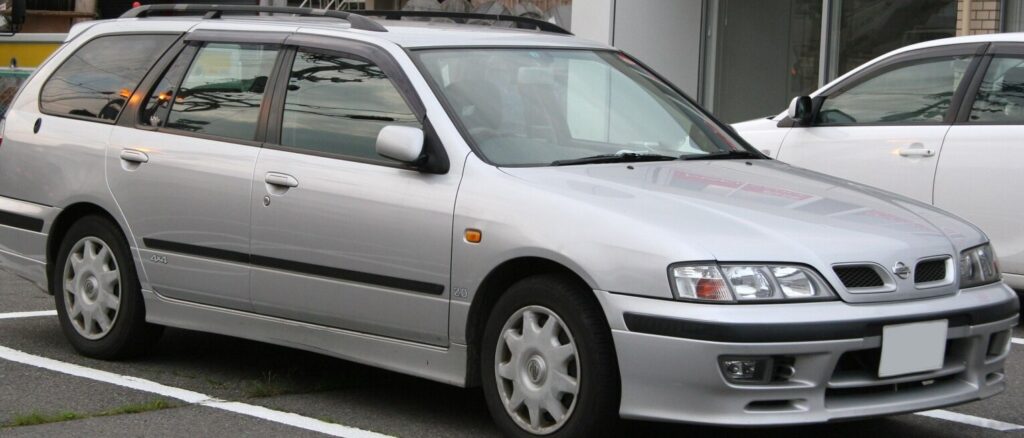
The Nissan Primera Wagon (P11) 2.0 16V, produced between 1998 and 2000, represented a practical and relatively upscale offering in the European and Asian markets. Positioned as a mid-range trim within the P11 Primera Wagon lineup, it aimed to balance performance, fuel efficiency, and family-oriented practicality. The P11 series, launched in 1997, was Nissan’s attempt to compete directly with established European rivals like the Ford Mondeo and Volkswagen Passat, offering a more refined and technologically advanced package than its predecessors. This particular variant, with its 2.0-liter engine and 16-valve configuration, provided a step up in power compared to the base models, while remaining more accessible than the more expensive options.
Technical Specifications
| Brand | Nissan |
| Model | Primera |
| Generation | Primera Wagon (P11) |
| Type (Engine) | 2.0 16V (115 Hp) |
| Start of production | 1998 |
| End of production | 2000 |
| Powertrain Architecture | Internal Combustion engine |
| Body type | Station wagon (estate) |
| Seats | 5 |
| Doors | 5 |
| Fuel Type | Petrol (Gasoline) |
| Power | 115 Hp @ 6000 rpm |
| Power per litre | 57.6 Hp/l |
| Torque | 166 Nm @ 4800 rpm / 122.44 lb.-ft. @ 4800 rpm |
| Engine layout | Front, Transverse |
| Engine Model/Code | SR20DE |
| Engine displacement | 1998 cm3 / 121.93 cu. in. |
| Number of cylinders | 4 |
| Engine configuration | Inline |
| Cylinder Bore | 86 mm / 3.39 in. |
| Piston Stroke | 86 mm / 3.39 in. |
| Compression ratio | 9.5:1 |
| Number of valves per cylinder | 4 |
| Fuel injection system | Multi-port manifold injection |
| Engine aspiration | Naturally aspirated engine |
| Valvetrain | DOHC |
| Engine oil capacity | 3.7 l / 3.91 US qt | 3.26 UK qt |
| Coolant | 6.6 l / 6.97 US qt | 5.81 UK qt |
| Trunk (boot) space – minimum | 430 l / 15.19 cu. ft. |
| Trunk (boot) space – maximum | 1650 l / 58.27 cu. ft. |
| Fuel tank capacity | 60 l / 15.85 US gal | 13.2 UK gal |
| Length | 4579 mm / 180.28 in. |
| Width | 1715 mm / 67.52 in. |
| Height | 1450 mm / 57.09 in. |
| Wheelbase | 2600 mm / 102.36 in. |
| Front track | 1465 mm / 57.68 in. |
| Rear (Back) track | 1454 mm / 57.24 in. |
| Drivetrain Architecture | The Internal combustion engine (ICE) drives the front wheels of the vehicle. |
| Drive wheel | Front wheel drive |
| Number of gears and type of gearbox | 5 gears, manual transmission |
| Front suspension | Spring-loaded rack |
| Rear suspension | Spring-loaded rack |
| Front brakes | Ventilated discs |
| Rear brakes | Disc |
| Assisting systems | ABS (Anti-lock braking system) |
| Steering type | Steering rack and pinion |
| Power steering | Hydraulic Steering |
| Tires size | 185/65 R14 |
Powertrain & Engine Architecture
The heart of the Primera Wagon 2.0 16V is the SR20DE engine, a 1.998-liter inline-four cylinder powerplant. This engine utilizes a double overhead camshaft (DOHC) valvetrain, operating 16 valves (four per cylinder) to optimize airflow and enhance performance. The SR20DE is a naturally aspirated engine, relying on atmospheric pressure for induction, and employs multi-port fuel injection for precise fuel delivery. The engine’s 9.5:1 compression ratio strikes a balance between efficiency and power output. The 5-speed manual transmission was the standard offering, providing drivers with direct control over the engine’s powerband. The SR20DE was known for its relative reliability and smooth operation, although it wasn’t considered a particularly high-performance engine.
Driving Characteristics
The 115 horsepower and 166 Nm (122 lb-ft) of torque delivered by the SR20DE engine in the Primera Wagon 2.0 16V provided adequate, but not exhilarating, performance. Acceleration was respectable for everyday driving, but it wasn’t designed for rapid overtaking or sporty driving. The 5-speed manual transmission allowed for reasonable control, but the gear ratios were geared towards fuel efficiency rather than outright speed. Compared to the more powerful 2.0 Visia models, the 16V version felt noticeably less responsive. The wagon’s weight, inherent in its body style, also contributed to a less agile feel compared to the Primera sedan.
Equipment & Trim Levels
The 2.0 16V Primera Wagon typically included features such as power windows, central locking, power steering, and an anti-lock braking system (ABS) as standard equipment. Interior upholstery was generally cloth, with a functional and durable design. Optional extras could include air conditioning, a sunroof, and upgraded audio systems. The trim level sat in the middle of the range, offering a good balance of features without the premium price tag of the higher-spec models. The dashboard layout was typical of Japanese cars of the era, prioritizing functionality and ease of use.
Chassis & Braking
The Primera Wagon utilized a spring-loaded rack suspension system both front and rear, providing a comfortable ride quality. The front brakes were ventilated discs, offering good stopping power, while the rear brakes were solid discs. The steering was a rack and pinion system with hydraulic power assistance, providing a reasonably responsive feel. The car rode on 185/65 R14 tires, which contributed to a comfortable ride but didn’t offer exceptional grip. Stabilizer bars were included to reduce body roll during cornering.
Market Reception & Comparison
The Nissan Primera Wagon 2.0 16V was generally well-received by automotive critics as a practical and reliable family car. It was praised for its spacious interior, comfortable ride, and good fuel economy. However, it was often criticized for its somewhat bland styling and lack of driving excitement compared to some of its European rivals. Compared to the higher-output Primera models, the 2.0 16V offered a more affordable entry point into the Primera range, but at the cost of performance. Fuel economy was competitive for its class, typically achieving around 30-35 mpg on a combined cycle.
Legacy
The Nissan Primera Wagon 2.0 16V, while not a particularly iconic model, remains a reasonably reliable and affordable used car option today. The SR20DE engine is known for its durability, and with proper maintenance, can provide many years of service. Parts availability is generally good, although some specific trim pieces may be difficult to find. The Primera Wagon 2.0 16V represents a solid, if unspectacular, example of a late-1990s family wagon, offering a blend of practicality, reliability, and affordability.