
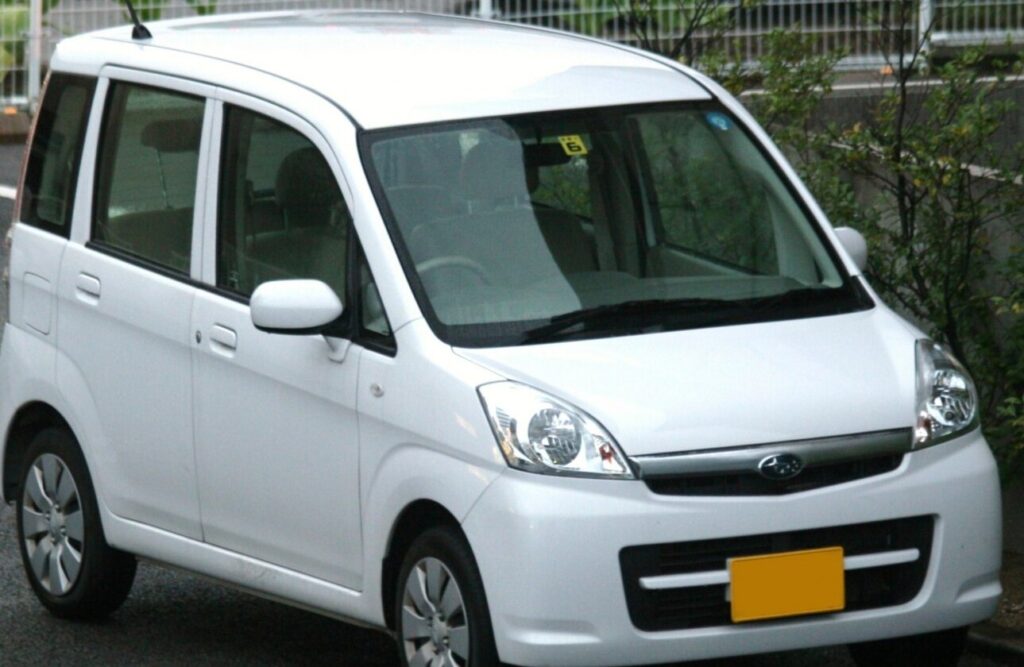
The Subaru Stella 0.7 L, produced between 2006 and 2011, represents Subaru’s entry into the Japanese Kei car segment – a class of ultra-compact and fuel-efficient vehicles designed for urban environments. The Stella, a five-door station wagon, was specifically tailored to the regulations governing Kei cars in Japan, focusing on affordability, practicality, and ease of maneuverability. This particular 0.7 L variant, equipped with a 64 horsepower engine, served as the base model within the Stella lineup, offering a no-frills transportation solution for Japanese buyers. It was a direct competitor to vehicles like the Daihatsu Mira and Suzuki Alto, all vying for dominance in the Kei car market.
Technical Specifications
| Brand | Subaru |
| Model | Stella |
| Generation | Stella |
| Type (Engine) | 0.7 (64 Hp) L |
| Start of production | 2006 |
| End of production | 2011 |
| Powertrain Architecture | Internal Combustion engine |
| Body type | Station wagon (estate) |
| Seats | 5 |
| Doors | 5 |
| Fuel Type | Petrol (Gasoline) |
| Emission standard | Euro 4 |
| Weight-to-power ratio | 13.4 kg/Hp, 74.4 Hp/tonne |
| Weight-to-torque ratio | 15.4 kg/Nm, 65.1 Nm/tonne |
| Power | 64 Hp @ 6400 rpm |
| Power per litre | 97.3 Hp/l |
| Torque | 56 Nm @ 4000 rpm, 41.3 lb.-ft. @ 4000 rpm |
| Engine layout | Front, Transverse |
| Engine Model/Code | EN07 |
| Engine displacement | 658 cm3, 40.15 cu. in. |
| Number of cylinders | 4 |
| Engine configuration | Inline |
| Cylinder Bore | 56 mm, 2.2 in. |
| Piston Stroke | 66.8 mm, 2.63 in. |
| Compression ratio | 10:1 |
| Number of valves per cylinder | 4 |
| Fuel injection system | Multi-port manifold injection |
| Engine aspiration | Naturally aspirated engine |
| Valvetrain | OHC |
| Engine oil capacity | 2.4 l, 2.54 US qt | 2.11 UK qt |
| Kerb Weight | 860 kg, 1895.98 lbs |
| Length | 3395 mm, 133.66 in |
| Width | 1475 mm, 58.07 in |
| Height | 1645 mm, 64.76 in |
| Wheelbase | 2360 mm, 92.91 in |
| Drivetrain Architecture | The Internal combustion engine (ICE) drives the front wheels of the vehicle. |
| Drive wheel | Front wheel drive |
Powertrain & Engine Architecture
The heart of the Stella 0.7 L is the EN07 engine, a 658cc inline-four cylinder petrol engine. This engine, designed specifically for Kei car regulations, utilizes a naturally aspirated configuration and multi-point fuel injection. The EN07 features an overhead camshaft (OHC) valvetrain, operating with four valves per cylinder. This configuration, while simple, was optimized for fuel efficiency and reliability rather than outright performance. The engine’s relatively high compression ratio of 10:1 contributes to its modest power output. The engine is transversely mounted at the front of the vehicle, driving the front wheels. The transmission paired with this engine is a four-speed automatic, chosen for its ease of use and suitability for urban driving conditions. This automatic transmission was not known for its sportiness, prioritizing smooth shifts and fuel economy over rapid acceleration.
Driving Characteristics
The Subaru Stella 0.7 L with the four-speed automatic transmission delivers a driving experience focused on practicality and ease. With only 64 horsepower, acceleration is understandably leisurely. The automatic transmission’s gear ratios are geared towards maximizing fuel efficiency, resulting in a noticeable delay when requesting sudden bursts of power. Compared to the available five-speed manual transmission, the automatic version sacrifices some responsiveness. However, the automatic provides a more relaxed driving experience, particularly in congested city traffic. The lightweight nature of the Stella (860 kg) helps to mitigate the lack of power to some extent, making it feel reasonably nimble in urban environments. The steering is light and easy, further enhancing its maneuverability.
Equipment & Trim Levels
The base-level Stella 0.7 L was typically equipped with basic amenities. Standard features generally included air conditioning, power steering, and a basic audio system. Interior upholstery was typically a simple cloth material. Safety features included dual airbags and anti-lock brakes (ABS) were often optional, depending on the specific year and package. Optional extras included power windows, central locking, and upgraded audio systems. The interior design was functional and utilitarian, prioritizing space efficiency over luxury. The dashboard layout was straightforward, with easily accessible controls.
Chassis & Braking
The Subaru Stella utilizes a front-wheel-drive layout with a MacPherson strut suspension in the front and a torsion beam suspension in the rear. The rear brakes were typically drum brakes, a cost-saving measure common in Kei cars, while the front brakes were disc brakes. The suspension setup was tuned for comfort and ride quality, rather than sporty handling. The relatively narrow tires and lightweight construction contribute to its predictable handling characteristics. Stabilizer bars were generally not included on the base model, further emphasizing its focus on comfort over performance.
Market Reception & Comparison
The Subaru Stella 0.7 L was generally well-received in Japan as an affordable and practical Kei car. Critics praised its fuel efficiency and ease of driving, but noted its limited power and basic interior. Compared to other Kei cars like the Daihatsu Mira and Suzuki Alto, the Stella offered a slightly more refined driving experience, but at a slightly higher price point. The automatic transmission version, while convenient, was often criticized for its sluggish performance compared to the manual transmission option. Fuel economy was a key selling point, with the Stella achieving respectable figures for its class. Reliability was generally good, with the EN07 engine proving to be a durable and dependable unit.
Legacy
The Subaru Stella, while not exported to many markets outside of Japan, remains a popular choice in the used Kei car market. The 0.7 L variant, with its automatic transmission, is particularly sought after by drivers who prioritize convenience and ease of use. The EN07 engine is known for its longevity and relatively low maintenance costs. However, potential buyers should be aware of the limited power output and the potential for age-related wear and tear on the automatic transmission. The Stella represents a significant chapter in Subaru’s history, demonstrating their ability to adapt to the unique demands of the Japanese Kei car market. Today, it’s remembered as a practical and economical city car that provided affordable transportation for many Japanese families.
