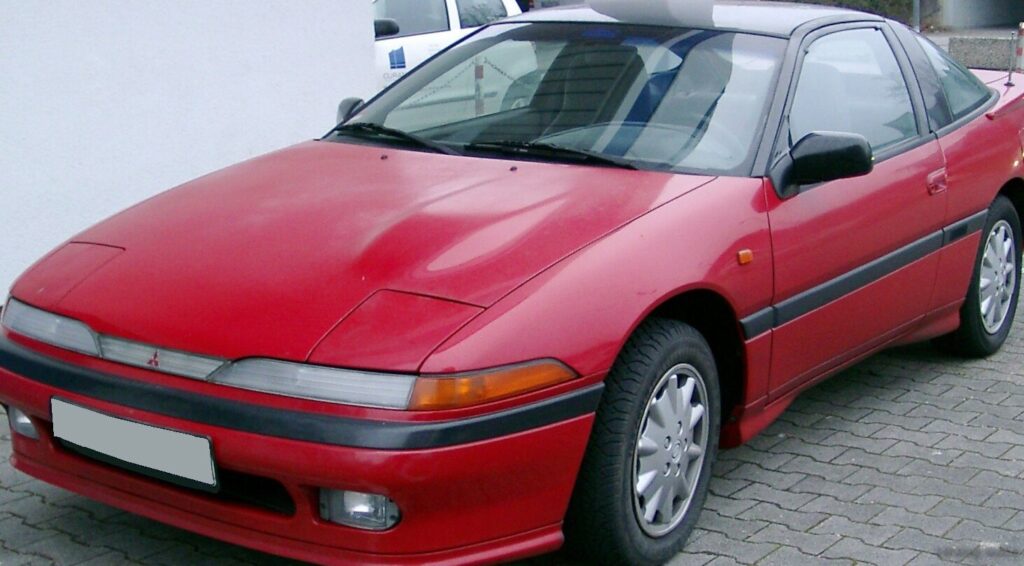
The Mitsubishi Eclipse first generation (1G), produced from 1990 to 1992, represented Mitsubishi’s entry into the increasingly popular compact coupe and liftback market. Positioned as an affordable and stylish alternative to established players like the Toyota Celica and Honda Prelude, the 1.8-liter (93 hp) automatic variant served as the entry point to the Eclipse range. This model, available in both coupe and liftback body styles, aimed to attract buyers seeking a blend of practicality, fuel efficiency, and a sporty aesthetic. It was built on the Mitsubishi 1HX0 platform, shared with the Eagle Talon and Plymouth Laser, a result of the Diamond Star Motors joint venture with Chrysler.
Technical Specifications
| Brand | Mitsubishi |
| Model | Eclipse |
| Generation | Eclipse I (1G) |
| Type (Engine) | 1.8 (93 Hp) Automatic |
| Start of production | 1990 |
| End of production | 1992 |
| Powertrain Architecture | Internal Combustion engine |
| Body type | Coupe, Liftback |
| Seats | 4 |
| Doors | 2 |
| Fuel consumption (urban) | 10 l/100 km (23.5 US mpg) |
| Fuel consumption (extra urban) | 6 l/100 km (39.2 US mpg) |
| Fuel Type | Petrol (Gasoline) |
| Maximum speed | 170 km/h (105.63 mph) |
| Weight-to-power ratio | 12.3 kg/Hp |
| Weight-to-torque ratio | 8.1 kg/Nm |
| Power | 93 Hp @ 5000 rpm |
| Power per litre | 53 Hp/l |
| Torque | 142 Nm @ 3500 rpm (104.73 lb.-ft. @ 3500 rpm) |
| Engine layout | Front, Transverse |
| Engine displacement | 1755 cm3 (107.1 cu. in.) |
| Number of cylinders | 4 |
| Engine configuration | Inline |
| Cylinder Bore | 80.6 mm (3.17 in.) |
| Piston Stroke | 86 mm (3.39 in.) |
| Compression ratio | 9:1 |
| Number of valves per cylinder | 2 |
| Fuel injection system | Multi-port manifold injection |
| Engine aspiration | Naturally aspirated engine |
| Valvetrain | OHC |
| Kerb Weight | 1145 kg (2524.29 lbs.) |
| Trunk (boot) space – minimum | 290 l (10.24 cu. ft.) |
| Trunk (boot) space – maximum | 730 l (25.78 cu. ft.) |
| Fuel tank capacity | 60 l (15.85 US gal | 13.2 UK gal) |
| Length | 4340 mm (170.87 in.) |
| Width | 1690 mm (66.54 in.) |
| Height | 1305 mm (51.38 in.) |
| Wheelbase | 2470 mm (97.24 in.) |
| Front track | 1465 mm (57.68 in.) |
| Rear (Back) track | 1450 mm (57.09 in.) |
| Drivetrain Architecture | Front wheel drive |
| Number of gears and type of gearbox | 4 gears, automatic transmission |
| Front suspension | Coil spring |
| Rear suspension | Coil spring |
| Front brakes | Ventilated discs |
| Rear brakes | Disc |
| Assisting systems | ABS (Anti-lock braking system) |
| Steering type | Steering rack and pinion |
| Power steering | Hydraulic Steering |
| Tires size | 185/70 R14 |
| Wheel rims size | 14 |
Powertrain & Engine Architecture
The heart of the 1.8-liter Eclipse was the 4G37 engine, a naturally aspirated, inline-four cylinder powerplant. This engine, producing 93 horsepower at 5000 rpm and 142 Nm (104.73 lb-ft) of torque at 3500 rpm, featured a single overhead camshaft (OHC) valvetrain with two valves per cylinder. Fuel delivery was handled by a multi-port fuel injection system, contributing to relatively smooth operation and acceptable fuel economy for the time. The engine’s 9:1 compression ratio was a typical value for naturally aspirated engines of this era. The automatic transmission was a four-speed unit, designed to provide comfortable and convenient shifting. While not known for its sportiness, it was a reliable unit, though it did impact overall acceleration compared to the available five-speed manual transmission.
Driving Characteristics
The 1.8-liter automatic Eclipse offered a comfortable, if not particularly exhilarating, driving experience. Acceleration was adequate for everyday driving, but the automatic transmission and relatively low horsepower meant it wasn’t a performance leader. The four-speed automatic’s gear ratios were tuned for fuel efficiency rather than rapid acceleration. Compared to the higher-output 2.0-liter variants, or even the turbocharged models that would arrive in later generations, the 1.8 felt noticeably slower. The front-wheel-drive configuration provided predictable handling, but lacked the dynamic capabilities of all-wheel-drive systems found in some competitors. The suspension, tuned for comfort, absorbed bumps reasonably well, making it a suitable daily driver.
Equipment & Trim Levels
The base 1.8-liter automatic Eclipse typically came with a fairly basic level of equipment. Standard features generally included cloth upholstery, a basic AM/FM stereo, manual windows and locks, and power steering. Air conditioning was often an optional extra. The interior design was functional and straightforward, prioritizing usability over luxury. Higher trim levels, such as the RS or LS, added features like upgraded audio systems, power windows and locks, cruise control, and alloy wheels. The liftback configuration offered increased cargo versatility compared to the coupe, with a significantly larger trunk volume when the rear seats were folded down.
Chassis & Braking
The Eclipse 1G utilized a front-engine, front-wheel-drive layout. Suspension consisted of coil springs all around, providing a comfortable ride. The front suspension featured independent struts, while the rear used a semi-independent twist beam setup. Braking duties were handled by ventilated discs at the front and solid discs at the rear. An anti-lock braking system (ABS) was available as an option, enhancing safety by preventing wheel lockup during hard braking. The steering system was a rack-and-pinion setup with hydraulic power assistance, providing reasonably precise steering feel.
Market Reception & Comparison
The 1.8-liter automatic Eclipse was generally well-received as an affordable and practical coupe. Critics praised its styling and interior space, but noted that its performance was somewhat underwhelming compared to some competitors. Fuel economy was a strong point, making it an attractive option for budget-conscious buyers. Compared to the more powerful 2.0-liter versions of the Eclipse, the 1.8 offered a lower price point but sacrificed performance. The 2.0-liter models, particularly those with the five-speed manual transmission, were favored by enthusiasts seeking a more engaging driving experience. The 1.8 automatic appealed to buyers prioritizing comfort, convenience, and fuel efficiency over outright speed.
Legacy
The first-generation Mitsubishi Eclipse, including the 1.8-liter automatic variant, laid the foundation for a successful model line that would continue for several generations. While the 4G37 engine isn’t known for being particularly complex, regular maintenance is key to longevity. Today, these cars are increasingly sought after by collectors and enthusiasts, particularly well-maintained examples. The 1.8 automatic, while not the most desirable trim, remains a relatively affordable entry point into the Eclipse world. Common issues include age-related wear and tear on suspension components, and potential for oil leaks. However, parts availability is generally good, and the relatively simple mechanical design makes it a manageable project for DIY mechanics.