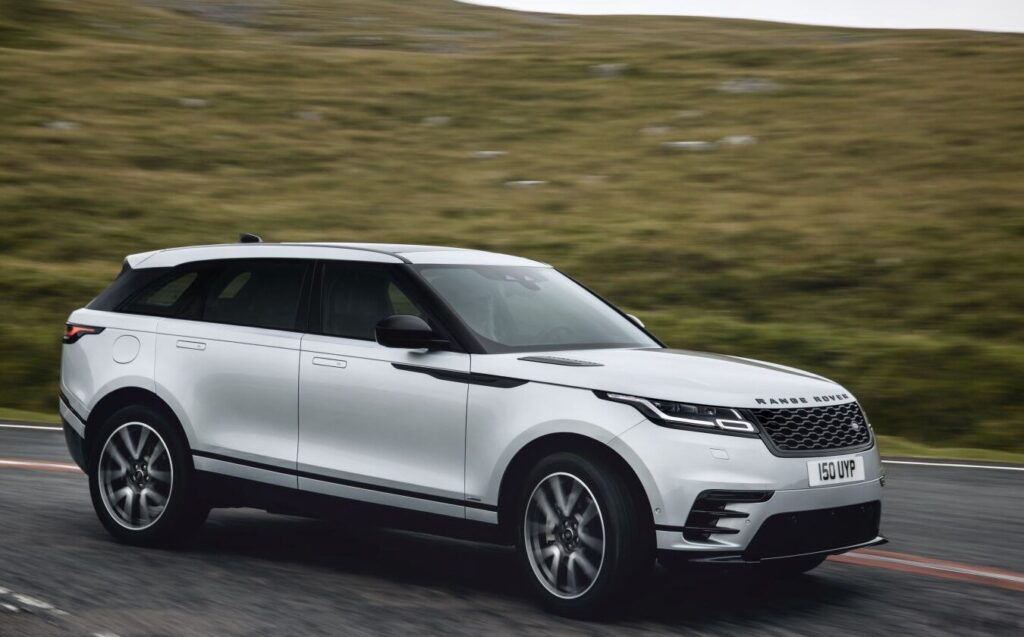
The Land Rover Range Rover Velar, introduced for the 2018 model year, quickly established itself as a stylish and technologically advanced mid-size luxury SUV. The 2020 facelift brought refinements to both the exterior and interior, along with updated powertrain options. The 3.0 D300 variant, produced from September 2020 to February 2023, represents a significant offering within the Velar lineup, positioned as a performance-oriented diesel option. This model combined a potent 3.0-liter inline-six diesel engine with a sophisticated all-wheel-drive system and an eight-speed automatic transmission, targeting buyers seeking a blend of luxury, capability, and efficiency.
Technical Specifications
| Brand | Land Rover |
| Model | Range Rover Velar |
| Generation | Range Rover Velar (facelift 2020) |
| Type (Engine) | 3.0 D300 (300 Hp) AWD Automatic |
| Start of production | September, 2020 |
| End of production | February, 2023 |
| Powertrain Architecture | Internal Combustion engine |
| Body type | SUV |
| Seats | 5 |
| Doors | 5 |
| Fuel Type | Diesel |
| Acceleration 0 – 100 km/h | 6.5 sec |
| Acceleration 0 – 62 mph | 6.5 sec |
| Acceleration 0 – 60 mph | 6.1 sec |
| Maximum speed | 230 km/h (142.92 mph) |
| Emission standard | Euro 5 |
| Weight-to-power ratio | 6.6 kg/Hp, 150.5 Hp/tonne |
| Weight-to-torque ratio | 3.1 kg/Nm, 326.1 Nm/tonne |
| Power | 300 Hp @ 4000 rpm |
| Power per litre | 100.1 Hp/l |
| Torque | 650 Nm @ 1500-2500 rpm (479.42 lb.-ft. @ 1500-2500 rpm) |
| Engine layout | Front, Longitudinal |
| Engine Model/Code | Ingenium / AJ20D6 |
| Engine displacement | 2996 cm3 (182.83 cu. in.) |
| Number of cylinders | 6 |
| Engine configuration | Inline |
| Cylinder Bore | 83.01 mm (3.27 in.) |
| Piston Stroke | 92.3 mm (3.63 in.) |
| Compression ratio | 15.5:1 |
| Number of valves per cylinder | 4 |
| Fuel injection system | Diesel Commonrail |
| Engine aspiration | Turbocharger, Intercooler |
| Engine oil capacity | 10 l (10.57 US qt | 8.8 UK qt) |
| Kerb Weight | 1993 kg (4393.81 lbs.) |
| Trunk (boot) space – minimum | 748 l (26.42 cu. ft.) |
| Trunk (boot) space – maximum | 1811 l (63.95 cu. ft.) |
| Fuel tank capacity | 66 l (17.44 US gal | 14.52 UK gal) |
| AdBlue tank | 17 l (4.49 US gal | 3.74 UK gal) |
| Permitted trailer load with brakes (12%) | 2500 kg (5511.56 lbs.) |
| Permitted trailer load without brakes | 750 kg (1653.47 lbs.) |
| Length | 4797 mm (188.86 in.) |
| Width with mirrors folded | 2041 mm (80.35 in.) |
| Width including mirrors | 2147 mm (84.53 in.) |
| Height | 1678-1683 mm (66.06 – 66.26 in.) |
| Wheelbase | 2874 mm (113.15 in.) |
| Front track | 1640-1644 mm (64.57 – 64.72 in.) |
| Rear (Back) track | 1657-1663 mm (65.24 – 65.47 in.) |
| Front overhang | 834 mm (32.83 in.) |
| Rear overhang | 1089 mm (42.87 in.) |
| Ride height (ground clearance) | 205-251 mm (8.07 – 9.88 in.) |
| Drag coefficient (Cd) | 0.33 |
| Minimum turning circle (turning diameter) | 11.94 m (39.17 ft.) |
| Approach angle | 22.5-27.5° |
| Departure angle | 24.8-29.5° |
| Ramp-over (brakeover) angle | 18.3-23.5° |
| Wading depth | 530-580 mm (20.87 – 22.83 in.) |
| Drivetrain Architecture | The Internal combustion engine (ICE) drives the rear wheels permanently, and the front wheels are driven through an electrically or mechanically operated clutch if necessary. |
| Drive wheel | All wheel drive (4×4) |
| Number of gears and type of gearbox | 8 gears, automatic transmission |
| Front suspension | Double wishbone |
| Rear suspension | Independent multi-link suspension |
| Front brakes | Ventilated discs, 370 mm |
| Rear brakes | Ventilated discs, 325 mm |
| Assisting systems | ABS (Anti-lock braking system) |
| Steering type | Steering rack and pinion |
| Power steering | Electric Steering |
INTRODUCTION
The Land Rover Range Rover Velar 3.0 D300 AWD Automatic, introduced with the 2020 facelift, represents a compelling blend of performance and refinement within the Velar model range. Built on the Premium Lightweight Architecture (PLA), also known as the iLQ platform, this variant aimed to deliver a more engaging driving experience than the lower-powered engine options while maintaining the Velar’s signature luxury and sophisticated design. Positioned above the 2.0-liter Ingenium engines, the D300 offered a significant power upgrade, appealing to drivers prioritizing strong acceleration and effortless cruising. Production spanned from September 2020 to February 2023, making it a relatively short-lived but notable iteration of the Velar.
Powertrain & Engine Architecture
At the heart of the D300 lies Land Rover’s Ingenium 3.0-liter inline-six diesel engine, designated as the AJ20D6. This engine utilizes a sophisticated diesel commonrail fuel injection system, delivering precise fuel metering for optimal combustion. A single turbocharger, coupled with an intercooler, provides ample boost, contributing to the engine’s 300 horsepower and 650 Nm (479.42 lb-ft) of torque. The torque peak, available from 1500-2500 rpm, ensures strong pulling power across a wide rev range. The engine also incorporates Start & Stop technology and a particulate filter to meet Euro 5 emission standards. Paired with the engine is a ZF eight-speed automatic transmission, known for its smooth and responsive shifts. This transmission is electronically controlled and adapts its shift points based on driving conditions and driver input. The all-wheel-drive system is a full-time setup, with a rear-wheel bias, enhancing handling and stability.
Driving Characteristics
The Velar D300 delivers a noticeably more spirited driving experience compared to the four-cylinder models. The abundant torque allows for effortless acceleration in everyday driving situations, and the 6.1-second 0-60 mph sprint demonstrates its performance capabilities. The eight-speed automatic transmission contributes to a relaxed cruising experience, with well-chosen gear ratios keeping the engine within its optimal power band. While not a sports SUV, the D300 offers a confident and composed ride, thanks to the well-tuned suspension and all-wheel-drive system. The steering is precise and well-weighted, providing good feedback to the driver. Compared to the higher-performance petrol variants, the D300 prioritizes torque delivery over outright horsepower, making it particularly well-suited for towing and long-distance journeys.
Equipment & Trim Levels
The D300 trim typically came well-equipped as standard, reflecting its position as a higher-spec model. Standard features generally included leather upholstery, heated front seats, a touchscreen infotainment system with navigation, a premium sound system, and a suite of advanced driver-assistance systems (ADAS) such as adaptive cruise control, lane keep assist, and automatic emergency braking. Optional extras included features like a panoramic sunroof, upgraded leather trim, configurable ambient lighting, and a head-up display. The interior design emphasized minimalism and sophistication, with a focus on high-quality materials and intuitive controls.
Chassis & Braking
The Velar D300 utilizes a double-wishbone front suspension and an independent multi-link rear suspension, providing a comfortable and controlled ride. The suspension is tuned to balance ride comfort with handling precision. Braking duties are handled by ventilated discs on all four wheels, with larger 370mm discs at the front and 325mm discs at the rear. The braking system is assisted by ABS (Anti-lock Braking System) and electronic brake-force distribution. Stabilizer bars are fitted to both the front and rear axles to reduce body roll during cornering.
Market Reception & Comparison
The Range Rover Velar D300 was generally well-received by automotive critics. Reviewers praised its powerful engine, refined ride, and luxurious interior. The diesel engine was noted for its efficiency and strong torque delivery, making it a practical choice for long-distance driving. Compared to the 2.0-liter diesel and petrol variants, the D300 offered a significant performance upgrade. However, it was more expensive and slightly less fuel-efficient. Against competitors like the Porsche Macan and BMW X3, the Velar D300 stood out with its distinctive styling and luxurious interior, although some critics noted that its infotainment system could be less intuitive than those offered by its German rivals.
Legacy
The Ingenium 3.0-liter diesel engine has proven to be a reliable and durable powertrain, and the D300 variant of the Velar has maintained a relatively good reputation for long-term reliability. On the used car market, the D300 commands a premium over the lower-powered models, reflecting its performance and equipment levels. Regular maintenance, including oil changes and adherence to Land Rover’s service schedule, is crucial for ensuring the longevity of this powertrain. The Velar D300 remains a desirable option for buyers seeking a stylish, capable, and refined luxury SUV with a strong diesel engine.