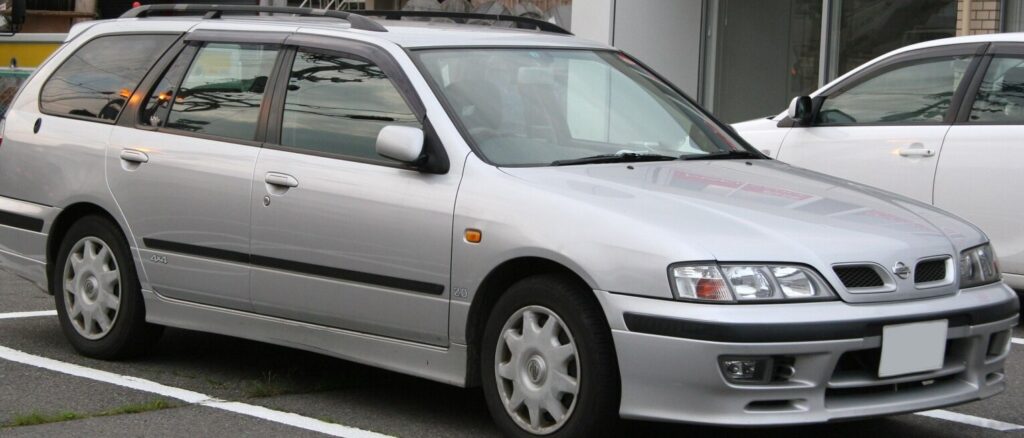
The Nissan Primera Wagon (P11) 2.0 16V, produced between 1999 and 2002, represented a practical and relatively upscale offering in the European and Asian markets. Positioned as a mid-range trim within the P11 Primera Wagon lineup, it aimed to balance performance with fuel efficiency and family-oriented practicality. The P11 series, launched in 1997, was Nissan’s attempt to compete directly with established European and Japanese rivals in the mid-size family car segment, offering a more refined experience than previous Primera models. This particular variant, with its 2.0-liter engine and 16-valve head, provided a step up in power compared to the base 1.6L models, while remaining more accessible than the more expensive and less common 2.2-liter options.
Technical Specifications
| Brand | Nissan |
| Model | Primera |
| Generation | Primera Wagon (P11) |
| Type (Engine) | 2.0 16V (140 Hp) |
| Start of production | 1999 year |
| End of production | 2002 year |
| Powertrain Architecture | Internal Combustion engine |
| Body type | Station wagon (estate) |
| Seats | 5 |
| Doors | 5 |
| Fuel consumption (urban) | 11.4 l/100 km (20.6 US mpg) |
| Fuel consumption (extra urban) | 6.5 l/100 km (36.2 US mpg) |
| Fuel Type | Petrol (Gasoline) |
| Acceleration 0 – 100 km/h | 10.5 sec |
| Acceleration 0 – 62 mph | 10.5 sec |
| Acceleration 0 – 60 mph | 10 sec |
| Maximum speed | 205 km/h (127.38 mph) |
| Weight-to-power ratio | 9.5 kg/Hp |
| Weight-to-torque ratio | 7.4 kg/Nm |
| Power | 140 Hp @ 5800 rpm |
| Power per litre | 70.1 Hp/l |
| Torque | 181 Nm @ 4800 rpm (133.5 lb.-ft. @ 4800 rpm) |
| Engine layout | Front, Transverse |
| Engine Model/Code | SR20DE |
| Engine displacement | 1998 cm3 (121.93 cu. in.) |
| Number of cylinders | 4 |
| Engine configuration | Inline |
| Cylinder Bore | 86 mm (3.39 in.) |
| Piston Stroke | 86 mm (3.39 in.) |
| Compression ratio | 10:1 |
| Number of valves per cylinder | 4 |
| Fuel injection system | Multi-port manifold injection |
| Engine aspiration | Naturally aspirated engine |
| Valvetrain | DOHC |
| Engine oil capacity | 3.7 l (3.91 US qt | 3.26 UK qt) |
| Coolant capacity | 6.6 l (6.97 US qt | 5.81 UK qt) |
| Kerb Weight | 1335 kg (2943.17 lbs.) |
| Max. weight | 1815 kg (4001.39 lbs.) |
| Max load | 480 kg (1058.22 lbs.) |
| Trunk (boot) space – minimum | 430 l (15.19 cu. ft.) |
| Trunk (boot) space – maximum | 1650 l (58.27 cu. ft.) |
| Fuel tank capacity | 60 l (15.85 US gal | 13.2 UK gal) |
| Length | 4579 mm (180.28 in.) |
| Width | 1715 mm (67.52 in.) |
| Height | 1450 mm (57.09 in.) |
| Wheelbase | 2600 mm (102.36 in.) |
| Front track | 1465 mm (57.68 in.) |
| Rear track | 1454 mm (57.24 in.) |
| Drivetrain Architecture | Front wheel drive |
| Number of gears | 5 gears, manual transmission |
| Front suspension | Spring-loaded rack |
| Rear suspension | Spring-loaded rack |
| Front brakes | Ventilated discs |
| Rear brakes | Disc |
| Assisting systems | ABS (Anti-lock braking system) |
| Steering type | Steering rack and pinion |
| Power steering | Hydraulic Steering |
| Tires size | 195/60R15 |
Powertrain & Engine Architecture
The heart of the Primera Wagon 2.0 16V is the SR20DE engine, a 1998cc inline-four cylinder powerplant. This engine, a staple in Nissan’s lineup during the late 1990s and early 2000s, is known for its relative reliability and smooth operation. The ‘DE’ designation signifies Nissan’s Dual Energy injection system, a multi-point fuel injection setup that optimizes fuel delivery for improved efficiency and power. The engine features a double overhead camshaft (DOHC) valvetrain, operating 16 valves (four per cylinder) to enhance breathing and high-rpm performance. The SR20DE is a non-interference engine, meaning that even if the timing belt breaks, the valves and pistons won’t collide, reducing the risk of catastrophic engine damage. The five-speed manual transmission was the standard offering for this trim, providing a direct and engaging driving experience. The transmission’s gear ratios were tuned for a balance between acceleration and fuel economy, with a relatively tall fifth gear for comfortable highway cruising.
Driving Characteristics
The 140 horsepower and 133.5 lb-ft of torque produced by the SR20DE engine in the Primera Wagon 2.0 16V provided adequate, though not exhilarating, performance. Acceleration from 0-60 mph took around 10 seconds, making it competitive with other mid-size wagons of the era. The engine felt responsive in the mid-range, offering sufficient power for overtaking maneuvers and maintaining speed on inclines. Compared to the base 1.6L Primera Wagon, the 2.0L offered a noticeable improvement in both acceleration and overall drivability. However, it didn’t possess the outright punch of the larger 2.2L engine, which was typically reserved for higher-spec trims. The manual transmission allowed for precise control over the engine’s powerband, while the relatively lightweight chassis contributed to a reasonably agile feel. The suspension, tuned for comfort, provided a compliant ride, but didn’t offer the sporty handling characteristics of some rivals.
Equipment & Trim Levels
The 2.0 16V Primera Wagon typically came equipped with a respectable level of standard features. Interior appointments included cloth upholstery, power windows, central locking, and a basic audio system. Air conditioning was generally standard, though higher trim levels offered climate control. Safety features included ABS anti-lock brakes and driver and passenger airbags. Optional extras included alloy wheels, a sunroof, and upgraded audio systems. The trim level sat comfortably in the middle of the Primera Wagon range, offering a good balance of features and affordability. It was aimed at families and individuals who prioritized practicality and comfort over outright performance or luxury.
Chassis & Braking
The Primera Wagon’s chassis utilized a MacPherson strut front suspension and a spring-loaded rack rear suspension. This setup provided a good compromise between ride comfort and handling stability. The front brakes were ventilated discs, offering good stopping power, while the rear brakes were solid discs. The ABS system helped to prevent wheel lockup during hard braking, enhancing safety. The steering was a hydraulic power-assisted rack and pinion system, providing a reasonably light and precise feel. The car rode on 195/60R15 tires, which offered a good balance of grip and ride comfort.
Market Reception & Comparison
The Nissan Primera Wagon 2.0 16V was generally well-received by automotive critics as a practical and reliable family car. It was praised for its spacious interior, comfortable ride, and fuel efficiency. However, some critics noted that its styling was somewhat conservative and that its performance wasn’t particularly exciting. Compared to rivals like the Ford Mondeo and Volkswagen Passat, the Primera Wagon offered a competitive package, but often lacked the brand prestige of its European competitors. Fuel economy was a strong point, with the 2.0L engine achieving around 36 mpg on the extra-urban cycle. Reliability was also a key strength, with the SR20DE engine proving to be a durable and long-lasting unit.
Legacy
The Nissan Primera Wagon 2.0 16V has proven to be a relatively reliable and durable vehicle in the used car market. The SR20DE engine is known for its longevity, and with regular maintenance, can continue to provide years of service. Parts availability is generally good, although some trim-specific components may be harder to find. Today, these wagons are often sought after by those looking for a practical and affordable family car with a reputation for reliability. While not a particularly collectible model, the Primera Wagon 2.0 16V represents a solid and dependable offering from Nissan during a period of increasing competition in the mid-size family car segment.