
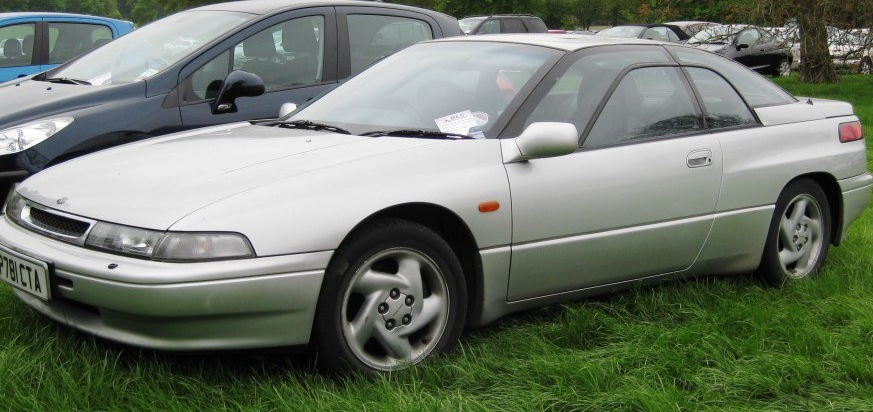
The Subaru SVX, internally designated as the CX, represented a bold departure for the Japanese automaker when it debuted in 1991 and continued through 1996 in the US market, with production extending to 1997 in some other regions. The 3.3i 24V 4WD (CXW) variant, producing 220 horsepower, was the sole engine and drivetrain configuration offered throughout its production run. This grand touring coupe aimed to compete with established European GT cars, offering a unique blend of Japanese engineering and distinctive styling. The SVX was built on Subaru’s unique platform, showcasing their commitment to all-wheel drive and horizontally-opposed “boxer” engines.
Technical Specifications
| Brand | Subaru |
| Model | SVX |
| Generation | SVX (CX) |
| Type (Engine) | 3.3 i 24V 4WD (CXW) (220 Hp) |
| Start of production | 1994 year |
| End of production | 1997 year |
| Powertrain Architecture | Internal Combustion engine |
| Body type | Coupe |
| Seats | 4 |
| Doors | 2 |
| Fuel consumption (combined) | 10.3 l/100 km |
| Fuel consumption (US mpg) | 22.8 US mpg |
| Fuel consumption (UK mpg) | 27.4 UK mpg |
| Fuel consumption (km/l) | 9.7 km/l |
| Fuel Type | Petrol (Gasoline) |
| Acceleration 0 – 100 km/h | 8.7 sec |
| Acceleration 0 – 62 mph | 8.7 sec |
| Acceleration 0 – 60 mph | 8.3 sec |
| Maximum speed | 230 km/h (142.92 mph) |
| Weight-to-power ratio | 5.9 kg/Hp |
| Power | 220 Hp @ 5600 rpm |
| Torque | 304 Nm @ 4600 rpm (224.22 lb.-ft. @ 4600 rpm) |
| Engine layout | Front, Longitudinal |
| Engine Model/Code | EG33 |
| Engine displacement | 3319 cm3 (202.54 cu. in.) |
| Number of cylinders | 6 |
| Engine configuration | Boxer |
| Cylinder Bore | 96.9 mm (3.81 in.) |
| Piston Stroke | 75 mm (2.95 in.) |
| Compression ratio | 10:1 |
| Number of valves per cylinder | 4 |
| Fuel injection system | Multi-port manifold injection |
| Engine aspiration | Naturally aspirated engine |
| Valvetrain | DOHC |
| Engine oil capacity | 6 l (6.34 US qt | 5.28 UK qt) |
| Coolant capacity | 7.8 l (8.24 US qt | 6.86 UK qt) |
| Kerb Weight | 1300 kg (2866.01 lbs.) |
| Max. weight | 2045 kg (4508.45 lbs.) |
| Max load | 745 kg (1642.44 lbs.) |
| Trunk (boot) space – minimum | 466 l (16.46 cu. ft.) |
| Trunk (boot) space – maximum | 1610 l (56.86 cu. ft.) |
| Fuel tank capacity | 70 l (18.49 US gal | 15.4 UK gal) |
| Length | 4625 mm (182.09 in.) |
| Width | 1770 mm (69.69 in.) |
| Height | 1770 mm (69.69 in.) |
| Wheelbase | 2610 mm (102.76 in.) |
| Front track | 1500 mm (59.06 in.) |
| Rear track | 1480 mm (58.27 in.) |
| Drive wheel | All wheel drive (4×4) |
| Number of gears | 4 |
| Gearbox type | automatic transmission |
| Front suspension | Coil spring |
| Rear suspension | Coil spring |
| Front brakes | Ventilated discs |
| Rear brakes | Ventilated discs |
| Assisting systems | ABS (Anti-lock braking system) |
| Steering type | Steering rack and pinion |
| Power steering | Hydraulic Steering |
| Tires size | 225/50 R16 |
| Wheel rims size | 7.5 J |
Powertrain & Engine Architecture
The heart of the SVX CXW is the EG33 3.3-liter flat-six “boxer” engine. This engine, a hallmark of Subaru engineering, features horizontally opposed cylinders, contributing to a low center of gravity and improved balance. The EG33 utilizes a multi-port fuel injection system and a dual overhead camshaft (DOHC) valvetrain with four valves per cylinder. This configuration allowed for a respectable 220 horsepower and 304 Nm (224 lb-ft) of torque. The engine’s longitudinal mounting and all-wheel-drive system necessitated a robust automatic transmission. The 4-speed automatic, while reliable, wasn’t known for its sporty responsiveness, prioritizing smooth shifts over aggressive downchanges. The engine code EG33 was used throughout the SVX’s production run, with minor revisions over the years.
Driving Characteristics
The SVX 3.3i Automatic offered a comfortable and refined driving experience, but it wasn’t a sports car in the traditional sense. The automatic transmission, while smooth, resulted in slightly slower acceleration compared to the manual transmission versions available in other markets. The 0-60 mph time of around 8.3 seconds was adequate for the era, but not particularly thrilling. The all-wheel-drive system provided excellent traction in all weather conditions, making it a capable grand tourer. The gear ratios were tuned for cruising comfort, with a focus on maintaining low engine speeds at highway speeds. Power delivery was linear, but the engine lacked the high-revving excitement of some of its European competitors.
Equipment & Trim Levels
The SVX CXW came reasonably well-equipped as standard. Features included leather upholstery, power-adjustable front seats, air conditioning, a premium sound system, and power windows and locks. The distinctive “window-within-a-window” design, featuring a small fixed rear window within a larger wraparound glass, was a signature SVX styling element. Optional extras included a sunroof, upgraded audio systems, and various cosmetic enhancements. The interior design was focused on providing a luxurious and comfortable environment for both driver and passengers.
Chassis & Braking
The SVX featured a fully independent suspension system with coil springs and anti-roll bars. The front suspension utilized MacPherson struts, while the rear employed a semi-trailing arm design. Braking duties were handled by ventilated disc brakes on all four wheels, supplemented by an Anti-lock Braking System (ABS). The chassis was designed to provide a stable and comfortable ride, prioritizing grand touring capabilities over outright handling prowess. The weight distribution, aided by the boxer engine, contributed to balanced handling characteristics.
Market Reception & Comparison
The Subaru SVX received mixed reviews upon its release. Critics praised its unique styling, comfortable interior, and all-weather capability. However, the automatic transmission was often criticized for its lack of responsiveness, and the price point positioned it in direct competition with more established European GT cars. Compared to the manual transmission versions, the automatic SVX offered less engaging driving experience. Fuel economy, at around 22.8 mpg, was average for the time. Reliability was generally good, although the complex engine and all-wheel-drive system could require more specialized maintenance.
Legacy
The Subaru SVX, while not a commercial success, remains a fondly remembered and somewhat quirky vehicle. The EG33 engine, while not without its quirks, proved to be relatively durable with proper maintenance. Today, the SVX has gained a cult following among Subaru enthusiasts and collectors. Parts availability can be a challenge, but a dedicated community exists to support owners. The SVX’s unique design and engineering continue to set it apart from other vehicles of its era, solidifying its place as a distinctive and memorable chapter in Subaru’s history. The 4-speed automatic transmission, while not the most modern, has proven to be reasonably reliable, though regular fluid changes are crucial for longevity.
