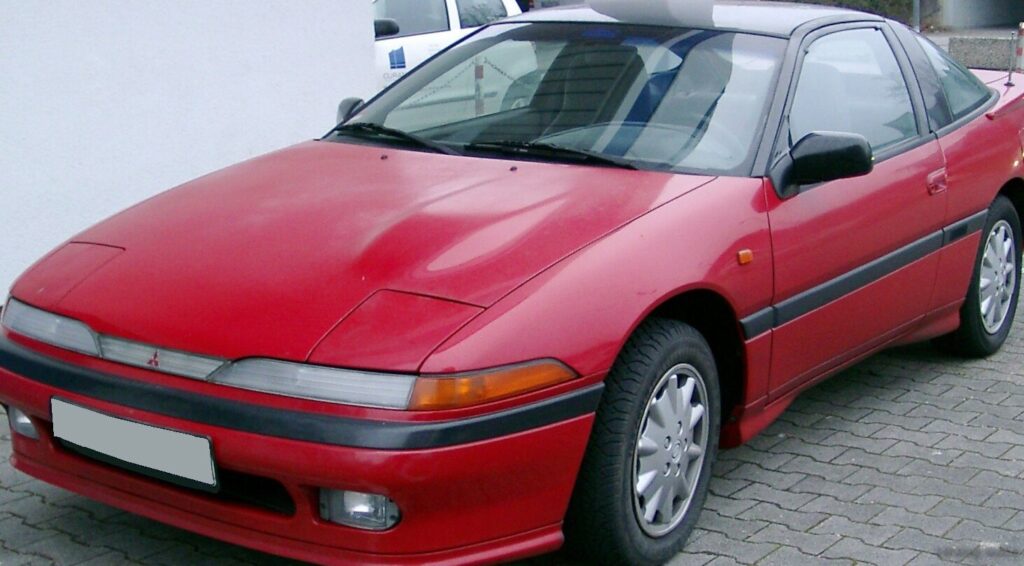
The Mitsubishi Eclipse first generation (1G), produced from 1990 to 1994, represented Mitsubishi’s entry into the increasingly popular North American sports coupe market. This front-wheel drive coupe, available in both coupe and liftback body styles, aimed to provide an affordable and stylish alternative to established players like the Toyota Celica and Honda Prelude. The 2.0i 16V variant, powered by the 4G63 engine producing 150 horsepower, was a key model in the lineup, bridging the gap between the base models and the more performance-oriented turbocharged versions. Production of this specific configuration ran from 1991 to 1992, solidifying its place as a significant offering during the early years of the first-generation Eclipse.
Technical Specifications
| Brand | Mitsubishi |
| Model | Eclipse |
| Generation | Eclipse I (1G) |
| Type (Engine) | 2.0 i 16V (150 Hp) |
| Start of production | 1991 year |
| End of production | 1992 year |
| Powertrain Architecture | Internal Combustion engine |
| Body type | Coupe, Liftback |
| Seats | 4 |
| Doors | 2 |
| Fuel consumption (urban) | 14 l/100 km (16.8 US mpg, 20.2 UK mpg, 7.1 km/l) |
| Fuel consumption (combined) | 8 l/100 km (29.4 US mpg, 35.3 UK mpg, 12.5 km/l) |
| Fuel Type | Petrol (Gasoline) |
| Acceleration 0 – 100 km/h | 9.2 sec |
| Acceleration 0 – 62 mph | 9.2 sec |
| Acceleration 0 – 60 mph | 8.7 sec |
| Maximum speed | 220 km/h (136.7 mph) |
| Weight-to-power ratio | 8.7 kg/Hp, 114.5 Hp/tonne |
| Weight-to-torque ratio | 7.5 kg/Nm, 133.6 Nm/tonne |
| Power | 150 Hp @ 6750 rpm |
| Power per litre | 75.1 Hp/l |
| Torque | 175 Nm @ 5500 rpm (129.07 lb.-ft. @ 5500 rpm) |
| Engine layout | Front, Transverse |
| Engine Model/Code | 4G63 |
| Engine displacement | 1997 cm3 (121.86 cu. in.) |
| Number of cylinders | 4 |
| Engine configuration | Inline |
| Cylinder Bore | 85 mm (3.35 in.) |
| Piston Stroke | 88 mm (3.46 in.) |
| Compression ratio | 9.8:1 |
| Number of valves per cylinder | 4 |
| Fuel injection system | Multi-port manifold injection |
| Engine aspiration | Naturally aspirated engine |
| Valvetrain | DOHC |
| Kerb Weight | 1310 kg (2888.06 lbs.) |
| Max. weight | 1635 kg (3604.56 lbs.) |
| Max load | 325 kg (716.5 lbs.) |
| Trunk (boot) space – minimum | 290 l (10.24 cu. ft.) |
| Trunk (boot) space – maximum | 730 l (25.78 cu. ft.) |
| Fuel tank capacity | 60 l (15.85 US gal | 13.2 UK gal) |
| Length | 4340 mm (170.87 in.) |
| Width | 1690 mm (66.54 in.) |
| Height | 1305 mm (51.38 in.) |
| Wheelbase | 2470 mm (97.24 in.) |
| Front track | 1465 mm (57.68 in.) |
| Rear (Back) track | 1450 mm (57.09 in.) |
| Drivetrain Architecture | The Internal combustion engine (ICE) drives the front wheels of the vehicle. |
| Drive wheel | Front wheel drive |
| Number of gears and type of gearbox | 5 gears, manual transmission |
| Front suspension | Coil spring |
| Rear suspension | Coil spring |
| Front brakes | Ventilated discs |
| Rear brakes | Disc |
| Assisting systems | ABS (Anti-lock braking system) |
| Steering type | Steering rack and pinion |
| Power steering | Hydraulic Steering |
| Tires size | 195/60 R15 |
Powertrain & Engine Architecture
The heart of the 2.0i 16V Eclipse is the 4G63 inline-four cylinder engine. This 1997cc (121.86 cubic inches) engine featured a cast iron block and an aluminum cylinder head, a common configuration for Mitsubishi engines of the era. The “16V” designation refers to the dual overhead camshafts (DOHC) operating four valves per cylinder, enhancing breathing and contributing to the engine’s respectable power output. Fuel delivery was handled by a multi-port fuel injection system, providing precise fuel metering for improved efficiency and performance. The 4G63 is known for its robustness and potential for modification, though the naturally aspirated version in the Eclipse 2.0i 16V was not typically subjected to extensive tuning. The engine was transversely mounted, driving the front wheels through a five-speed manual transmission. This configuration was chosen to maximize interior space and maintain a relatively compact engine bay.
Driving Characteristics
The 150 horsepower and 129 lb-ft of torque produced by the 2.0i 16V engine provided adequate, though not exhilarating, performance. Acceleration from 0-60 mph took approximately 8.7 seconds, and the car could reach a top speed of 136.7 mph. Compared to the turbocharged Eclipse GSX, the 2.0i 16V felt noticeably less powerful, particularly during highway passing maneuvers. However, the naturally aspirated engine offered a more linear power delivery, making it easier to modulate throttle response. The five-speed manual transmission featured relatively short gear ratios, keeping the engine in its powerband during spirited driving. The front-wheel drive configuration, while common for the class, could exhibit torque steer under hard acceleration. Overall, the driving experience was geared towards comfortable cruising and occasional bursts of performance, rather than outright sportiness.
Equipment & Trim Levels
The 2.0i 16V Eclipse typically came with a reasonable level of standard equipment. Interior features included cloth upholstery, a basic stereo system, and manual windows and locks. Air conditioning was often included, but could be optional depending on the specific package. The dashboard layout was functional and driver-focused, with clearly marked gauges. Optional extras included a sunroof, upgraded stereo systems, and alloy wheels. The 2.0i 16V occupied a mid-range position in the Eclipse lineup, offering more features than the base models but lacking the performance enhancements and luxury appointments of the GSX and GS trims.
Chassis & Braking
The Eclipse 1G utilized a relatively simple chassis design, featuring coil spring suspension at all four corners. The front suspension employed MacPherson struts, while the rear utilized a semi-independent twist beam setup. This suspension configuration provided a comfortable ride quality, but didn’t offer the same level of handling precision as more sophisticated independent rear suspension systems. Braking duties were handled by ventilated discs at the front and solid discs at the rear. An anti-lock braking system (ABS) was available as an option, enhancing safety and control during emergency braking situations. The steering system was a rack-and-pinion setup with hydraulic power assistance, providing responsive and relatively light steering feel.
Market Reception & Comparison
The Mitsubishi Eclipse 2.0i 16V was generally well-received by automotive critics as an affordable and stylish coupe. It was praised for its comfortable ride, decent fuel economy (around 29.4 US mpg combined), and reliable engine. However, it was often criticized for its lack of outright performance compared to its turbocharged siblings and competitors like the Toyota Celica GT. The 2.0i 16V offered a good balance of value and practicality, making it a popular choice for buyers who prioritized affordability and everyday usability over all-out performance. Compared to the more expensive GSX, the 2.0i 16V offered a lower purchase price and potentially lower maintenance costs.
Legacy
The 4G63 engine, in its various forms, has become legendary for its durability and tunability. While the naturally aspirated version in the Eclipse 2.0i 16V is less frequently modified than its turbocharged counterparts, it remains a reliable and relatively simple engine to maintain. Today, well-maintained examples of the 1991-1992 Eclipse 2.0i 16V are becoming increasingly sought after by enthusiasts and collectors. The car represents a significant piece of Mitsubishi’s history and a nostalgic reminder of the early days of the affordable sports coupe market. Finding parts can be challenging, but the 4G63’s widespread use in other Mitsubishi models ensures that many components remain readily available. The Eclipse 1G, and particularly the 2.0i 16V variant, continues to hold a special place in the hearts of many automotive enthusiasts.