
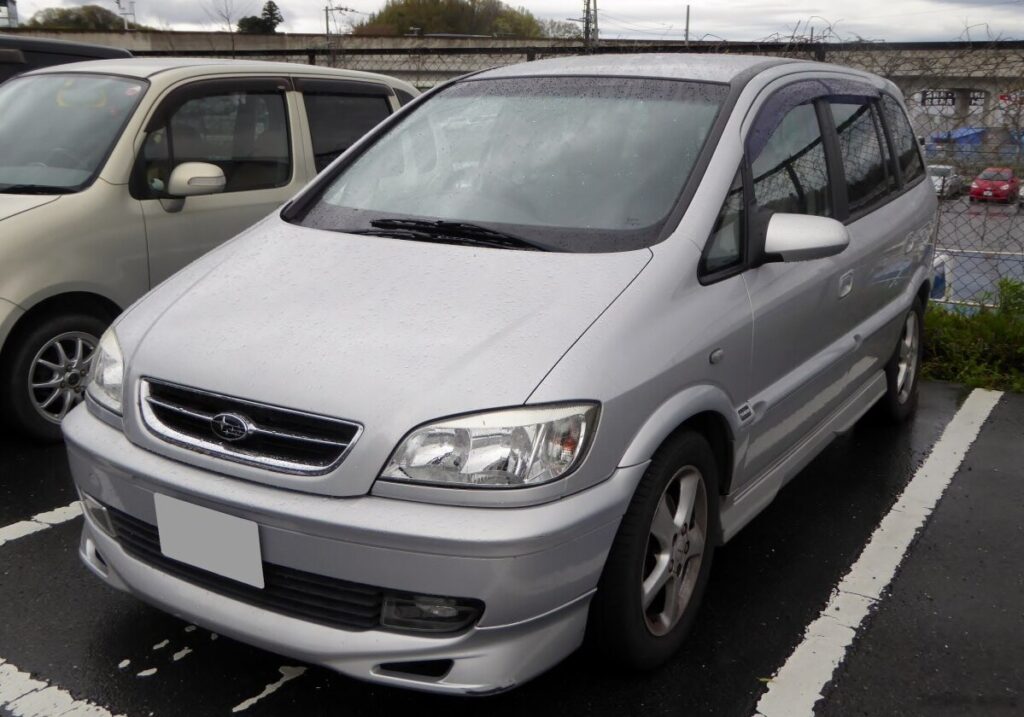
The Subaru Traviq 2.2 16V, produced between 2001 and 2004, was a compact minivan designed primarily for the Japanese domestic market (JDM) and select export markets, including Australia and Europe. Positioned as a practical and versatile family vehicle, the Traviq offered seven-passenger seating in a relatively small footprint. It was based on Subaru’s expertise in all-wheel drive, though the 2.2 16V variant was exclusively front-wheel drive. This model occupied a unique niche, bridging the gap between smaller kei cars and larger, more expensive minivans. The Traviq aimed to provide a comfortable and functional transportation solution for families seeking space and practicality without the bulk of a full-size minivan.
Technical Specifications
| Brand | Subaru |
| Model | Traviq |
| Generation | Traviq |
| Type (Engine) | 2.2 16V (147 Hp) |
| Start of production | 2001 |
| End of production | 2004 |
| Powertrain Architecture | Internal Combustion engine |
| Body type | Minivan |
| Seats | 7 |
| Doors | 5 |
| Fuel consumption (urban) | 13 l/100 km (18.1 US mpg, 21.7 UK mpg) |
| Fuel consumption (extra urban) | 7.5 l/100 km (31.4 US mpg, 37.7 UK mpg) |
| Fuel Type | Petrol (Gasoline) |
| Acceleration 0 – 100 km/h | 11 sec |
| Acceleration 0 – 62 mph | 11 sec |
| Acceleration 0 – 60 mph | 10.5 sec |
| Maximum speed | 180 km/h (111.85 mph) |
| Weight-to-power ratio | 9.9 kg/Hp, 100.7 Hp/tonne |
| Weight-to-torque ratio | 7.2 kg/Nm, 139 Nm/tonne |
| Power | 147 Hp @ 5800 rpm |
| Power per litre | 66.9 Hp/l |
| Torque | 203 Nm @ 4000 rpm (149.73 lb.-ft. @ 4000 rpm) |
| Engine layout | Front, Transverse |
| Engine Model/Code | Z22SE |
| Engine displacement | 2198 cm3 (134.13 cu. in.) |
| Number of cylinders | 4 |
| Engine configuration | Inline |
| Cylinder Bore | 86 mm (3.39 in.) |
| Piston Stroke | 94.6 mm (3.72 in.) |
| Compression ratio | 10:1 |
| Number of valves per cylinder | 4 |
| Fuel injection system | Multi-port manifold injection |
| Engine aspiration | Naturally aspirated engine |
| Valvetrain | DOHC |
| Engine oil capacity | 5 l (5.28 US qt | 4.4 UK qt) |
| Coolant capacity | 6.8 l (7.19 US qt | 5.98 UK qt) |
| Kerb Weight | 1460 kg (3218.75 lbs.) |
| Max. weight | 2000 kg (4409.25 lbs.) |
| Max load | 540 kg (1190.5 lbs.) |
| Trunk (boot) space – minimum | 150 l (5.3 cu. ft.) |
| Trunk (boot) space – maximum | 1700 l (60.03 cu. ft.) |
| Fuel tank capacity | 58 l (15.32 US gal | 12.76 UK gal) |
| Length | 4315 mm (169.88 in.) |
| Width | 1740 mm (68.5 in.) |
| Height | 1630 mm (64.17 in.) |
| Wheelbase | 2695 mm (106.1 in.) |
| Front track | 1460 mm (57.48 in.) |
| Rear track | 1470 mm (57.87 in.) |
| Drivetrain Architecture | The Internal combustion engine (ICE) drives the front wheels of the vehicle. |
| Drive wheel | Front wheel drive |
| Number of gears | 4 |
| Gearbox type | automatic transmission |
| Front suspension | Spring Strut |
| Rear suspension | Coil spring |
| Front brakes | Ventilated discs |
| Rear brakes | Disc |
| Assisting systems | ABS (Anti-lock braking system) |
| Steering type | Steering rack and pinion |
| Power steering | Hydraulic Steering |
| Tires size | 195/65 R15 |
Powertrain & Engine Architecture
The Subaru Traviq 2.2 16V was powered by the Z22SE engine, a 2.2-liter inline-four cylinder gasoline engine. This engine, part of Subaru’s EJ series, featured a double overhead camshaft (DOHC) valvetrain with four valves per cylinder. The Z22SE utilized a multi-port fuel injection system, delivering fuel directly into the intake ports. The engine produced 147 horsepower at 5800 rpm and 203 Nm (149.73 lb-ft) of torque at 4000 rpm. The engine’s 10:1 compression ratio was typical for naturally aspirated engines of the era. Paired with the engine was a four-speed automatic transmission, designed for smooth and convenient operation. This transmission was chosen to appeal to a broader audience seeking ease of use over sporty driving dynamics.
Driving Characteristics
The 2.2-liter engine and four-speed automatic transmission combination in the Traviq provided adequate, but not particularly exhilarating, performance. Acceleration from 0 to 60 mph took approximately 10.5 seconds, and the top speed was limited to 180 km/h (111.85 mph). The automatic transmission was tuned for fuel efficiency and smooth shifts, rather than aggressive downshifts or quick acceleration. Compared to potential manual transmission versions (not widely available), the automatic offered less driver engagement and slightly reduced fuel economy. The gear ratios were optimized for everyday driving conditions, prioritizing comfortable cruising over spirited performance. The front-wheel drive configuration contributed to a noticeable difference in handling compared to Subaru’s traditionally all-wheel drive vehicles.
Equipment & Trim Levels
The Traviq 2.2 16V typically came equipped with a reasonable level of standard features. These included power windows and locks, air conditioning, and a basic audio system. Interior upholstery was generally cloth, with options for upgraded materials available. Dashboard configuration was functional and straightforward, prioritizing usability over aesthetic flair. Optional extras included alloy wheels, a sunroof, and an upgraded audio system with a CD player. Safety features included ABS (Anti-lock Braking System) as standard equipment. The Traviq wasn’t positioned as a luxury vehicle, so the trim levels focused on providing essential comfort and convenience features at an affordable price point.
Chassis & Braking
The Traviq’s chassis featured a MacPherson strut front suspension and a coil spring rear suspension. This setup provided a comfortable ride quality, suitable for everyday driving. The front brakes were ventilated discs, offering adequate stopping power, while the rear brakes were solid discs. The steering system utilized a rack and pinion setup with hydraulic power steering, providing light and easy steering feel. The vehicle’s weight of 1460 kg (3218.75 lbs) influenced the suspension tuning, aiming for a balance between comfort and handling. Stabilizer bars were included to reduce body roll during cornering, but the overall handling characteristics were geared towards practicality rather than sporty performance.
Market Reception & Comparison
The Subaru Traviq 2.2 16V received mixed reviews. Critics generally praised its spacious interior and practical design, but noted its unremarkable performance and somewhat bland styling. Compared to other minivans available at the time, the Traviq offered a more compact footprint, making it easier to maneuver in urban environments. However, its fuel economy was average for its class, and its performance lagged behind some of its competitors. The automatic transmission was seen as a convenient feature, but some reviewers preferred the responsiveness of a manual gearbox. The Traviq’s relatively low price point was a key selling point, making it an attractive option for budget-conscious families.
Legacy
The Subaru Traviq 2.2 16V, while not a groundbreaking vehicle, served as a practical and affordable family transportation option during its production run. The Z22SE engine proved to be reasonably reliable, although regular maintenance is crucial for long-term durability. In the used car market today, Traviqs are relatively rare, particularly in North America. Those that are available are typically priced affordably, making them an attractive option for buyers seeking a budget-friendly minivan. The Traviq’s legacy lies in its practicality and versatility, offering a functional and spacious interior in a compact package. Its simplicity and relatively straightforward mechanical design make it a potentially appealing option for DIY mechanics.
