
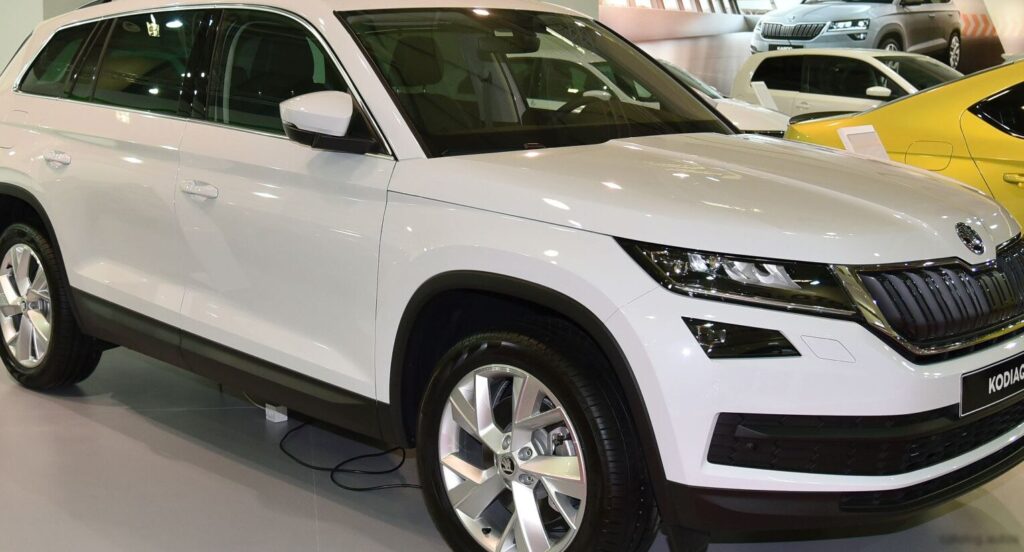
The Skoda Kodiaq GT TSI330 Automatic, produced between November 2018 and April 2021, represents a mid-range offering within the first generation (Kodiaq I) of Skoda’s popular SUV. Positioned as a more performance-oriented variant, it aimed to bridge the gap between the base engine options and the more powerful, often all-wheel-drive, Kodiaq trims. The Kodiaq, launched in 2016, was Skoda’s first foray into the seven-seater SUV segment, designed primarily for the European market but with increasing global appeal. The GT TSI330, with its 186 horsepower engine and automatic transmission, provided a balance of practicality, fuel efficiency, and driving enjoyment for families and individuals alike.
Technical Specifications
| Brand | Skoda |
| Model | Kodiaq |
| Generation | Kodiaq I |
| Type (Engine) | GT TSI330 (186 Hp) Automatic |
| Start of production | November, 2018 |
| End of production | April, 2021 |
| Powertrain Architecture | Internal Combustion engine |
| Body type | SUV |
| Seats | 5 |
| Doors | 5 |
| Fuel consumption (combined) | 6.6-6.7 l/100 km (35.6 – 35.1 US mpg, 42.8 – 42.2 UK mpg, 15.2 – 14.9 km/l) |
| Fuel Type | Petrol (Gasoline) |
| Acceleration 0 – 100 km/h | 8.8 sec |
| Acceleration 0 – 62 mph | 8.8 sec |
| Acceleration 0 – 60 mph | 8.4 sec |
| Maximum speed | 200 km/h (124.27 mph) |
| Weight-to-power ratio | 8.6 kg/Hp, 116.3 Hp/tonne |
| Weight-to-torque ratio | 5 kg/Nm, 200 Nm/tonne |
| Power | 186 Hp @ 4100-6000 rpm |
| Power per litre | 93.8 Hp/l |
| Torque | 320 Nm @ 1500-4000 rpm (236.02 lb.-ft. @ 1500-4000 rpm) |
| Engine layout | Front, Transverse |
| Engine displacement | 1984 cm3 (121.07 cu. in.) |
| Number of cylinders | 4 |
| Engine configuration | Inline |
| Number of valves per cylinder | 4 |
| Fuel injection system | Direct injection |
| Engine aspiration | Turbocharger, Intercooler |
| Kerb Weight | 1600 kg (3527.4 lbs) |
| Trunk (boot) space – minimum | 463 l (16.35 cu. ft.) |
| Trunk (boot) space – maximum | 1607 l (56.75 cu. ft.) |
| Fuel tank capacity | 60 l (15.85 US gal | 13.2 UK gal) |
| Length | 4634 mm (182.44 in) |
| Width | 1883 mm (74.13 in) |
| Height | 1649 mm (64.92 in) |
| Wheelbase | 2791 mm (109.88 in) |
| Drivetrain Architecture | The Internal combustion engine (ICE) drives the front wheels of the vehicle. |
| Drive wheel | Front wheel drive |
| Number of gears and type of gearbox | 7 gears, automatic transmission |
| Front suspension | Independent type McPherson |
| Rear suspension | Independent multi-link suspension |
| Front brakes | Ventilated discs |
| Rear brakes | Disc |
| Assisting systems | ABS (Anti-lock braking system) |
| Tires size | 215/65 R17; 235/50 R19 |
| Wheel rims size | 17; 19 |
Powertrain & Engine Architecture
The heart of the Kodiaq GT TSI330 is the EA888 2.0-liter turbocharged four-cylinder gasoline engine. This engine, widely used across the Volkswagen Group, is known for its robust construction and tuning potential. Specifically, this variant utilizes the EA888 engine code, often associated with outputs around 186 horsepower. The engine employs direct fuel injection, delivering fuel directly into the combustion chamber for improved efficiency and power. A single turbocharger, coupled with an intercooler, provides forced induction, boosting torque and responsiveness. The engine features a timing chain, contributing to lower maintenance costs compared to timing belt setups. The seven-speed dual-clutch transmission (DCT) is a key component, offering quick and smooth gear changes. This DCT, designated as the DQ380, is known for its efficiency and responsiveness, although some units have been known to require servicing at higher mileages.
Driving Characteristics
The 186 hp and 236 lb-ft of torque delivered by the GT TSI330 provide a noticeable step up in performance compared to the lower-powered Kodiaq variants. Acceleration from 0-60 mph in around 8.4 seconds is respectable for a mid-size SUV. The DCT transmission contributes to a more engaging driving experience, with quick shifts and minimal torque interruption. However, it’s not a sports car; the focus remains on comfortable and practical transportation. Compared to the 1.4 TSI engine, the 2.0 TSI offers significantly more low-end torque, making overtaking and highway merging easier. While not as sporty as the Kodiaq RS (which features a more powerful engine and all-wheel drive), the GT TSI330 provides a good balance of performance and fuel economy. The front-wheel-drive configuration means traction can be limited in slippery conditions, especially under hard acceleration.
Equipment & Trim Levels
The GT TSI330 typically came well-equipped, reflecting its mid-range positioning. Standard features often included alloy wheels (typically 18-inch), automatic climate control, a touchscreen infotainment system with Apple CarPlay and Android Auto compatibility, and a suite of safety features like ABS, ESC, and multiple airbags. Interior upholstery was usually a combination of fabric and leatherette. Optional extras included a panoramic sunroof, adaptive cruise control, a premium sound system, and parking sensors. Trim levels varied slightly depending on the market, but generally, the GT TSI330 offered a comfortable and well-appointed interior.
Chassis & Braking
The Kodiaq I utilizes a McPherson strut front suspension and a multi-link rear suspension, providing a comfortable ride and decent handling. The suspension is tuned for comfort rather than outright sportiness. The GT TSI330 typically featured ventilated front disc brakes and solid rear disc brakes. ABS (Anti-lock Braking System) and ESC (Electronic Stability Control) were standard, enhancing safety and stability. Stabilizer bars were fitted front and rear to reduce body roll during cornering. The weight distribution, being front-heavy due to the engine and front-wheel-drive configuration, influences the handling characteristics.
Market Reception & Comparison
The Kodiaq GT TSI330 was generally well-received by automotive critics. It was praised for its spacious interior, comfortable ride, and decent performance. Fuel economy, averaging around 35 mpg in combined driving, was also a positive point. Compared to the lower-powered 1.4 TSI variants, the GT TSI330 offered a more refined and capable driving experience. However, some critics noted that the front-wheel-drive configuration limited its appeal in regions with harsh winters. Compared to the Kodiaq RS, the GT TSI330 offered a more affordable entry point into the Kodiaq range, albeit with less performance and all-wheel-drive capability.
Legacy
The EA888 engine, found in the Kodiaq GT TSI330, has proven to be a reliable unit when properly maintained. The DCT transmission, while generally robust, can require servicing at higher mileages to prevent potential issues. On the used car market, the Kodiaq GT TSI330 represents a good value proposition, offering a spacious and well-equipped SUV at a reasonable price. Its blend of practicality, performance, and fuel efficiency continues to make it an attractive option for families and individuals seeking a versatile vehicle. Regular maintenance, including oil changes and DCT fluid changes, is crucial to ensure the long-term reliability of this powertrain.
