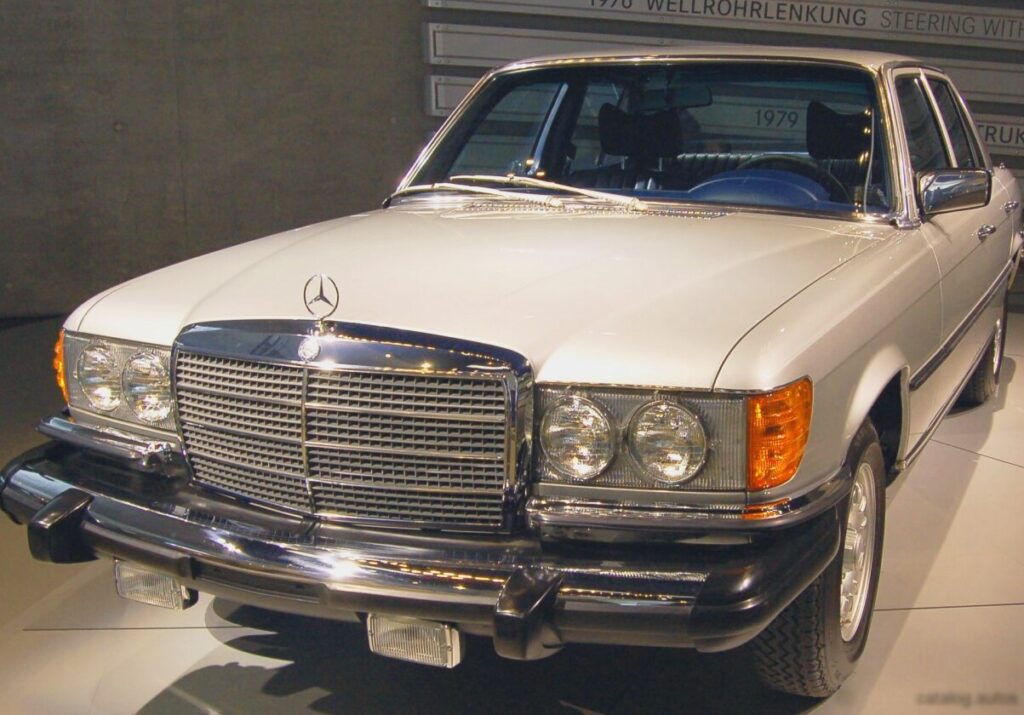
The Mercedes-Benz S-Class SEL (V116) 350 SEL V8, produced from January 1976 to April 1978, represented a significant evolution in luxury automotive engineering. Part of the second generation of the S-Class (W116 series), the SEL – “Sonderklasse-Erhöhte Luxusausstattung” or “Special Class – Increased Luxury Equipment” – was the long-wheelbase variant, offering enhanced rear passenger space. The 350 SEL V8, equipped with the M116 E 35 engine, served as a cornerstone of the lineup, balancing performance with the refined comfort expected of a flagship Mercedes-Benz. It was positioned as a mid-range offering within the V116 series, slotting between the six-cylinder 350 SE and the higher-performance 450 SEL.
Technical Specifications
| Brand | Mercedes-Benz |
| Model | S-class |
| Generation | S-class SEL (V116) |
| Type (Engine) | 350 SEL V8 (195 Hp) |
| Start of production | January, 1976 |
| End of production | April, 1978 |
| Powertrain Architecture | Internal Combustion engine |
| Body type | Sedan |
| Seats | 5 |
| Doors | 4 |
| Fuel consumption (combined) | 13 l/100 km (18.1 US mpg, 21.7 UK mpg, 7.7 km/l) |
| Fuel Type | Petrol (Gasoline) |
| Acceleration 0 – 100 km/h | 10 sec |
| Acceleration 0 – 62 mph | 10 sec |
| Acceleration 0 – 60 mph | 9.5 sec |
| Maximum speed | 205 km/h (127.38 mph) |
| Weight-to-power ratio | 8.7 kg/Hp, 114.7 Hp/tonne |
| Weight-to-torque ratio | 6.2 kg/Nm, 161.8 Nm/tonne |
| Power | 195 Hp @ 5500 rpm |
| Power per litre | 55.7 Hp/l |
| Torque | 275 Nm @ 4000 rpm (202.83 lb.-ft. @ 4000 rpm) |
| Engine layout | Front, Longitudinal |
| Engine Model/Code | M 116 E 35 / 116.985 |
| Engine displacement | 3499 cm3 (213.52 cu. in.) |
| Number of cylinders | 8 |
| Engine configuration | V-engine |
| Cylinder Bore | 92 mm (3.62 in.) |
| Piston Stroke | 65.8 mm (2.59 in.) |
| Compression ratio | 9:1 |
| Number of valves per cylinder | 2 |
| Fuel injection system | Multi-port manifold injection |
| Engine aspiration | Naturally aspirated engine |
| Valvetrain | SOHC |
| Engine oil capacity | 8 l (8.45 US qt | 7.04 UK qt) |
| Coolant capacity | 8 l (8.45 US qt | 7.04 UK qt) |
| Kerb Weight | 1700 kg (3747.86 lbs.) |
| Max. weight | 2220 kg (4894.26 lbs.) |
| Max load | 520 kg (1146.4 lbs.) |
| Trunk (boot) space – minimum | 530 l (18.72 cu. ft.) |
| Fuel tank capacity | 96 l (25.36 US gal | 21.12 UK gal) |
| Length | 5060 mm (199.21 in.) |
| Width | 1870 mm (73.62 in.) |
| Height | 1430 mm (56.3 in.) |
| Wheelbase | 2960 mm (116.54 in.) |
| Front track | 1521 mm (59.88 in.) |
| Rear (Back) track | 1505 mm (59.25 in.) |
| Drivetrain Architecture | The Internal combustion engine (ICE) drives the rear wheels of the vehicle. |
| Drive wheel | Rear wheel drive |
| Number of gears and type of gearbox | 4 gears, manual transmission |
| Front suspension | Double wishbone |
| Rear suspension | Trailing arm |
| Front brakes | Ventilated discs |
| Rear brakes | Disc |
| Steering type | Cone worm with recirculation balls |
| Power steering | Hydraulic Steering |
| Tires size | Front wheel tires: 205/70 R14 Rear wheel tires: 205/70 R14 |
| Wheel rims size | Front wheel rims: 6.5J x 14 Rear wheel rims: 6.5J x 14 |
Powertrain & Engine Architecture
The heart of the 350 SEL V8 was the M116 E 35 engine, a 3.5-liter naturally aspirated V8. This engine, a hallmark of Mercedes-Benz engineering, featured a cast iron block and aluminum cylinder heads. It employed a single overhead camshaft (SOHC) design per bank, operating two valves per cylinder. Fuel delivery was handled by a Bosch K-Jetronic multi-port fuel injection system, a sophisticated system for its time that contributed to smooth operation and relatively good fuel efficiency. The engine produced 195 horsepower at 5,500 rpm and 275 Nm (202.83 lb-ft) of torque at 4,000 rpm. The engine’s relatively high compression ratio of 9:1 demanded premium fuel. The standard transmission was a 4-speed manual, though an automatic transmission was also available, and was a popular choice for buyers prioritizing comfort.
Driving Characteristics
The 350 SEL V8 offered a driving experience focused on refined comfort and effortless cruising. While not a sports car, the V8 provided ample power for confident acceleration and highway passing. The 0-60 mph time of around 9.5 seconds was respectable for the era. The automatic transmission, while smooth, did slightly diminish acceleration compared to the manual version. The long wheelbase and sophisticated suspension – featuring double wishbones at the front and a trailing arm setup at the rear – delivered a remarkably smooth and stable ride, even on imperfect road surfaces. Steering was via a hydraulic power steering system, providing a light and easy feel, though lacking the directness of more modern systems.
Equipment & Trim Levels
The 350 SEL V8 came standard with a high level of equipment, befitting its status as a luxury vehicle. Standard features included power windows, central locking, and a high-quality radio. The interior was typically trimmed with leather upholstery, and wood veneer accents were used throughout the cabin. Optional extras included air conditioning, a sunroof, and upgraded audio systems. The SEL models, with their extended wheelbase, offered significantly more rear legroom than the standard S-Class models, making them particularly appealing to those who were often chauffeured.
Chassis & Braking
The V116 S-Class featured a robust chassis designed for both comfort and safety. The suspension system, as mentioned, prioritized ride quality. Braking was accomplished via ventilated disc brakes at the front and solid discs at the rear. Hydraulic power assistance was standard. The steering system utilized a cone worm and recirculation ball mechanism, providing a stable but somewhat indirect steering feel. Tires were typically 205/70 R14, mounted on 6.5J x 14 inch wheels.
Market Reception & Comparison
The 350 SEL V8 was well-received by automotive critics and buyers alike. It was praised for its smooth ride, refined interior, and powerful engine. Compared to the six-cylinder 350 SE, the V8 offered noticeably more performance. However, it was more expensive and consumed more fuel. Compared to the 450 SEL, the 350 SEL V8 offered a better balance between performance and economy, making it a popular choice for those who wanted a luxurious S-Class but didn’t require the extra power of the larger engine. Fuel economy, at 13 l/100km (18.1 US mpg), was typical for a large luxury car of the era.
Legacy
The Mercedes-Benz V116 S-Class, including the 350 SEL V8, is considered a classic of the era. The M116 engine is known for its durability and relatively straightforward maintenance. Well-maintained examples are highly sought after by collectors today. While parts availability can be a challenge, the engine’s robust design means that it can often withstand significant mileage. The 350 SEL V8 represents a high point in Mercedes-Benz engineering, offering a blend of luxury, performance, and durability that continues to appeal to enthusiasts decades after its production ended. The car’s enduring appeal is a testament to the quality of its design and construction.