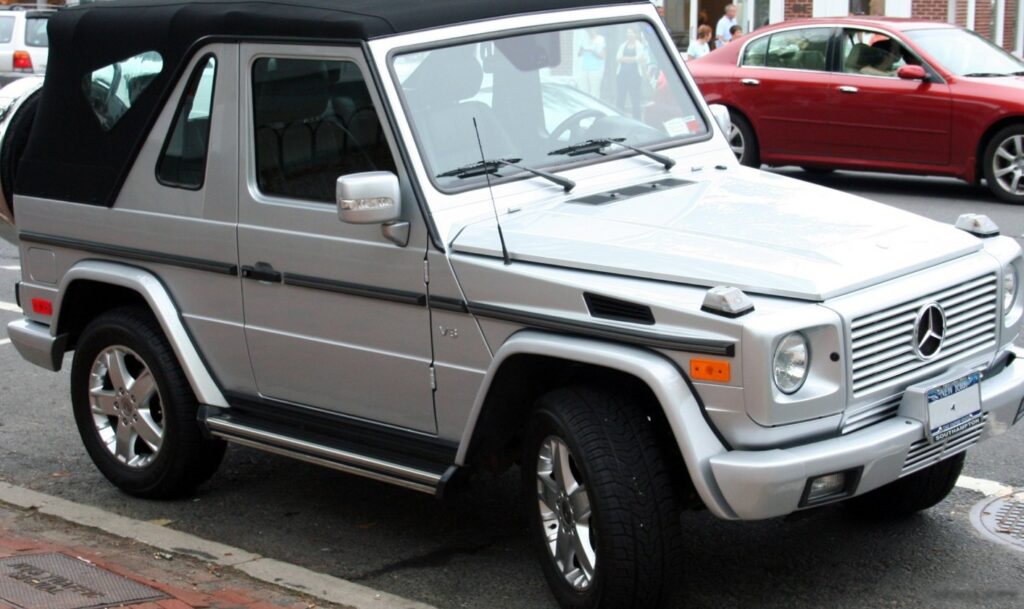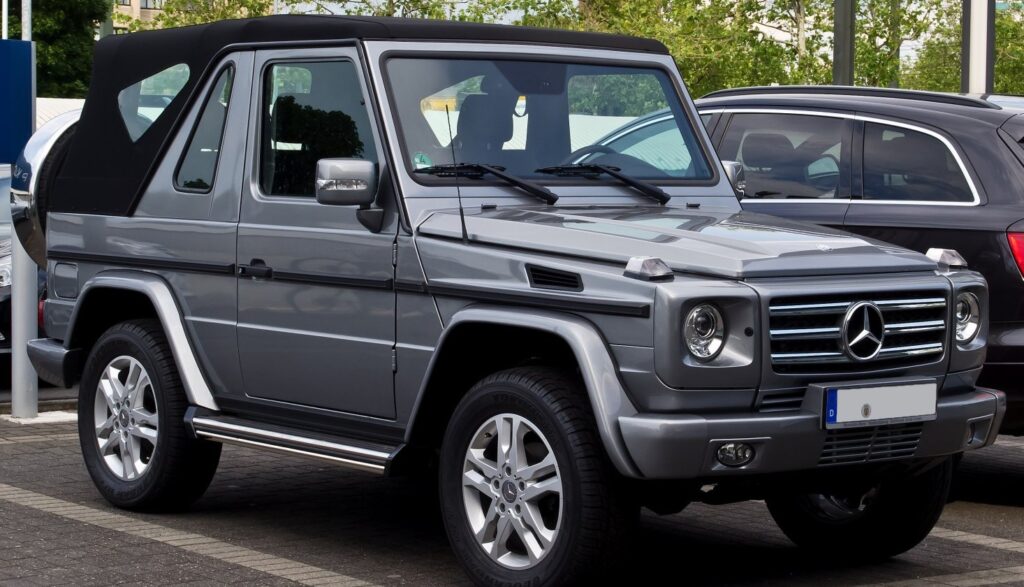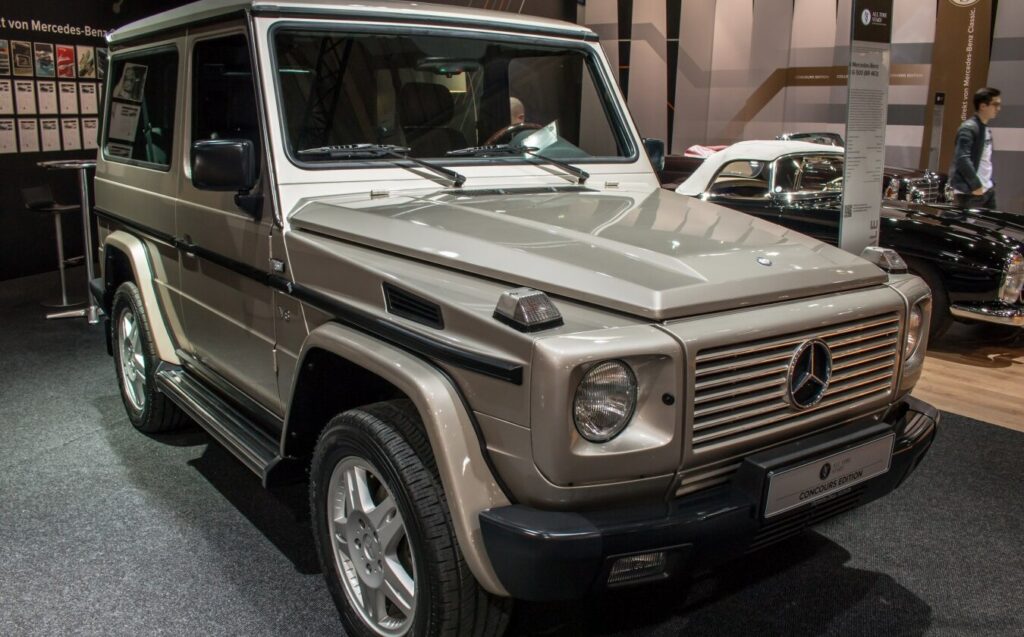
The Mercedes-Benz G 55 AMG, produced between July 1999 and March 2001, represents a pivotal point in the evolution of the iconic G-Class (W463) series. This high-performance variant combined the G-Class’s legendary off-road capability with the potent power of Mercedes-AMG’s 5.4-liter V8 engine. Positioned as the flagship performance model within the W463 range, the G 55 AMG catered to buyers seeking a uniquely capable and luxurious SUV. It bridged the gap between utilitarian robustness and high-end performance, establishing a template for future AMG-tuned G-Class models.
Technical Specifications
| Brand | Mercedes-Benz |
| Model | G-class |
| Generation | G-class (W463) |
| Type | AMG G 55 V8 (354 Hp) 4MATIC Automatic |
| Start of production | July, 1999 |
| End of production | March, 2001 |
| Powertrain Architecture | Internal Combustion engine |
| Body type | Off-road vehicle |
| Seats | 5 |
| Doors | 3 |
| Fuel consumption (urban) | 21.6 l/100 km (10.9 US mpg, 13.1 UK mpg, 4.6 km/l) |
| Fuel consumption (extra urban) | 13.1 l/100 km (18 US mpg, 21.6 UK mpg, 7.6 km/l) |
| Fuel consumption (combined) | 16.2 l/100 km (14.5 US mpg, 17.4 UK mpg, 6.2 km/l) |
| Fuel Type | Petrol (Gasoline) |
| Acceleration 0 – 100 km/h | 7.4 sec |
| Acceleration 0 – 62 mph | 7.4 sec |
| Acceleration 0 – 60 mph | 7 sec |
| Maximum speed | 209 km/h (129.87 mph) |
| Emission standard | Euro 4 |
| Weight-to-power ratio | 6.7 kg/Hp, 149.7 Hp/tonne |
| Weight-to-torque ratio | 4.5 kg/Nm, 222 Nm/tonne |
| Power | 354 Hp @ 5500 rpm |
| Power per litre | 65.1 Hp/l |
| Torque | 525 Nm @ 3000 rpm (387.22 lb.-ft. @ 3000 rpm) |
| Engine layout | Front, Longitudinal |
| Engine Model/Code | M 113.982 |
| Engine displacement | 5439 cm3 (331.91 cu. in.) |
| Number of cylinders | 8 |
| Engine configuration | V-engine |
| Cylinder Bore | 97 mm (3.82 in.) |
| Piston Stroke | 92 mm (3.62 in.) |
| Compression ratio | 10.5:1 |
| Number of valves per cylinder | 3 |
| Fuel injection system | Multi-port manifold injection |
| Engine aspiration | Naturally aspirated engine |
| Valvetrain | SOHC |
| Engine oil capacity | 8 l (8.45 US qt | 7.04 UK qt) |
| Coolant | 12 l (12.68 US qt | 10.56 UK qt) |
| Kerb Weight | 2365 kg (5213.93 lbs.) |
| Max. weight | 2810 kg (6194.99 lbs.) |
| Max load | 445 kg (981.06 lbs.) |
| Trunk (boot) space – minimum | 250 l (8.83 cu. ft.) |
| Trunk (boot) space – maximum | 1580 l (55.8 cu. ft.) |
| Fuel tank capacity | 96 l (25.36 US gal | 21.12 UK gal) |
| Max. roof load | 150 kg (330.69 lbs.) |
| Permitted trailer load with brakes (12%) | 2925 kg (6448.52 lbs.) |
| Permitted trailer load without brakes | 750 kg (1653.47 lbs.) |
| Length | 4230 mm (166.54 in.) |
| Width | 1760 mm (69.29 in.) |
| Height | 1931 mm (76.02 in.) |
| Wheelbase | 2400 mm (94.49 in.) |
| Front track | 1475 mm (58.07 in.) |
| Rear (Back) track | 1475 mm (58.07 in.) |
| Minimum turning circle | 11.3 m (37.07 ft.) |
| Drivetrain Architecture | The Internal combustion engine (ICE) drives permanently the four wheels of the vehicle. |
| Drive wheel | All wheel drive (4×4) |
| Number of gears | 5 |
| Gearbox type | automatic transmission |
| Front suspension | Coil spring, Rigid axle suspension, Trailing arm |
| Rear suspension | Rigid axle suspension, Trailing arm, Coil spring |
| Front brakes | Ventilated discs |
| Rear brakes | Disc |
| Assisting systems | ABS (Anti-lock braking system) |
| Steering type | Cone worm with recirculation balls |
| Power steering | Hydraulic Steering |
| Tires size | 265/60 R 18 |
| Wheel rims size | 7.5 J x 18 |
Powertrain & Engine Architecture
The heart of the G 55 AMG is the M113.982 5.4-liter naturally aspirated V8 engine. This engine, a hallmark of Mercedes-AMG’s engineering prowess, featured all-aluminum construction, three valves per cylinder, and a multi-port fuel injection system. The engine produced 354 horsepower at 5500 rpm and 525 Nm (387 lb-ft) of torque at 3000 rpm. The M113 engine family was known for its robust build quality and relatively simple design, contributing to its longevity. Power was delivered to all four wheels via a five-speed automatic transmission, a crucial component in managing the engine’s substantial output. This transmission was specifically tuned for the G 55 AMG to provide smooth shifts and responsive acceleration, although it lacked the advanced features of later automatic gearboxes.
Driving Characteristics
The G 55 AMG offered a unique driving experience. While retaining the G-Class’s inherent off-road prowess, the AMG variant delivered significantly enhanced on-road performance. Acceleration to 60 mph was achieved in approximately 7 seconds, and the top speed was electronically limited to 129.87 mph. The automatic transmission, while not as quick-shifting as modern units, provided a comfortable and predictable driving experience. The G 55’s substantial weight (2365 kg / 5214 lbs) was noticeable, but the engine’s ample torque helped to overcome this, providing strong acceleration in most situations. Compared to the standard G-Class models with smaller engines, the G 55 offered a dramatically improved level of performance and refinement.
Equipment & Trim Levels
The G 55 AMG came standard with a comprehensive list of features, reflecting its position as the top-of-the-line G-Class model. Interior appointments included leather upholstery, wood trim, and power-adjustable front seats. Standard equipment also included automatic climate control, a premium sound system, and alloy wheels. Optional extras included a sunroof, upgraded audio systems, and various customization options through Mercedes-Benz’s designo program. The interior, while luxurious for its time, retained the G-Class’s utilitarian aesthetic, emphasizing functionality and durability.
Chassis & Braking
The G 55 AMG utilized a robust ladder-frame chassis, a defining characteristic of the G-Class. The suspension consisted of coil springs and rigid axles front and rear, providing exceptional off-road articulation and durability. Braking duties were handled by ventilated discs at the front and solid discs at the rear, equipped with an Anti-lock Braking System (ABS). While adequate for the vehicle’s weight and performance, the braking system wasn’t as sophisticated as those found in contemporary sports cars. The G 55’s tires were 265/60 R18, providing a good balance of on-road grip and off-road traction.
Market Reception & Comparison
The G 55 AMG was generally well-received by automotive critics, who praised its unique combination of luxury, performance, and off-road capability. However, its high price and substantial fuel consumption (16.2 l/100 km combined) were noted drawbacks. Compared to other high-performance SUVs of the era, such as the Porsche Cayenne, the G 55 AMG offered a more rugged and utilitarian character. Its fuel economy was significantly worse than most competitors, but its off-road prowess was unmatched. The G 55 AMG appealed to a niche market of buyers who valued exclusivity and uncompromising capability.
Legacy
The G 55 AMG played a significant role in establishing the G-Class as a desirable luxury SUV. Its success paved the way for future AMG-tuned G-Class models, including the current G 63. The M113 engine, while no longer in production, remains highly regarded for its reliability and performance. Today, the W463 G 55 AMG is a sought-after collector’s item, commanding premium prices in the used car market. Well-maintained examples are prized for their rarity, performance, and iconic status. The powertrain, while aging, is generally considered durable, but regular maintenance is essential to ensure its continued reliability.