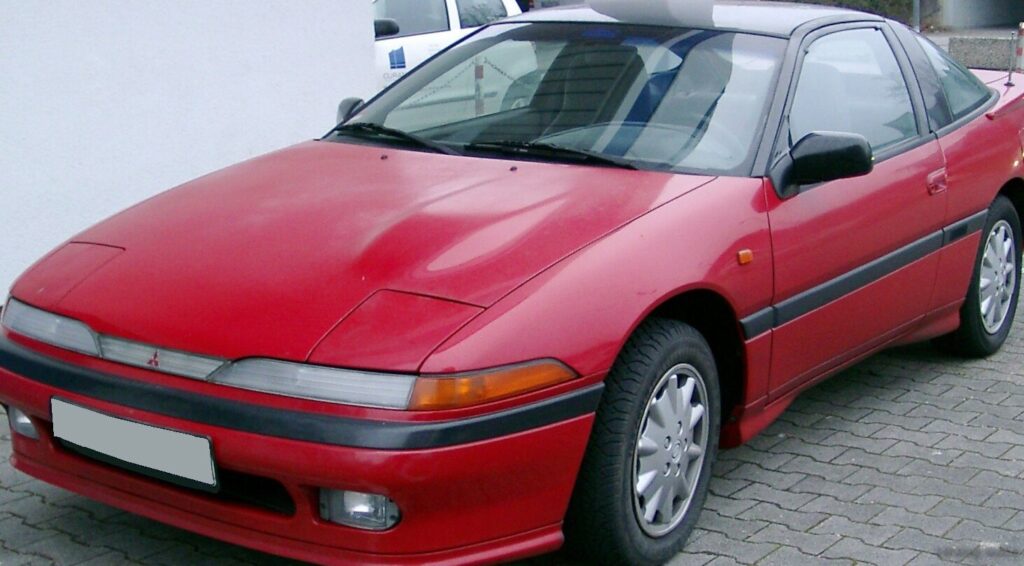
The Mitsubishi Eclipse first generation (1G), produced from 1989 to 1994, represented a significant departure for Mitsubishi, aiming to capture a younger, more style-conscious audience. The 2.0i 16V 4WD Turbo variant, available from 1990 to 1992, was a performance-oriented model positioned near the top of the Eclipse range. It combined a turbocharged engine with all-wheel drive and an automatic transmission, offering a blend of power and usability. This model was primarily sold in North America and Japan, where the demand for sporty coupes with advanced technology was high.
Technical Specifications
| Brand | Mitsubishi |
| Model | Eclipse |
| Generation | Eclipse I (1G) |
| Type | 2.0 i 16V 4WD Turbo (195 Hp) Automatic |
| Start of production | 1990 |
| End of production | 1992 |
| Powertrain Architecture | Internal Combustion engine |
| Body type | Coupe, Liftback |
| Seats | 4 |
| Doors | 2 |
| Fuel consumption (combined) | 10.7 l/100 km (22 US mpg, 26.4 UK mpg, 9.3 km/l) |
| Fuel Type | Petrol (Gasoline) |
| Maximum speed | 220 km/h (136.7 mph) |
| Weight-to-power ratio | 7.2 kg/Hp, 139 Hp/tonne |
| Weight-to-torque ratio | 5.1 kg/Nm, 196 Nm/tonne |
| Power | 195 Hp @ 5000 rpm |
| Power per litre | 97.6 Hp/l |
| Torque | 275 Nm @ 3000 rpm (202.83 lb.-ft. @ 3000 rpm) |
| Engine layout | Front, Transverse |
| Engine displacement | 1997 cm3 (121.86 cu. in.) |
| Number of cylinders | 4 |
| Engine configuration | Inline |
| Cylinder Bore | 85 mm (3.35 in.) |
| Piston Stroke | 88 mm (3.46 in.) |
| Compression ratio | 7.8:1 |
| Number of valves per cylinder | 4 |
| Fuel injection system | Multi-port manifold injection |
| Engine aspiration | Turbocharger |
| Valvetrain | DOHC |
| Kerb Weight | 1403 kg (3093.09 lbs.) |
| Fuel tank capacity | 60 l (15.85 US gal | 13.2 UK gal) |
| Length | 4390 mm (172.83 in.) |
| Width | 1695 mm (66.73 in.) |
| Height | 1321 mm (52.01 in.) |
| Wheelbase | 2470 mm (97.24 in.) |
| Front track | 1465 mm (57.68 in.) |
| Rear track | 1455 mm (57.28 in.) |
| Drive wheel | All wheel drive (4×4) |
| Number of gears | 4 |
| Gearbox type | Automatic transmission |
| Front suspension | Coil spring |
| Rear suspension | Coil spring |
| Front brakes | Ventilated discs |
| Rear brakes | Disc |
| Assisting systems | ABS (Anti-lock braking system) |
| Steering type | Steering rack and pinion |
| Power steering | Hydraulic Steering |
| Tires size | 205/55 R16 V |
| Wheel rims size | 16 |
Powertrain & Engine Architecture
The heart of the 2.0i 16V Turbo was the 4G63 engine, a 1997cc inline-four cylinder powerplant. This engine featured a cast iron block and an aluminum cylinder head, equipped with dual overhead camshafts (DOHC) and four valves per cylinder. The turbocharger, a Mitsubishi TD04H, provided significant boost, increasing power output to 195 horsepower at 5000 rpm and 275 Nm (202.83 lb-ft) of torque at 3000 rpm. Fuel delivery was handled by a multi-port fuel injection system. The 4G63 engine was known for its robustness and tunability, becoming a popular choice for aftermarket modifications. The automatic transmission was a four-speed unit, designed to handle the increased power and torque of the turbocharged engine. While not as sporty as a manual transmission, it offered convenience and ease of use for everyday driving.
Driving Characteristics
The 2.0i 16V Turbo Automatic offered a unique driving experience. The all-wheel drive system provided excellent traction, particularly in inclement weather. However, the automatic transmission, while smooth, did detract somewhat from the sporty feel of the car. Gear changes weren’t as crisp or responsive as those of a manual transmission, and the engine sometimes felt slightly strained during hard acceleration. Compared to the five-speed manual version, the automatic was a bit slower in terms of acceleration. The automatic transmission’s gear ratios were optimized for fuel economy and smooth cruising rather than outright performance. Despite this, the turbocharger provided a noticeable surge of power, making the Eclipse a fun and engaging car to drive.
Equipment & Trim Levels
The 2.0i 16V 4WD Turbo typically came well-equipped, reflecting its position as a premium trim level. Standard features included power windows, power locks, air conditioning, and a decent sound system. The interior featured cloth upholstery, although leather was available as an option. The dashboard layout was functional and driver-focused, with easy-to-read gauges. Optional extras included a sunroof, upgraded sound system with a cassette player, and alloy wheels. The liftback body style offered increased practicality with a larger cargo area compared to the coupe.
Chassis & Braking
The Eclipse 1G featured a MacPherson strut front suspension and a multi-link rear suspension, providing a comfortable ride and good handling characteristics. The all-wheel drive system added to the car’s stability and cornering ability. Braking duties were handled by ventilated discs at the front and solid discs at the rear. An anti-lock braking system (ABS) was standard, enhancing safety and control during hard braking. The steering was rack and pinion with hydraulic power assistance, providing precise and responsive steering feel.
Market Reception & Comparison
The 2.0i 16V 4WD Turbo was generally well-received by automotive critics. It was praised for its powerful engine, all-wheel drive system, and comfortable interior. However, some critics noted that the automatic transmission detracted from the sporty driving experience. Compared to other trims in the Eclipse lineup, such as the naturally aspirated 2.0-liter models, the turbo version offered significantly more performance. It also compared favorably to competitors like the Toyota Celica and Nissan 240SX, offering a unique combination of power, technology, and affordability. Fuel economy was reasonable for a turbocharged all-wheel drive car, averaging around 22 mpg in combined driving.
Legacy
The Mitsubishi Eclipse 1G 2.0i 16V 4WD Turbo remains a popular choice among enthusiasts today. The 4G63 engine is renowned for its durability and potential for modification, making it a favorite among tuners. While finding a well-maintained example can be challenging, these cars offer a unique blend of 1990s styling, performance, and technology. The automatic transmission, while not ideal for purists, does make these cars more accessible to a wider range of drivers. Parts availability is generally good, although some specific components may be difficult to find. Overall, the 2.0i 16V 4WD Turbo represents a significant chapter in Mitsubishi’s history and a desirable classic for those seeking a sporty and capable coupe.