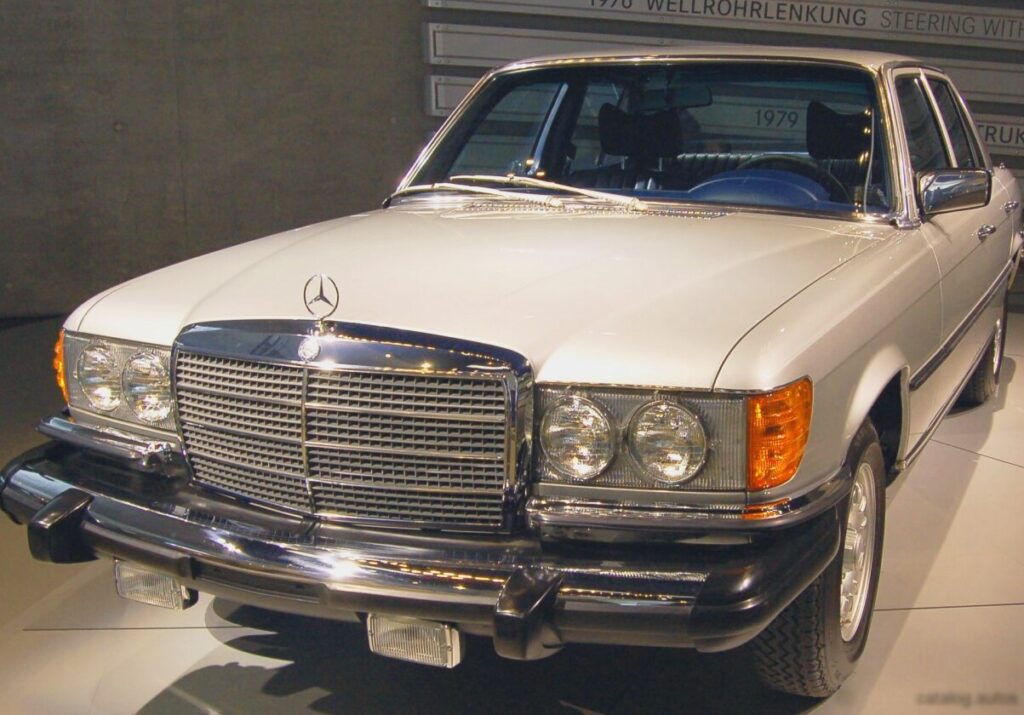
The Mercedes-Benz S-Class SEL (V116) 350 SEL V8, produced between September 1973 and January 1976, represented a significant evolution in luxury automotive engineering. As part of the W116 series, the 350 SEL was a long-wheelbase (SEL) variant, offering increased rear passenger space and cementing the S-Class’s reputation for opulent comfort. It occupied a middle ground within the V116 lineup, positioned above the 280 SEL but below the more powerful and exclusive 450 SEL. This model was primarily aimed at the North American and European markets, where buyers desired a blend of performance, prestige, and spaciousness. The 350 SEL V8 was a key model in establishing the S-Class as the benchmark for full-size luxury sedans.
Technical Specifications
| Brand | Mercedes-Benz |
| Model | S-class |
| Generation | S-class SEL (V116) |
| Type (Engine) | 350 SEL V8 (200 Hp) |
| Start of production | September, 1973 |
| End of production | January, 1976 |
| Powertrain Architecture | Internal Combustion engine |
| Body type | Sedan |
| Seats | 5 |
| Doors | 4 |
| Fuel consumption (combined) | 13 l/100 km (18.1 US mpg, 21.7 UK mpg, 7.7 km/l) |
| Fuel Type | Petrol (Gasoline) |
| Acceleration 0 – 100 km/h | 10 sec |
| Acceleration 0 – 62 mph | 10 sec |
| Acceleration 0 – 60 mph | 9.5 sec |
| Maximum speed | 205 km/h (127.38 mph) |
| Weight-to-power ratio | 8.5 kg/Hp, 117.6 Hp/tonne |
| Weight-to-torque ratio | 5.9 kg/Nm, 168.2 Nm/tonne |
| Power | 200 Hp @ 5800 rpm |
| Power per litre | 57.2 Hp/l |
| Torque | 286 Nm @ 4000 rpm (210.94 lb.-ft. @ 4000 rpm) |
| Engine layout | Front, Longitudinal |
| Engine Model/Code | M 116 E 35 / 116.983 |
| Engine displacement | 3499 cm3 (213.52 cu. in.) |
| Number of cylinders | 8 |
| Engine configuration | V-engine |
| Cylinder Bore | 92 mm (3.62 in.) |
| Piston Stroke | 65.8 mm (2.59 in.) |
| Compression ratio | 9.5:1 |
| Number of valves per cylinder | 2 |
| Fuel injection system | Multi-port manifold injection |
| Engine aspiration | Naturally aspirated engine |
| Valvetrain | SOHC |
| Engine oil capacity | 8 l (8.45 US qt | 7.04 UK qt) |
| Coolant capacity | 8 l (8.45 US qt | 7.04 UK qt) |
| Kerb Weight | 1700 kg (3747.86 lbs.) |
| Max. weight | 2220 kg (4894.26 lbs.) |
| Max load | 520 kg (1146.4 lbs.) |
| Trunk (boot) space – minimum | 530 l (18.72 cu. ft.) |
| Fuel tank capacity | 96 l (25.36 US gal | 21.12 UK gal) |
| Length | 5060 mm (199.21 in.) |
| Width | 1870 mm (73.62 in.) |
| Height | 1430 mm (56.3 in.) |
| Wheelbase | 2960 mm (116.54 in.) |
| Front track | 1521 mm (59.88 in.) |
| Rear (Back) track | 1505 mm (59.25 in.) |
| Drivetrain Architecture | The Internal combustion engine (ICE) drives the rear wheels of the vehicle. |
| Drive wheel | Rear wheel drive |
| Number of gears and type of gearbox | 4 gears, manual transmission |
| Front suspension | Double wishbone |
| Rear suspension | Trailing arm |
| Front brakes | Ventilated discs |
| Rear brakes | Disc |
| Steering type | Cone worm with recirculation balls |
| Power steering | Hydraulic Steering |
| Tires size | Front wheel tires: 205/70 R14 Rear wheel tires: 205/70 R14 |
| Wheel rims size | Front wheel rims: 6.5J x 14 Rear wheel rims: 6.5J x 14 |
Powertrain & Engine Architecture
The heart of the 350 SEL was the M116 E 35 3.5-liter V8 engine. This engine, a cornerstone of Mercedes-Benz’s engineering prowess, featured a 90-degree V-angle and a single overhead camshaft (SOHC) per bank. It utilized Bosch K-Jetronic multi-port fuel injection, a sophisticated system for its time that contributed to smooth power delivery and relatively good fuel efficiency. The engine produced 200 horsepower at 5800 rpm and 286 Nm (210.94 lb-ft) of torque at 4000 rpm. The 4-speed manual transmission was standard, offering a more engaging driving experience, though an automatic transmission was also available as an option. The engine’s longitudinal mounting and rear-wheel-drive configuration were typical for luxury cars of the era.
Driving Characteristics
The 350 SEL V8, even with the manual transmission, wasn’t designed for outright sportiness. Instead, it prioritized a refined and comfortable driving experience. The 3.5-liter V8 provided ample power for effortless cruising and confident overtaking. The manual gearbox, while offering more control, had relatively long throws compared to modern transmissions. Acceleration to 60 mph took around 9.5 seconds, respectable for the early 1970s, but not particularly quick. The focus was on smooth power delivery and a quiet cabin, making long journeys a pleasure. Compared to the later 450 SEL, the 350 SEL offered a slightly more balanced feel due to its lower weight, though it lacked the ultimate performance of its larger-displacement sibling.
Equipment & Trim Levels
The 350 SEL V8 came standard with a generous array of features befitting its luxury status. These included power-assisted steering, ventilated disc brakes on the front wheels, and comfortable seating upholstered in high-quality materials, typically leather or MB-Tex (Mercedes-Benz’s synthetic leather). Air conditioning, power windows, and a high-fidelity sound system were also common. Optional extras included a sunroof, automatic climate control, and upgraded audio systems. The SEL designation meant extended rear legroom, making it particularly appealing to those who frequently traveled with passengers. Interior trim options allowed for a degree of personalization, with various wood veneers and color combinations available.
Chassis & Braking
The V116 S-Class featured a robust chassis with independent suspension all around. The front suspension utilized double wishbones, while the rear employed a trailing arm setup. This configuration provided a comfortable ride and good handling characteristics. The front brakes were ventilated discs, offering excellent stopping power, while the rear brakes were solid discs. Hydraulic power steering was standard, making maneuvering the large sedan relatively easy. The car’s substantial weight (approximately 1700 kg or 3747.86 lbs) contributed to its stable feel on the road.
Market Reception & Comparison
The 350 SEL V8 was generally well-received by automotive critics. It was praised for its comfortable ride, refined engine, and luxurious interior. However, some critics noted that its performance wasn’t as exhilarating as some of its competitors, particularly American full-size luxury cars. Compared to the 280 SEL, the 350 SEL offered a significant performance boost, while the 450 SEL provided even more power but at a higher price point. Fuel economy, at 13 l/100 km (18.1 US mpg), was typical for a large V8-powered car of the era. Reliability was generally good, though maintenance costs could be substantial due to the complexity of the fuel injection system and the car’s overall engineering.
Legacy
The Mercedes-Benz V116 S-Class, including the 350 SEL V8, remains a highly sought-after classic car. The M116 engine is known for its durability and relatively straightforward maintenance, although parts availability can be a challenge. Well-maintained examples command high prices in the collector car market. The V116 series established many of the design cues and engineering principles that would define the S-Class for decades to come, solidifying its position as a leader in the luxury car segment. Today, the 350 SEL V8 represents a bygone era of automotive elegance and engineering excellence, offering a unique blend of comfort, style, and prestige.