
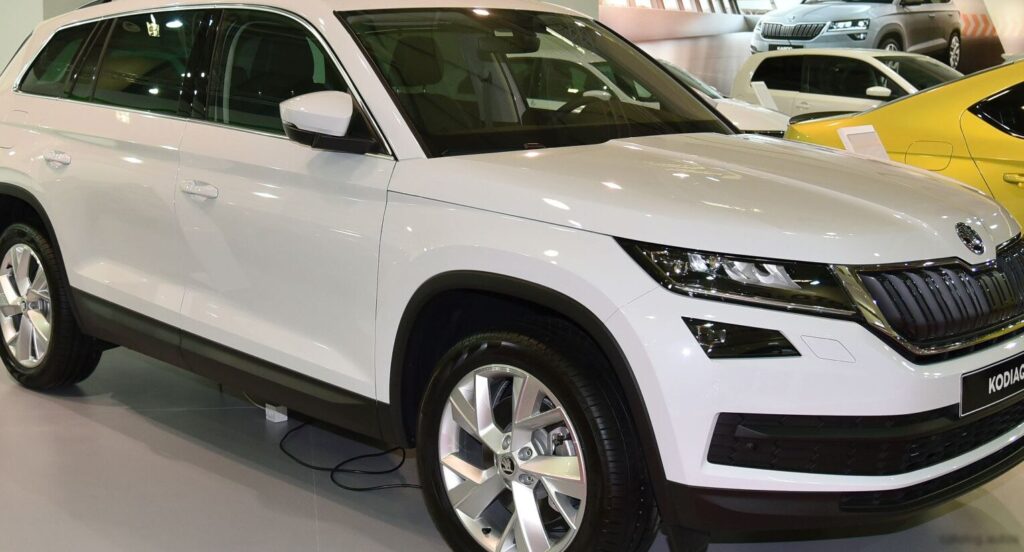
The Skoda Kodiaq RS 2.0 BiTDI 4×4 DSG 7 Seat, produced from 2018 to 2020, represents the performance-oriented variant of Skoda’s first seven-seater SUV. Positioned as the flagship model within the Kodiaq I range, it aimed to deliver a blend of practicality, space, and dynamic driving characteristics. Built on the Volkswagen Group’s MQB platform (specifically the A7 iteration), the Kodiaq RS targeted buyers seeking a versatile family vehicle with enhanced performance compared to the standard Kodiaq trims. This model was primarily sold in Europe, where demand for diesel-powered SUVs with all-wheel drive remained strong.
Technical Specifications
| Brand | Skoda |
| Model | Kodiaq |
| Generation | Kodiaq I |
| Type | RS 2.0 BiTDI (240 Hp) 4×4 DSG 7 Seat |
| Start of production | 2018 |
| End of production | 2020 |
| Powertrain Architecture | Internal Combustion engine |
| Body type | SUV |
| Seats | 7 |
| Doors | 5 |
| Fuel consumption (urban) | 7.4 l/100 km (31.8 US mpg, 38.2 UK mpg, 13.5 km/l) |
| Fuel consumption (extra urban) | 5.8 l/100 km (40.6 US mpg, 48.7 UK mpg, 17.2 km/l) |
| Fuel consumption (combined) | 6.4 l/100 km (36.8 US mpg, 44.1 UK mpg, 15.6 km/l) |
| CO2 emissions | 167 g/km |
| Fuel Type | Diesel |
| Acceleration 0 – 100 km/h | 7 sec |
| Acceleration 0 – 62 mph | 7 sec |
| Acceleration 0 – 60 mph | 6.7 sec |
| Maximum speed | 220 km/h (136.7 mph) |
| Emission standard | Euro 6d – TEMP |
| Weight-to-power ratio | 7.7 kg/Hp, 130.6 Hp/tonne |
| Weight-to-torque ratio | 3.7 kg/Nm, 272 Nm/tonne |
| Power | 240 Hp @ 4000 rpm |
| Power per litre | 122 Hp/l |
| Torque | 500 Nm @ 1750-2500 rpm (368.78 lb.-ft. @ 1750-2500 rpm) |
| Engine layout | Front, Transverse |
| Engine Model/Code | EA288 / CUAA |
| Engine displacement | 1968 cm3 (120.09 cu. in.) |
| Number of cylinders | 4 |
| Engine configuration | Inline |
| Cylinder Bore | 81 mm (3.19 in.) |
| Piston Stroke | 95.5 mm (3.76 in.) |
| Compression ratio | 15.5:1 |
| Number of valves per cylinder | 4 |
| Fuel injection system | Diesel Commonrail |
| Engine aspiration | BiTurbo, Intercooler |
| Engine oil capacity | 4.9 l (5.18 US qt | 4.31 UK qt) |
| Coolant | 8 l (8.45 US qt | 7.04 UK qt) |
| Kerb Weight | 1838-1941 kg (4052.1 – 4279.17 lbs.) |
| Max. weight | 2529 kg (5575.49 lbs.) |
| Max load | 588-691 kg (1296.32 – 1523.39 lbs.) |
| Trunk (boot) space – minimum | 230 l (8.12 cu. ft.) |
| Trunk (boot) space – maximum | 1950 l (68.86 cu. ft.) |
| Fuel tank capacity | 60 l (15.85 US gal | 13.2 UK gal) |
| Length | 4699 mm (185 in.) |
| Width | 1882 mm (74.09 in.) |
| Height | 1685 mm (66.34 in.) |
| Wheelbase | 2789 mm (109.8 in.) |
| Front track | 1579 mm (62.17 in.) |
| Rear (Back) track | 1567 mm (61.69 in.) |
| Ride height (ground clearance) | 197 mm (7.76 in.) |
| Drag coefficient (Cd) | 0.338 |
| Minimum turning circle | 12.2 m (40.03 ft.) |
| Drivetrain Architecture | All wheel drive (4×4) |
| Number of gears | 7 |
| Gearbox type | Automatic transmission DSG |
| Front suspension | Independent type McPherson, Transverse stabilizer |
| Rear suspension | Independent multi-link suspension, Transverse stabilizer |
| Front brakes | Ventilated discs |
| Rear brakes | Disc |
| Tires size | 235/45 R20 100V |
| Wheel rims size | 8J x 20 |
Powertrain & Engine Architecture
The Kodiaq RS is powered by the EA288 2.0-liter four-cylinder turbocharged diesel engine, specifically the CUAA code variant. This engine utilizes a bi-turbo setup, employing two turbochargers – a low-pressure turbo and a high-pressure turbo – working in sequence to provide a broad torque curve and minimize turbo lag. The engine features a common rail direct injection system, delivering fuel at pressures up to 2,500 bar for optimized combustion. The cylinder head incorporates four valves per cylinder, enhancing volumetric efficiency. The engine produces 240 horsepower at 4,000 rpm and a substantial 500 Nm (368.78 lb-ft) of torque between 1,750 and 2,500 rpm. This power is channeled through a seven-speed dual-clutch transmission (DSG) and Skoda’s all-wheel-drive system.
Driving Characteristics
The 2.0 BiTDI engine, coupled with the DSG transmission and all-wheel drive, delivers brisk acceleration. The 0-62 mph (0-100 km/h) sprint takes approximately 7 seconds. The DSG transmission provides quick and smooth gear changes, contributing to a responsive driving experience. While not a sports car, the Kodiaq RS offers confident handling and stability, particularly on winding roads. Compared to lower-powered Kodiaq variants, the RS provides significantly more pulling power, making it more capable when fully loaded or towing. The all-wheel-drive system enhances traction in adverse weather conditions. The gear ratios are tuned for a balance between acceleration and fuel efficiency, with taller gearing in higher gears for relaxed cruising.
Equipment & Trim Levels
The Kodiaq RS came generously equipped as standard. Key features included sport seats upholstered in Alcantara and leather, stainless steel pedals, a sports steering wheel, and unique RS badging both inside and out. Infotainment was provided by a large touchscreen display with navigation and smartphone integration. Standard safety features included adaptive cruise control, lane assist, and automatic emergency braking. Optional extras included a panoramic sunroof, a Canton sound system, and electrically adjustable front seats with memory function. The interior trim typically featured dark colors and sporty accents to emphasize the RS’s performance character.
Chassis & Braking
The Kodiaq RS features a specially tuned suspension system compared to other Kodiaq models. It utilizes stiffer springs and dampers to reduce body roll and improve handling. Both the front and rear axles are equipped with transverse stabilizer bars. The braking system consists of ventilated disc brakes on all four wheels, providing ample stopping power. The RS variant also benefits from a slightly lowered ride height, further enhancing its stability. The all-wheel-drive system utilizes a multi-plate clutch to distribute torque between the front and rear axles as needed, optimizing traction and handling.
Market Reception & Comparison
The Kodiaq RS was generally well-received by automotive critics. It was praised for its strong performance, spacious interior, and practical features. However, some reviewers noted that the ride quality could be firm, particularly on rough roads. Compared to the standard Kodiaq models, the RS offered a significant performance upgrade, but at a higher price point. Against competitors like the Peugeot 5008 GT and the Land Rover Discovery Sport, the Kodiaq RS offered a compelling combination of value, space, and performance. Fuel economy was respectable for a performance SUV, averaging around 36.8 US mpg in combined driving.
Legacy
The EA288 engine, in its various iterations, has proven to be a robust and reliable powertrain. While diesel engines have faced increased scrutiny in recent years, the 2.0 BiTDI in the Kodiaq RS is generally considered to be a durable unit, provided it receives regular maintenance. The Kodiaq RS has become a sought-after model on the used car market, appealing to buyers who appreciate its blend of practicality, performance, and space. Its seven-seat configuration and all-wheel-drive capability make it a versatile choice for families and those who require a capable vehicle for all-weather conditions. The DSG transmission, while generally reliable, requires periodic servicing to ensure optimal performance.
