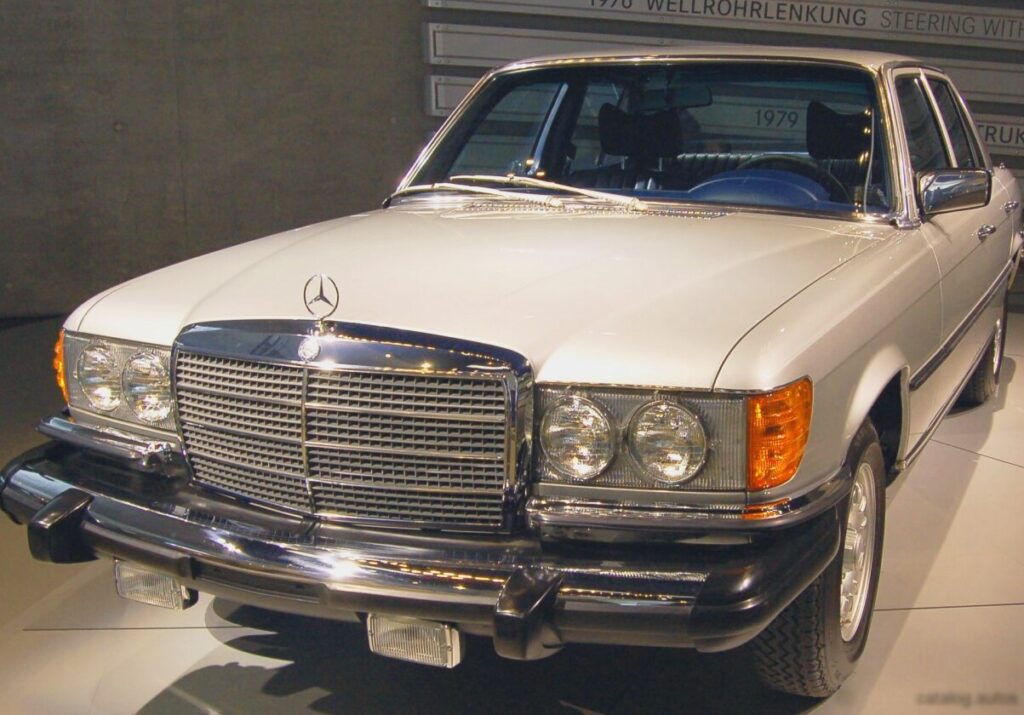
The Mercedes-Benz S-Class SEL (V116) 350 SEL, produced between September 1973 and January 1976, represented a significant evolution in luxury automotive engineering. Positioned as a mid-range offering within the V116 S-Class lineup – which also included the 280 SEL and the flagship 450 SEL – the 350 SEL aimed to balance performance and refinement with a more accessible price point. The “SEL” designation signified the “Sonderklasse-Einspritzmotor” (Special Class – Fuel Injection) and indicated a longer wheelbase version of the standard S-Class sedan, offering increased rear passenger legroom. This generation S-Class, internally designated as the W116, was a pivotal model for Mercedes-Benz, establishing many of the safety and technological features that would become hallmarks of the brand.
Technical Specifications
| Brand | Mercedes-Benz |
| Model | S-class |
| Generation | S-class SEL (V116) |
| Type (Engine) | 350 SEL V8 (200 Hp) Automatic |
| Start of production | September, 1973 |
| End of production | January, 1976 |
| Powertrain Architecture | Internal Combustion engine |
| Body type | Sedan |
| Seats | 5 |
| Doors | 4 |
| Fuel consumption (combined) | 13 l/100 km (18.1 US mpg, 21.7 UK mpg, 7.7 km/l) |
| Fuel Type | Petrol (Gasoline) |
| Acceleration 0 – 100 km/h | 10.4 sec |
| Acceleration 0 – 62 mph | 10.4 sec |
| Acceleration 0 – 60 mph | 9.9 sec |
| Maximum speed | 200 km/h (124.27 mph) |
| Weight-to-power ratio | 8.5 kg/Hp, 117.6 Hp/tonne |
| Weight-to-torque ratio | 5.9 kg/Nm, 168.2 Nm/tonne |
| Power | 200 Hp @ 5800 rpm |
| Power per litre | 57.2 Hp/l |
| Torque | 286 Nm @ 4000 rpm (210.94 lb.-ft. @ 4000 rpm) |
| Engine layout | Front, Longitudinal |
| Engine Model/Code | M 116 E 35 / 116.983 |
| Engine displacement | 3499 cm3 (213.52 cu. in.) |
| Number of cylinders | 8 |
| Engine configuration | V-engine |
| Cylinder Bore | 92 mm (3.62 in.) |
| Piston Stroke | 65.8 mm (2.59 in.) |
| Compression ratio | 9.5:1 |
| Number of valves per cylinder | 2 |
| Fuel injection system | Multi-port manifold injection |
| Engine aspiration | Naturally aspirated engine |
| Valvetrain | SOHC |
| Engine oil capacity | 8 l (8.45 US qt | 7.04 UK qt) |
| Coolant | 8 l (8.45 US qt | 7.04 UK qt) |
| Kerb Weight | 1700 kg (3747.86 lbs.) |
| Max. weight | 2220 kg (4894.26 lbs.) |
| Max load | 520 kg (1146.4 lbs.) |
| Trunk (boot) space – minimum | 530 l (18.72 cu. ft.) |
| Fuel tank capacity | 96 l (25.36 US gal | 21.12 UK gal) |
| Length | 5060 mm (199.21 in.) |
| Width | 1870 mm (73.62 in.) |
| Height | 1430 mm (56.3 in.) |
| Wheelbase | 2960 mm (116.54 in.) |
| Front track | 1521 mm (59.88 in.) |
| Rear (Back) track | 1505 mm (59.25 in.) |
| Drive wheel | Rear wheel drive |
| Number of gears and type of gearbox | 3 gears, automatic transmission |
| Front suspension | Double wishbone |
| Rear suspension | Trailing arm |
| Front brakes | Ventilated discs |
| Rear brakes | Disc |
| Steering type | Cone worm with recirculation balls |
| Power steering | Hydraulic Steering |
| Tires size | Front wheel tires: 205/70 R14 Rear wheel tires: 205/70 R14 |
| Wheel rims size | Front wheel rims: 6.5J x 14 Rear wheel rims: 6.5J x 14 |
Powertrain & Engine Architecture
The heart of the 350 SEL was the M116 E 35 engine, a 3.5-liter (3499 cc) naturally aspirated V8. This engine featured a single overhead camshaft (SOHC) design with two valves per cylinder. Crucially, it employed Bosch K-Jetronic fuel injection, a mechanical system known for its precision and reliability. The K-Jetronic system delivered fuel directly to the intake ports, improving efficiency and reducing emissions compared to earlier carbureted designs. The engine produced 200 horsepower at 5800 rpm and 286 Nm (210.94 lb-ft) of torque at 4000 rpm. The engine’s longitudinal mounting and rear-wheel drive configuration were standard for Mercedes-Benz at the time. The 350 SEL was exclusively offered with a three-speed automatic transmission, designed to provide smooth and effortless shifting, befitting the car’s luxury character.
Driving Characteristics
The 350 SEL Automatic offered a distinctly comfortable and refined driving experience. While not overtly sporty, the V8 engine provided ample power for relaxed highway cruising and confident overtaking. The automatic transmission, while lacking the responsiveness of a manual, contributed to the car’s ease of use. Acceleration from 0 to 60 mph took approximately 9.9 seconds, and the car could reach a top speed of 200 km/h (124 mph). Compared to the 280 SEL, the 350 SEL offered noticeably more power and torque, resulting in improved acceleration and overall performance. However, it lacked the outright performance of the 450 SEL, which featured a larger 4.5-liter V8. The gear ratios of the three-speed automatic were optimized for smooth cruising rather than aggressive acceleration.
Equipment & Trim Levels
The 350 SEL came standard with a high level of equipment, reflecting its status as a luxury vehicle. Features included power steering, power-assisted disc brakes on all four wheels (a significant safety advancement for the era), central locking, and a high-quality interior with cloth upholstery. Leather upholstery, air conditioning, a sunroof, and a premium sound system were available as optional extras. The interior design was characterized by its elegant simplicity and attention to detail, with wood trim accents and comfortable seating. The longer wheelbase of the SEL models provided increased rear legroom, enhancing the comfort of rear passengers.
Chassis & Braking
The V116 S-Class featured a robust chassis with independent suspension on all four wheels. The front suspension utilized a double wishbone design, while the rear suspension employed a trailing arm setup. This configuration provided a comfortable ride and good handling characteristics. The 350 SEL was equipped with ventilated disc brakes on the front wheels and solid disc brakes on the rear, offering excellent stopping power. Hydraulic power steering was standard, making the car easy to maneuver, especially at low speeds. Stabilizer bars were fitted to both the front and rear suspension to reduce body roll during cornering.
Market Reception & Comparison
The 350 SEL was well-received by automotive critics and buyers alike. It was praised for its comfortable ride, refined interior, and reliable V8 engine. Compared to the 280 SEL, the 350 SEL offered a significant performance upgrade without the higher price tag of the 450 SEL. Fuel economy, however, was a concern, with the 350 SEL consuming approximately 13 liters per 100 kilometers (18.1 US mpg). Reliability was generally excellent, although the K-Jetronic fuel injection system could require specialized maintenance. The 350 SEL was seen as a sweet spot in the S-Class lineup, offering a compelling combination of luxury, performance, and value.
Legacy
The Mercedes-Benz V116 S-Class, including the 350 SEL variant, remains a highly sought-after classic car today. The M116 engine is known for its durability and longevity, and well-maintained examples can still provide years of reliable service. The 350 SEL’s combination of classic styling, luxurious features, and robust engineering has made it a favorite among collectors and enthusiasts. While parts availability can be a challenge, a dedicated network of suppliers and specialists exists to support the preservation and restoration of these iconic vehicles. The V116 S-Class established a benchmark for luxury sedans and paved the way for future generations of Mercedes-Benz flagship models.